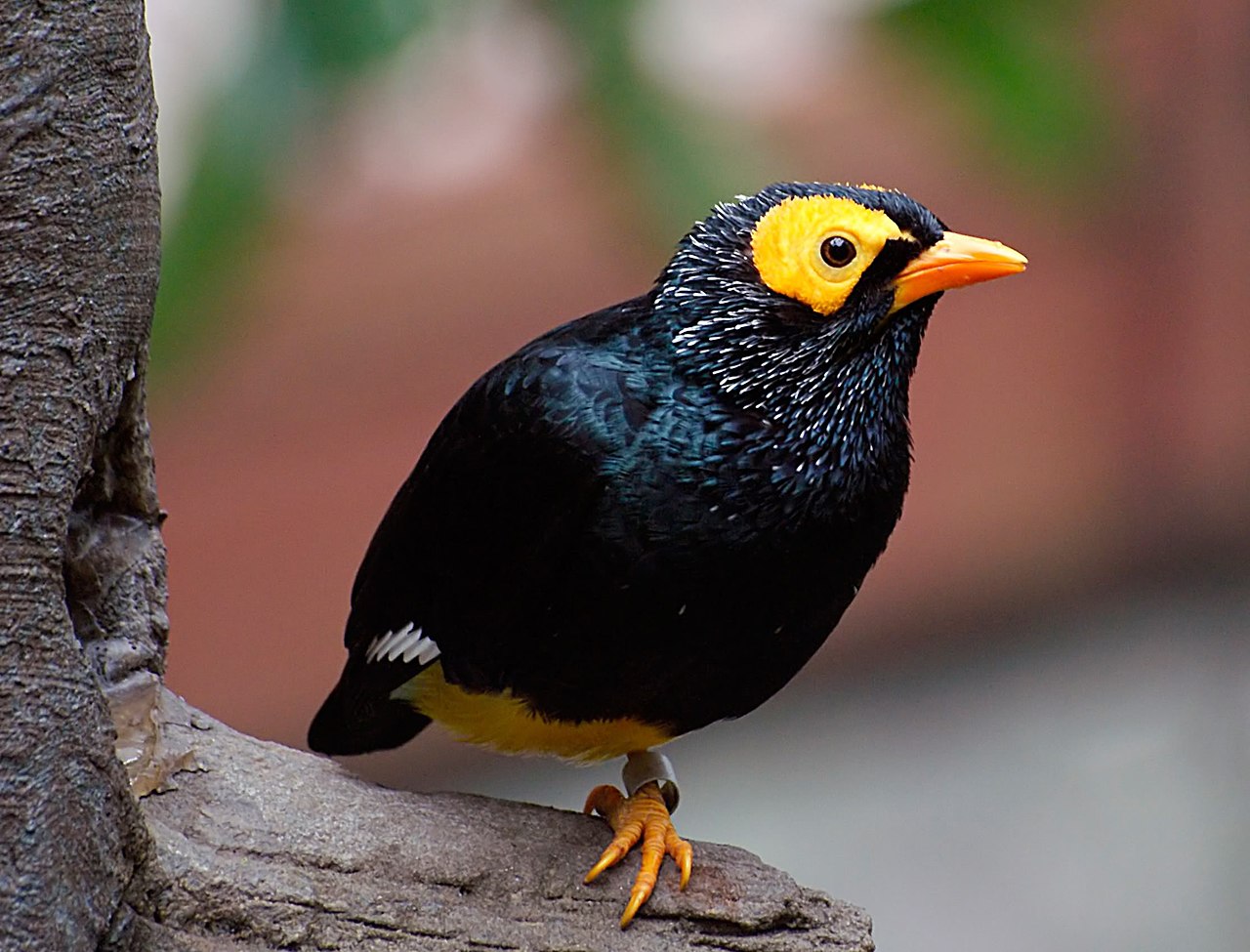
The yellow-faced myna is a species of starling in the family Sturnidae. It is found in New Guinea and nearby smaller islands, where its natural habitat is subtropical or tropical moist lowland forests. The long-tailed myna was formerly included as a subspecies. One of the largest species of starling, this species attains 23 to 26 cm in length and weighs around 217 g (7.7 oz). They have dark plumage with a metallic lustre and bright orange facial markings and beak. These birds are social and omnivorous. Their diet consists of fruit and insects for which they forage high in the canopy. They are common birds with a wide range, and the International Union for Conservation of Nature has assessed their conservation status as being of "least concern". It was named after Charles Dumont.
Region
New Guinea region (Melanesia)
Typical Environment
Occurs widely across the lowlands of New Guinea and on nearby islands, inhabiting primary and secondary tropical moist forests. It favors forest edges, riverine forests, gardens, and plantations, often staying high in the canopy. The species readily uses disturbed habitats where fruiting trees remain. It is common in many parts of its range and often aggregates at fruiting figs.
Altitude Range
Sea level to 1200 m
Climate Zone
Tropical
Ease of Keeping
Beginner friendly: 2/5
One of the largest starlings, the yellow-faced myna has striking bare orange facial skin and a glossy dark body. It is an active canopy frugivore that also takes insects and helps disperse seeds of many rainforest trees. Usually seen in noisy pairs or small groups, it frequents fruiting trees and forest edges. The long-tailed myna was once treated as a subspecies but is now recognized as a separate species.


Yellow-faced myna

With a hill myna (Gracula sp.)
Temperament
social and active
Flight Pattern
strong direct flight with rapid wingbeats
Social Behavior
Usually seen in pairs or small, noisy groups that move between fruiting trees. Nests in tree cavities like other mynas, and adults may defend good feeding sites. Often associates loosely with other frugivores in the canopy.
Migratory Pattern
Resident
Song Description
Vocal and noisy, giving a mix of loud whistles, chatter, and nasal squawks. Calls carry through the canopy and are used to keep contact while foraging. Vocalizations vary with context, including harsher alarm notes near nests.
Plumage
Glossy dark plumage with a metallic green-purple sheen; overall sleek and smooth-feathered appearance.
Diet
Primarily eats fruit, especially figs and other soft, pulpy fruits. Supplements its diet with insects and other arthropods gleaned from foliage and bark. Will occasionally take nectar or small invertebrates disturbed by foraging.
Preferred Environment
Feeds high in the forest canopy and at the edges of clearings, often at fruiting trees. Also visits gardens and plantations where suitable fruiting trees are present.