

The yellow-crowned night heron is one of two species of night heron in the genus Nyctanassa. Unlike the black-crowned night heron, which has a worldwide distribution, the yellow-crowned is restricted to the Americas. It is known as the bihoreau violacé in French and the pedrete corona clara or yaboa común in some Spanish-speaking countries.
Region
Americas
Typical Environment
Found from the Atlantic and Gulf coasts of the United States south through Mexico, Central America, and the Caribbean to northern South America. It frequents coastal marshes, mangroves, tidal creeks, oyster beds, and estuaries, and also occurs inland along rivers, ponds, and suburban wetlands where crayfish are abundant. Breeding colonies are placed in trees or shrubs near water, sometimes on barrier islands. Post-breeding dispersal can carry birds far inland, and it occasionally uses urban stormwater ponds.
Altitude Range
Sea level to 1500 m
Climate Zone
Subtropical
Ease of Keeping
Beginner friendly: 1/5
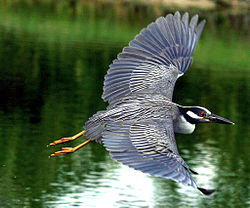
This nocturnal heron specializes in hunting crabs and crayfish, using its stout bill to crush hard shells. Adults are easily recognized by a pale yellow crown, white cheek patch, and long nuchal plumes in breeding season. It nests colonially in trees or mangroves near water, often returning to the same sites year after year. Northern populations may migrate, while tropical birds are largely resident.


Adult N. v. ssp. pauper, North Seymour Island, Galapagos Islands

Juvenile yellow-crowned night heron

Juvenile eating a blue land crab


Temperament
shy and crepuscular
Flight Pattern
steady, direct flight with slow, deep wingbeats
Social Behavior
Typically nests colonially, placing stick nests in trees or mangroves near water. Pairs defend small territories around the nest, and both sexes incubate and feed the young. Outside the breeding season it may roost in loose groups by day and forage singly or in small parties at night.
Migratory Pattern
Partial migrant
Song Description
Vocalizations are mostly harsh, barking calls such as a loud quok or squawk, especially in flight or at colonies. It is generally quiet while foraging, with soft grunts and croaks during close interactions.
Plumage
Adults are slate-gray with fine barring on the wings, a black head with a white cheek patch, and a yellow to whitish crown; long white nuchal plumes appear in breeding season. Juveniles are brown and heavily streaked and spotted, gradually acquiring adult coloration over several years.
Diet
Primarily takes crustaceans, especially crabs in coastal areas and crayfish inland. It also consumes aquatic insects, small fish, mollusks, and occasionally amphibians. The bird often stalks slowly or stands motionless, striking quickly to seize prey and crushing hard-shelled items with its powerful bill.
Preferred Environment
Forages along tidal flats, saltmarsh edges, oyster beds, mangrove roots, and shallow freshwater margins. In inland regions it commonly hunts in ditches, rice fields, and suburban ponds where crayfish are abundant.


