

The yellow-crowned woodpecker or Mahratta woodpecker is a species of small pied woodpecker found in the Indian subcontinent. It is the only species placed in the genus Leiopicus.
Region
Indian subcontinent
Typical Environment
Occurs widely across peninsular India and into adjacent parts of the Indian subcontinent, favoring dry deciduous woodland, thorn scrub, groves, and semi-open country. It adapts well to human-modified landscapes such as orchards, roadside trees, and large gardens. Typically keeps to lower to mid-levels of trees but will forage from the trunk to fine outer branches. Prefers areas with scattered mature trees and plenty of dead wood for nesting.
Altitude Range
0–1500 m
Climate Zone
Tropical
Ease of Keeping
Beginner friendly: 1/5
Also known as the Mahratta woodpecker, it is the only species in the genus Leiopicus. It thrives in dry, open woodlands and even orchards and city parks, often foraging on small branches as much as on trunks. Males typically show a small reddish hindcrown or nape spot in addition to the yellow crown. Its steady drumming and sharp calls make it easier to detect than to see in dense foliage.


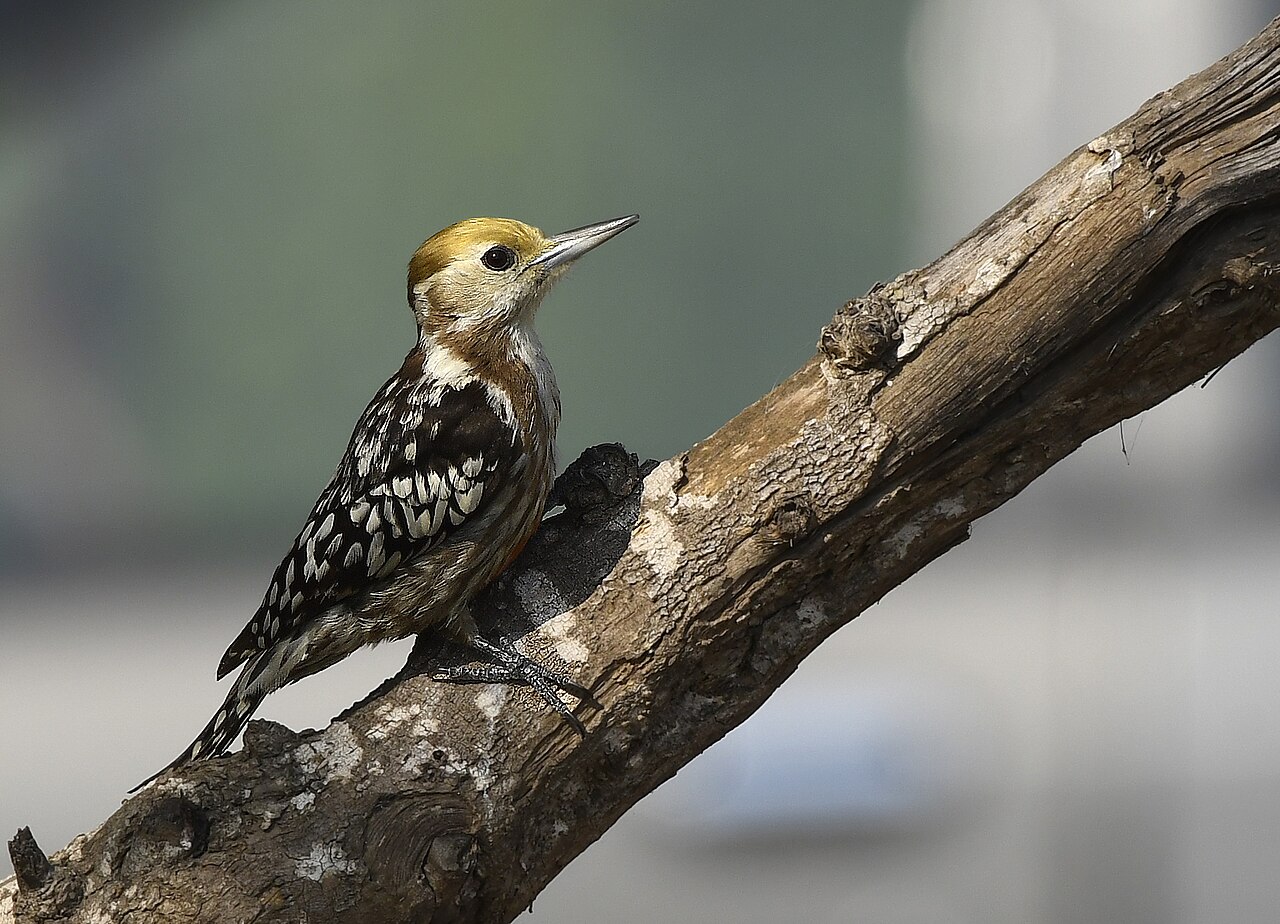
Female at Khijadiya Bird Sanctuary

Female at Khijadiya Bird Sanctuary
Temperament
active and wary
Flight Pattern
undulating with short rapid wingbeats
Social Behavior
Usually seen singly or in pairs; may join mixed-species flocks in the non-breeding season. Nests are excavated in dead or decaying wood; both sexes participate in excavation and incubation. Clutches are typically small, and family groups stay together for some weeks post-fledging.
Migratory Pattern
Resident
Song Description
Gives sharp, metallic tik or pik notes and short rattling series. Drumming is a brief, even burst on resonant branches. Vocalizations carry well in open woodland.
Plumage
Small pied woodpecker with black-and-white barred upperparts and pale buff underparts streaked on the flanks. Crown shows a distinct yellow patch; male often with a small red hindcrown or nape spot. Face has a whitish supercilium and darker eye-stripe, with fine spotting on the wings forming a laddered look on the back.
Diet
Feeds mainly on insects such as ants, beetles, and their larvae, gleaning and probing bark and small branches. Uses its chisel bill to flake bark and its long sticky tongue to extract hidden prey from crevices. Will also take termites and occasionally small fruits or berries when insect prey is scarce.
Preferred Environment
Forages on tree trunks, larger limbs, and fine outer branches in open woodland, thorn scrub, orchards, and roadside groves. Often uses dead snags and stubs where larvae are abundant, and readily exploits trees in cultivated areas.


