

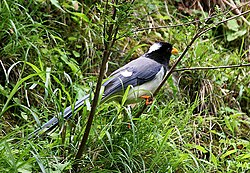
The yellow-billed blue-magpie , or gold-billed magpie, is a passerine bird in the family Corvidae, along with crows and jays. It forms a superspecies with the Taiwan blue magpie and the red-billed blue magpie. The species' range covers the northern parts of the Indian Subcontinent, including the lower Himalayan foothills, with a disjunct population in Vietnam.
Region
Himalayas and northern Indochina
Typical Environment
Found along the lower to mid-elevation Himalayan ranges from northern Pakistan and India through Nepal and Bhutan to northeastern India, with a disjunct population in northern Vietnam. Prefers evergreen and mixed broadleaf forests, forest edges, wooded ravines, and riverine corridors. It readily uses secondary growth, orchards, and forested village margins. Often makes short altitudinal movements following food availability.
Altitude Range
1000–3200 m
Climate Zone
Highland
Ease of Keeping
Beginner friendly: 2/5
A striking corvid with a bright yellow bill and extremely long, graduated tail, it is gregarious and noisy in forested hills of the Himalayas. It often travels in small parties, forages opportunistically, and may exhibit cooperative nesting behaviors. Its agility through dense canopy and habit of following human settlements near forests make it conspicuous where it occurs.




Temperament
social and active
Flight Pattern
short rapid wingbeats with agile glides through canopy
Social Behavior
Typically seen in small, noisy groups that move along forest edges and clearings. Builds bulky cup nests high in trees; pairs are monogamous and may be assisted by helpers. Highly inquisitive and bold around human settlements near forests.
Migratory Pattern
Resident
Song Description
Vocal repertoire includes loud ringing calls, harsh scolds, and chattering notes. Calls carry far through valleys and are often given in chorus by the group.
Plumage
Glossy blue upperparts with very long, white-tipped tail feathers; underparts pale grey to whitish. Head and upper breast are black with a contrasting whitish nape patch; wings show blue with pale markings. Tail is strongly graduated with black bars and bold white tips.
Diet
Omnivorous, taking insects, other invertebrates, and small vertebrates when available. Also consumes fruits, berries, seeds, and occasionally eggs or nestlings. Opportunistically scavenges and may cache food items. Forages both in the canopy and on the ground along edges and paths.
Preferred Environment
Feeds along forest edges, clearings, riverine woods, and wooded village margins. Often exploits fruiting trees and disturbed habitats with patchy cover.


