

The white-winged flufftail is a very rare African bird in the family Sarothruridae. The estimated global population size of white-winged flufftails is less than 250 adults. These birds reside in Ethiopia and South Africa but it is unknown whether these populations are one large or two different populations.
Region
East and Southern African highlands
Typical Environment
Occurs in scattered high-altitude sedge and peat marshes in the Ethiopian highlands and the highveld of South Africa (e.g., Wakkerstroom–Chrissiesmeer–Dullstroom area). It favors shallowly flooded, dense Cyperus and Carex sedge beds with soft peat substrates and minimal disturbance. Vegetation structure is critical: short to medium-height, tightly packed sedges with interspersed shallow water. Sites are typically seasonal or ephemeral and can change markedly with rainfall patterns. The species is extremely local and patchy, tracking suitable marsh condition after rains.
Altitude Range
1500–2600 m
Climate Zone
Highland
Ease of Keeping
Beginner friendly: 1/5
One of Africa’s rarest birds, the white-winged flufftail is confined to a handful of high-altitude sedge marshes in Ethiopia and South Africa. Its distinctive white wing panel is usually only seen when it flushes for a short, low flight. It is highly threatened by drainage, peat extraction, overgrazing, and burning of wetlands. Whether the Ethiopian and South African occurrences form one migratory population or two isolated ones remains uncertain.

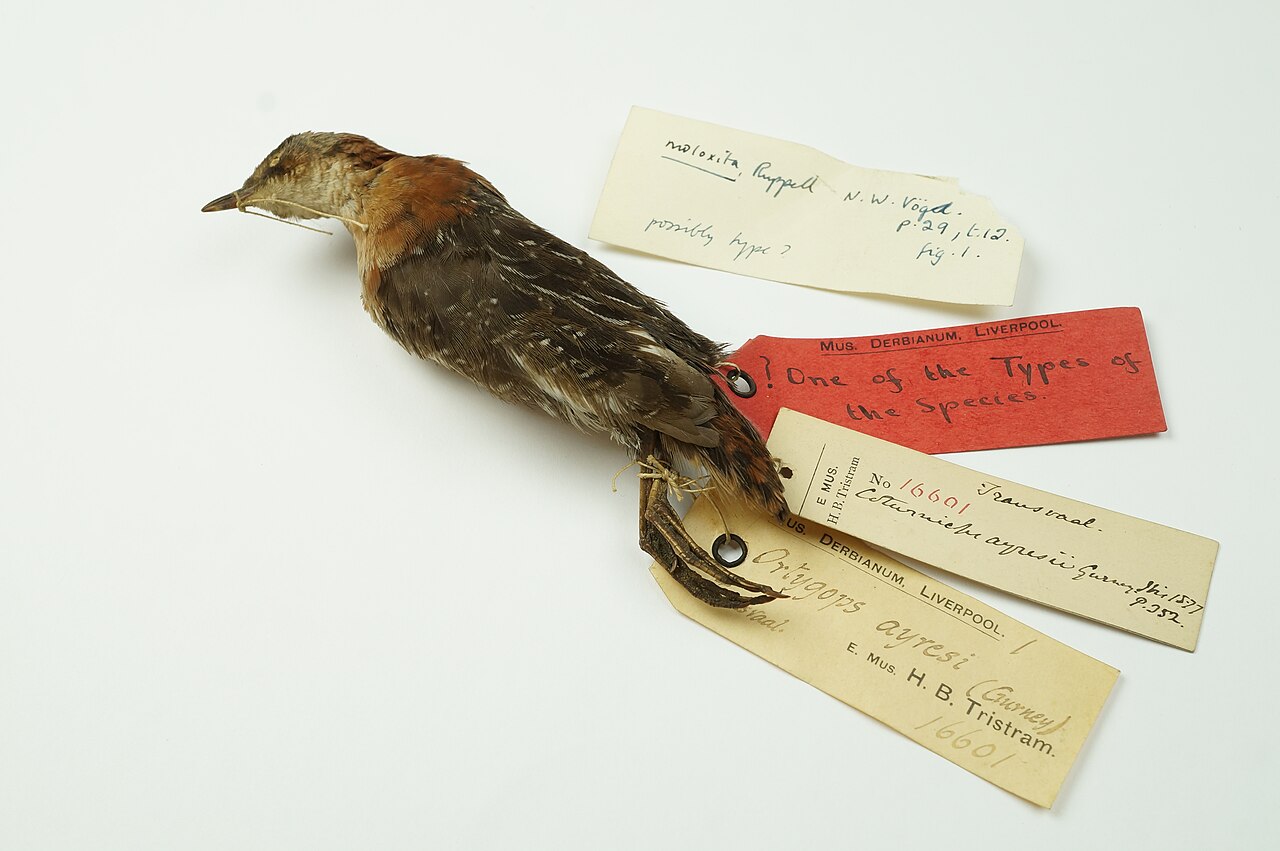
Specimen NML-VZ T16601 Sarothrura ayresi held in the Vertebrate Zoology collection at World Museum, National Museums Liverpool.


Temperament
solitary and secretive
Flight Pattern
flushes reluctantly with short rapid wingbeats; low, brief flights over marsh
Social Behavior
Typically encountered singly or in pairs, keeping to dense sedge cover. Nests are well-concealed platforms or cups within sedge tussocks, close to shallow water. Likely forms seasonal pair bonds and times breeding with peak marsh inundation and sedge growth.
Migratory Pattern
Seasonal migrant
Song Description
Vocalizations are soft and ventriloquial, often given at dusk and dawn. Calls include repeated ticking or clicking notes and low, hooting phrases that carry poorly over distance.
Plumage
A small, secretive rail with dense, finely barred plumage; males appear darker and sootier with fine pale barring, females warmer brown with buff barring. Both sexes show a conspicuous white panel formed by the secondary coverts, most evident in flight. Underparts are dark with fine barring; upperparts mottled to barred for camouflage in sedges.
Diet
Feeds mainly on small invertebrates such as beetles, flies and their larvae, small snails, worms, and other aquatic or semi-aquatic arthropods. It gleans and probes among sedge bases, peat, and shallow water. Occasional seeds or plant fragments may be taken incidentally while foraging.
Preferred Environment
Forages within dense sedge beds and along the shallow edges of marsh pools where soft peat and leaf litter accumulate. It stays under cover, moving quietly through tight vegetation and rarely venturing into open water.


