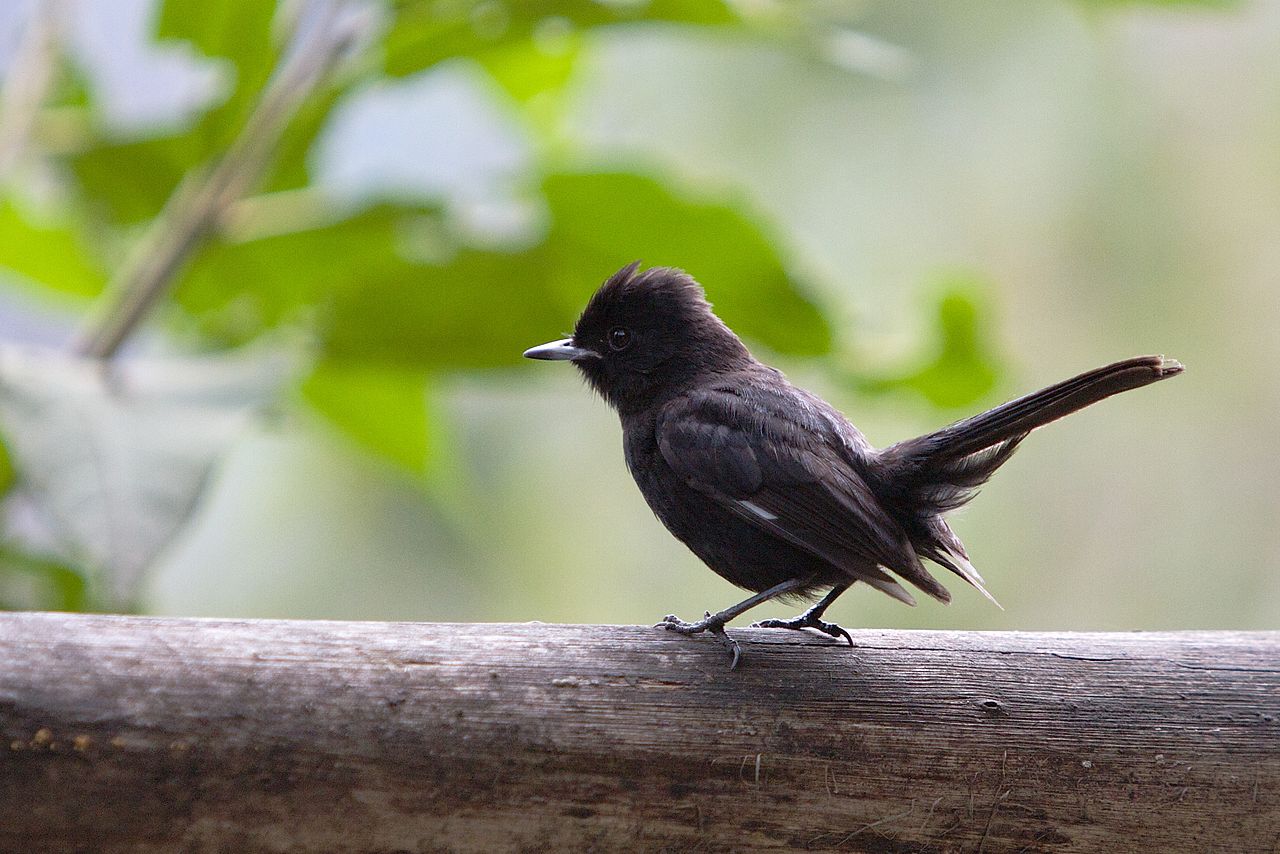
The white-winged black tit is a passerine bird in the tit family Paridae. It is also known as the white-winged tit, dark-eyed black tit or northern black tit. The species was first described by Eduard Rüppell in 1840.
Region
Horn of Africa and northern East Africa
Typical Environment
Found from Eritrea and northern Ethiopia south through parts of Sudan and South Sudan to northern Kenya and Somalia, primarily in dry savanna and thorn-scrub. It favors acacia-dominated woodland, bushy valleys, and lightly wooded slopes. Birds often occur near watercourses where scattered trees provide nest cavities. It tolerates human-altered landscapes with remnant trees and hedgerows. The species is largely sedentary, with local movements tracking food availability.
Altitude Range
600–2500 m
Climate Zone
Subtropical
Ease of Keeping
Beginner friendly: 2/5
Also called the white-winged tit, dark-eyed black tit, or northern black tit, this species is a small, active member of the family Paridae. It was first described by Eduard Rüppell in 1840 from northeastern Africa. It is largely non-migratory and adapts well to arid thornbush and acacia woodland. It often joins mixed-species foraging parties outside the breeding season.


Temperament
social and active
Flight Pattern
short rapid wingbeats with bounding undulations
Social Behavior
Usually seen in pairs or small family parties and frequently joins mixed-species flocks outside the breeding season. Nests in natural cavities or old woodpecker holes, lining the nest with plant fibers, hair, and feathers. Both parents incubate and feed the young, and they defend a small territory during breeding.
Migratory Pattern
Resident
Song Description
A series of high, thin, descending whistles interspersed with rapid scolding notes. Calls include sharp tsee-tsee and rattling churrs given while foraging. Song is most persistent at dawn during the breeding period.
Plumage
Almost entirely black with a conspicuous white wing panel formed by the bases of the flight feathers and white edges to the outer tail feathers. Plumage is glossy to sooty black depending on wear. Underparts are uniformly dark.
Diet
Primarily insectivorous, gleaning beetles, caterpillars, ants, termites, and spiders from foliage and bark. Will probe crevices and pick prey from twigs and leaves, occasionally sallying short distances to snatch flying insects. Supplements diet with small seeds and berries when insects are scarce.
Preferred Environment
Forages from the mid to upper canopy of acacia and other thorny trees, also working along trunks and larger branches. Often feeds along woodland edges, riparian thickets, and scattered trees in open savanna, and readily joins mixed flocks to exploit patchy prey.