

The white-winged chough is one of only two surviving species of the Australian mud-nest builders family, Corcoracidae, and is the only member of the genus Corcorax. It is native to southern and eastern Australia and is an example of convergent evolution as it is only distantly related to the European choughs that it closely resembles in shape, and for which it was named.
Region
Southern and eastern Australia
Typical Environment
Occurs from coastal and foothill regions through open eucalypt woodlands, dry sclerophyll forests, mallee, and farmland edges. It favors areas with ample leaf litter and soft soils for probing and foraging. Riparian woodlands and sheltered gullies are used frequently, especially where mud for nest construction is available. It avoids dense rainforests and the most arid interior, but can use suburban parks and picnic areas when habitat structure is suitable.
Altitude Range
Sea level to 1200 m
Climate Zone
Temperate
Ease of Keeping
Beginner friendly: 1/5
White-winged choughs are highly social, living in tight-knit family groups that cooperatively build large mud nests and raise young together. They are only distantly related to the true choughs of Eurasia but look similar due to convergent evolution. Adults have striking red eyes, while juveniles have brown eyes and often remain with the group for several seasons. Groups have been observed attempting to 'kidnap' young from neighboring groups to bolster their own workforce.


Landing on a branch in Brisbane Ranges National Park, Australia

On the search for food in short grass

Foraging in short grass this bird has found a small beetle

A group searching for food
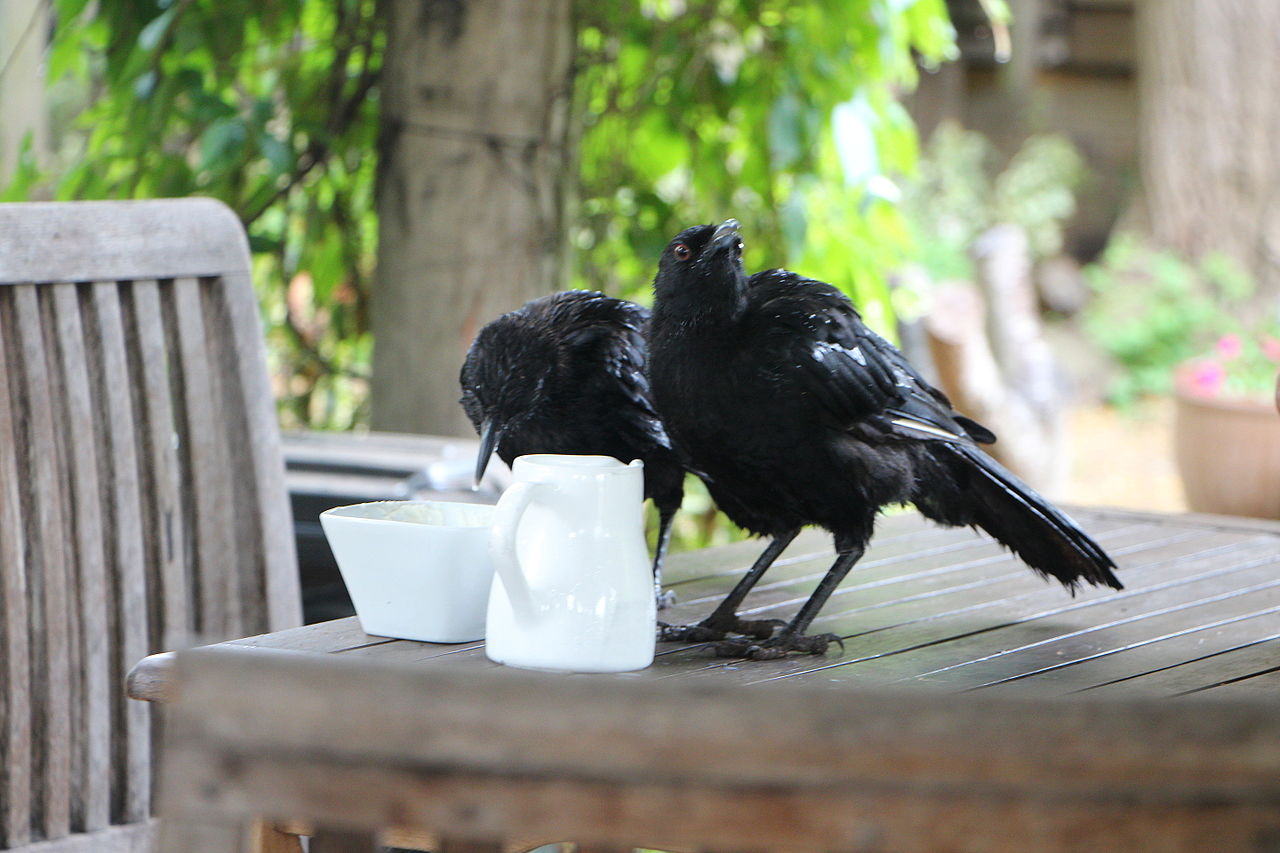
White-winged choughs helping themselves to leftover cream and milk at an outdoor café in the Megalong Valley.

Nest in Binya State Forest, New South Wales, Australia
Temperament
social and cooperative
Flight Pattern
short rapid wingbeats with gliding; rather floppy, low flights
Social Behavior
Lives in cohesive family groups that defend territories and forage together on the ground. Breeding is cooperative, with multiple group members helping build a mud nest and feed nestlings. Young may remain with parents for several years, and intergroup conflicts can include attempted recruitment of juveniles.
Migratory Pattern
Resident
Song Description
Vocalizations include mournful, descending whistles and rich, ringing calls given in chorus by the group. Soft contact notes keep the flock coordinated while foraging, and loud alarm calls erupt when predators approach.
Plumage
Glossy black overall with conspicuous white primary patches revealed in flight; long tail and loose, soft body feathers.
Diet
Primarily takes ground-dwelling invertebrates such as beetles, larvae, ants, and spiders, probing leaf litter and soft soil with its curved bill. It also eats seeds, bulbs, and fallen fruits, and occasionally small vertebrates, eggs, or carrion. Foraging is often cooperative, with group members spreading out and moving in a loose line.
Preferred Environment
Feeds mainly on the ground in open woodlands, forest edges, and along tracks and clearings with abundant leaf litter. It frequently works damp areas after rain and visits picnic sites or gardens where food is easily accessible.


