
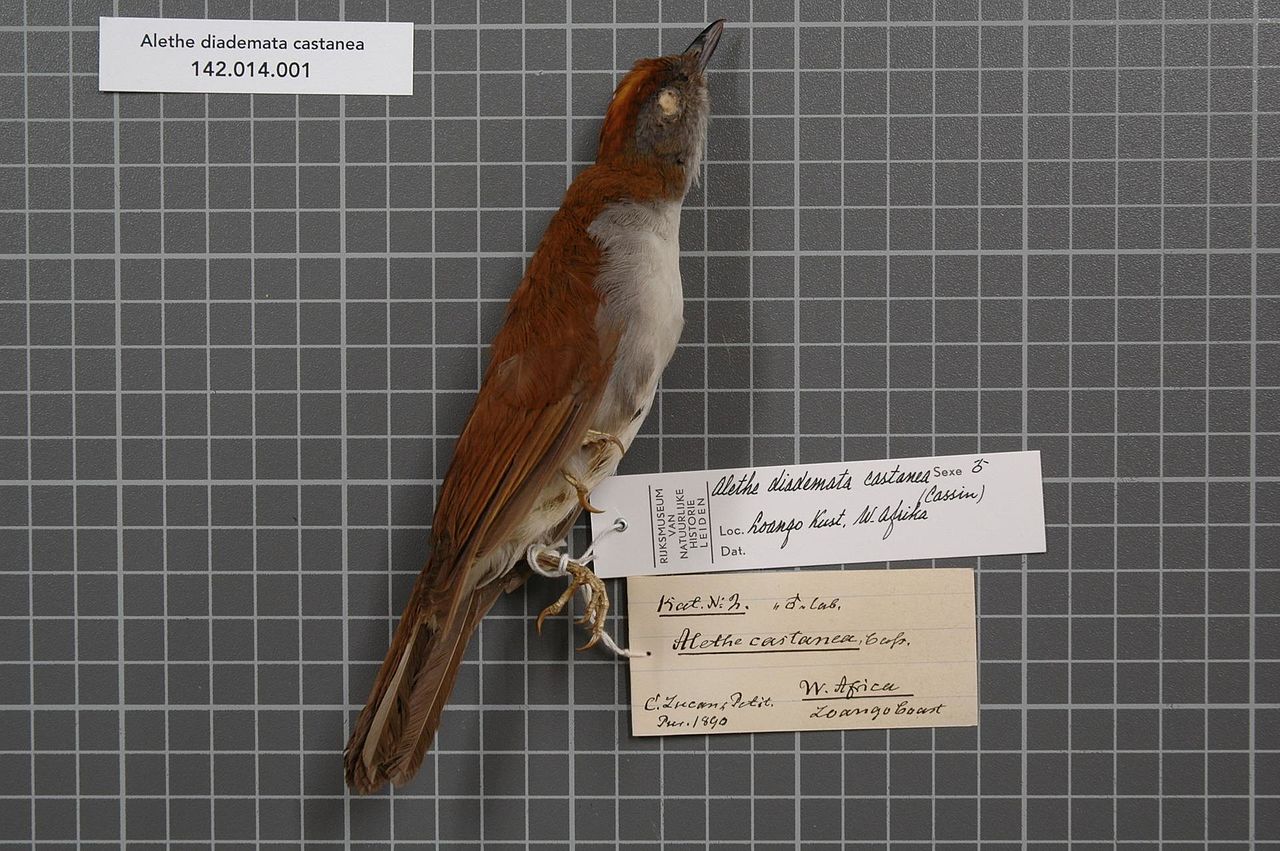
The white-tailed alethe is a species of bird in the Old World flycatcher family Muscicapidae. It is found in western Africa from Senegal to Togo. Its natural habitat is subtropical or tropical moist lowland forests.
Region
West Africa
Typical Environment
Occurs from Senegal east to Togo, primarily in subtropical and tropical moist lowland forests. It favors dense understory in mature rainforest but also uses secondary forest, gallery forest, and well-wooded edges. The species keeps close to the ground and often forages along shaded trails and near streams. It avoids open habitats and heavily degraded areas, relying on continuous canopy and leaf-litter cover.
Altitude Range
Sea level to 1200 m
Climate Zone
Tropical
Ease of Keeping
Beginner friendly: 1/5
A shy understory bird of West Africa’s lowland rainforests, the white-tailed alethe often reveals itself by flicking its tail to show bright white flashes. It forages quietly on or near the forest floor, turning leaves to find hidden invertebrates. The species belongs to the Old World flycatcher family Muscicapidae and is typically found in dense, humid forest. Its populations are considered stable where intact habitat remains.

Temperament
shy and skulking
Flight Pattern
short rapid wingbeats with low, direct dashes
Social Behavior
Usually seen singly or in pairs in dense understory. Often participates in mixed-species flocks but keeps to low levels near the forest floor. Nests are typically cup-shaped and placed low in vegetation or on banks; both sexes likely contribute to care.
Migratory Pattern
Resident
Song Description
Song is a simple, mellow series of whistled notes delivered from low perches within cover. Calls include soft chips and sharp scolding notes when disturbed.
Plumage
Compact, thrush-like alethe with rich brown to rufous upperparts and paler underparts; tail shows striking white when flicked, often with a dark subterminal band. Head often appears grayish-brown with a subtle pale forecrown ‘diadem’. Underparts are buffy to whitish with warmer flanks; wings plain.
Diet
Primarily feeds on insects and other small invertebrates gleaned from leaf litter and low vegetation. It flips leaves and probes crevices to uncover hidden prey such as beetles, ants, and spiders. May occasionally take small snails or other arthropods and opportunistically nip small fruits.
Preferred Environment
Forages on shaded forest floors, along trails, and near streams where leaf litter accumulates. Prefers dense understory and tangles that provide cover while feeding.


