

The white-tailed eagle, sometimes known as the "sea eagle", is a large bird of prey, widely distributed across temperate Eurasia. Like all eagles, it is a member of the family Accipitridae which also includes other diurnal raptors such as hawks, kites, and harriers. One of up to eleven members in the genus Haliaeetus, which are commonly called sea eagles, it is also referred to as the white-tailed sea-eagle. Sometimes, it is known as the ern or erne, gray sea eagle and Eurasian sea eagle.
Region
Temperate Eurasia
Typical Environment
Found along coasts, estuaries, large lakes, and broad rivers from Iceland and northern/western Europe across Russia to the Pacific. It favors open water with adjacent perches or cliffs and nearby undisturbed nesting sites. Inland, it uses reservoirs, floodplains, and wetland mosaics where fish and waterbirds are abundant. Winter ranges expand to ice-free coasts and large unfrozen waterbodies, and some northern breeders move southward seasonally.
Altitude Range
Sea level to 1500 m
Climate Zone
Temperate
Ease of Keeping
Beginner friendly: 1/5
The white-tailed eagle is one of Europe’s largest raptors, with a massive wingspan and a distinctive white, wedge-shaped tail in adults. It has rebounded strongly in many regions thanks to legal protection and reintroduction programs. Pairs are long-lived and reuse enormous stick nests year after year, often adding new material each season.


Wintering adult white-tailed eagle in Hokkaido, Japan

Two adult white-tailed eagles in snow in Färnebofjärden National Park, Sweden

The white-tailed eagle is the largest eagle found in Europe and most of its Asian range.

An illustration of the large bill and sharply curved talons of a juvenile white-tailed eagle

Adult eagle from Svolvær, Norway showing characteristic long, broad, fingered wings, heavy bill and short wedge-shaped tail

An example of a darker, more richly coloured adult than average

A typical white tailed eagle juvenile

Plumage of an immature white-tailed eagle

Closeup of white-tailed eagle calling

An adult eagle at the Littleisland lighthouse in Norway

A young eagle above its nest at Littleisland lighthouse

White-tailed eagles are fairly associated with wooded areas but usually ones quite near water.

About to grasp a fish near the Isle of Mull, Scotland

In winter, white-tailed eagles often live largely on carrion.

White-tailed eagle with caught fish

An adult white-tailed eagle with an apparent bird kill, of unidentified species. It is warding off crows wishing to scavenge it.

Swimming male common eiders are a frequent quarry of white-tailed eagles.

Juvenile white-tailed eagle pursuing two northern lapwings

1896 rendering of a white-tailed eagle with rabbit prey

White-tailed eagle adult on the island of Hiiumaa in Estonia

A juvenile (right) being mobbed by a pair of common buzzards over the Isle of Canna

White-tailed eagles often steal food opportunistically from other birds, especially fish from ospreys.

An unoccupied white-tailed eagle nest in Norway. Despite the preferable location, it is likely an alternate nest.

Egg, Collection Museum Wiesbaden

Egg, Haliaeetus albicilla groenlandicus - MHNT
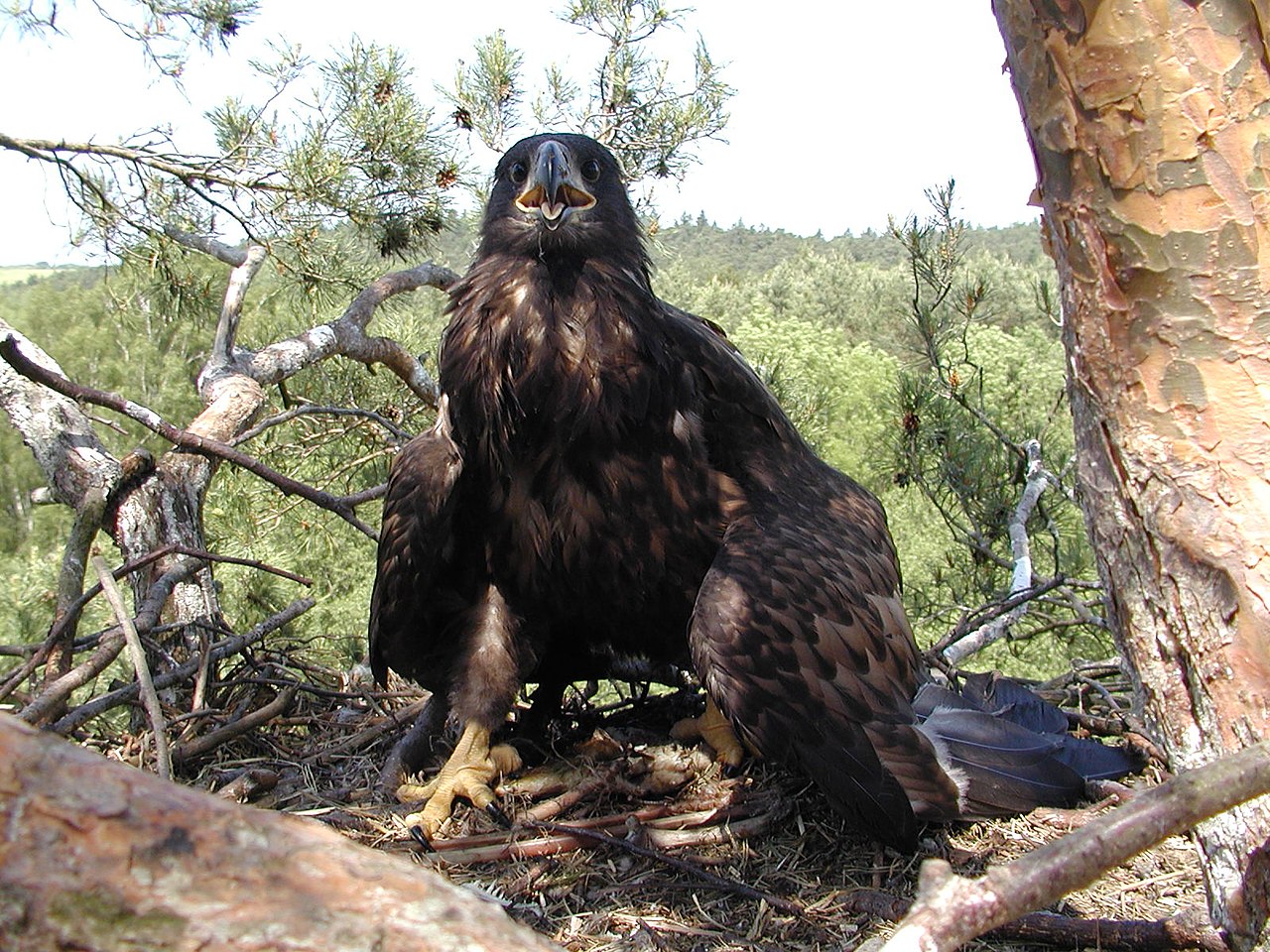
A large nestling in Brandenburg, Germany

Young white-tailed eagles quickly become assured fish predators.

An adult and a juvenile white-tailed eagle fighting

White-tailed eagle skeleton


A dark-hued juvenile feeding on the carcass of a large fish, likely that of a large carp

Adult in flight in Isle of Skye, Scotland, from the population of reintroduced birds of Norwegian stock
![A white tailed eagle was shot in the winter of 1857 at Stolford in Bridgwater Bay and subsequently preserved for display. It may be seen at the Somerset Heritage Centre (TA2 6SF). It was presented to the county museum by Miss Bailey, the executrix of the owner's will, in 1881.[287]](https://upload.wikimedia.org/wikipedia/commons/d/da/White_tailed_Eagle_from_Bridgwater_Bay.jpg)
A white tailed eagle was shot in the winter of 1857 at Stolford in Bridgwater Bay and subsequently preserved for display. It may be seen at the Somerset Heritage Centre (TA2 6SF). It was presented to the county museum by Miss Bailey, the executrix of the owner's will, in 1881.[287]

A white-tailed eagle killed by a wind turbine in Hungary


Temperament
solitary and territorial
Flight Pattern
soaring glider with long, steady wingbeats and flat, plank-like wings
Social Behavior
Usually forms long-term monogamous pairs that maintain large territories. Nests are huge stick platforms placed in tall trees or on cliffs and are reused and enlarged each year. Non-breeding birds and wintering individuals may roost communally near reliable food sources.
Migratory Pattern
Partial migrant
Song Description
Vocalizations include ringing yelps, cackles, and yodeling calls, often heard around nest sites. Calls carry over long distances and can resemble harsh, gull-like cries.
Plumage
Overall dark brown to chocolate-brown body with a paler buff head and neck; adults show a clean white, wedge-shaped tail. Juveniles are darker with mottling and lack the white tail, gaining adult plumage over several years. Feathers are broad, giving a plank-winged look in flight.
Diet
Primarily hunts fish taken near the surface or snatched from just below, and also preys on waterbirds such as ducks and gulls. Carrion is readily scavenged, especially in winter, and it will pirate food from other birds like ospreys. Opportunistically takes small to medium mammals and will forage along shorelines for washed-up prey.
Preferred Environment
Feeds along coasts, estuaries, tidal flats, large lakes, and wide rivers where open water and perches are available. Often hunts from a perch or low soaring flight, making short stoops to the water’s surface or ground.


