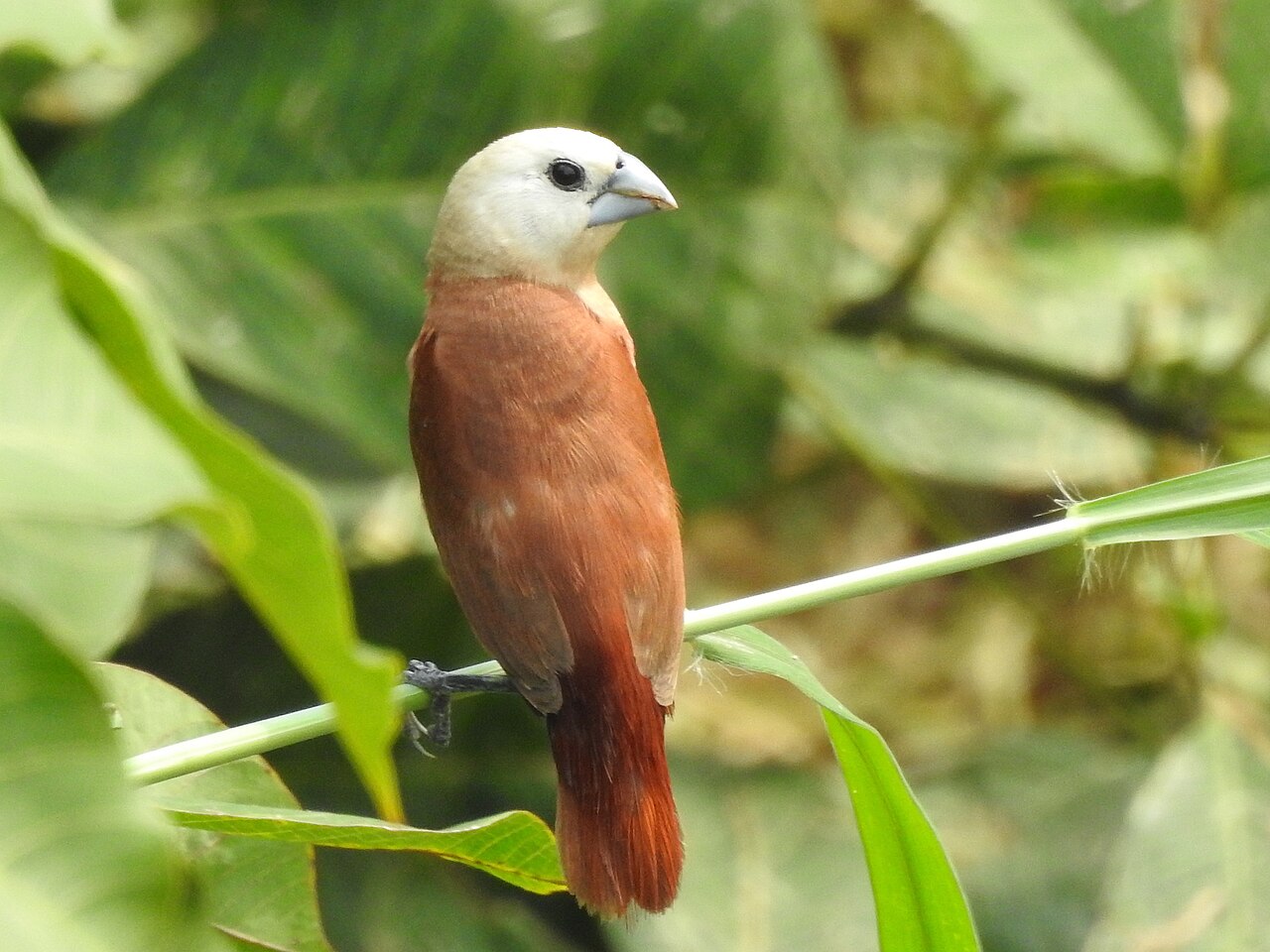
The white-headed fruit dove is a species of bird in the pigeon family Columbidae. It was described by the English ornithologist John Gould in 1856, and the specific name eugeniae honours the French empress Eugénie de Montijo. Adults of the species have white heads, a purplish-red breast patch, a grey shoulder patch, olive-green upperparts, greenish underparts with a blue tinge, and a yellowish vent. Juveniles have green heads with the white restricted to the forehead and upper throat, a much smaller grey shoulder patch, and the red breast patch restricted to the centre of the breast.
Region
Maluku Islands (Wallacea)
Typical Environment
Primarily inhabits lowland and foothill evergreen forests, including secondary growth and forest edges. Often forages high in the canopy at fruiting figs and other native fruit trees, occasionally descending to mid-story levels. It may also utilize coastal woodland and scrub where fruiting trees are abundant. The species favors relatively undisturbed tracts but can persist in moderately degraded habitats if fruit resources remain.
Altitude Range
Sea level to 600 m
Climate Zone
Tropical
Ease of Keeping
Beginner friendly: 1/5
A canopy-dwelling fruit-dove, it plays a key role in seed dispersal for many native trees. Its striking white head and purplish-red breast patch make it one of the most distinctive Ptilinopus doves. It is generally shy and more often detected by its soft, low coos than by sight. Forest loss and hunting on small islands can impact local populations.


Temperament
shy and unobtrusive
Flight Pattern
short rapid wingbeats with swift, direct dashes between trees
Social Behavior
Usually seen singly, in pairs, or in small loose groups at fruiting trees. Nests are typical dove-like flimsy platforms placed in dense foliage. Breeding behavior likely involves simple courtship displays and soft vocalizations.
Migratory Pattern
Resident
Song Description
Gives low, soft coos and mournful hoots that carry through the forest canopy. Vocalizations are often repeated in slow sequences and can be the best clue to its presence.
Plumage
Adult with clean white head, purplish-red breast patch, grey shoulder patch, olive-green upperparts, and greenish underparts with a bluish tinge; vent yellowish. Juveniles are greener on the head with white limited to the forehead and upper throat; their shoulder patch is smaller and the breast patch reduced.
Diet
Feeds mainly on small fruits and berries, especially figs and drupes, which it swallows whole. It helps disperse seeds across the forest as seeds pass through the gut or are regurgitated. Occasionally supplements diet with tender plant matter and flower buds when fruit is scarce.
Preferred Environment
Forages in the upper canopy and mid-story of primary and secondary forest, frequently at fruiting fig trees. Also visits forest edges and gardens with mature fruiting trees.