
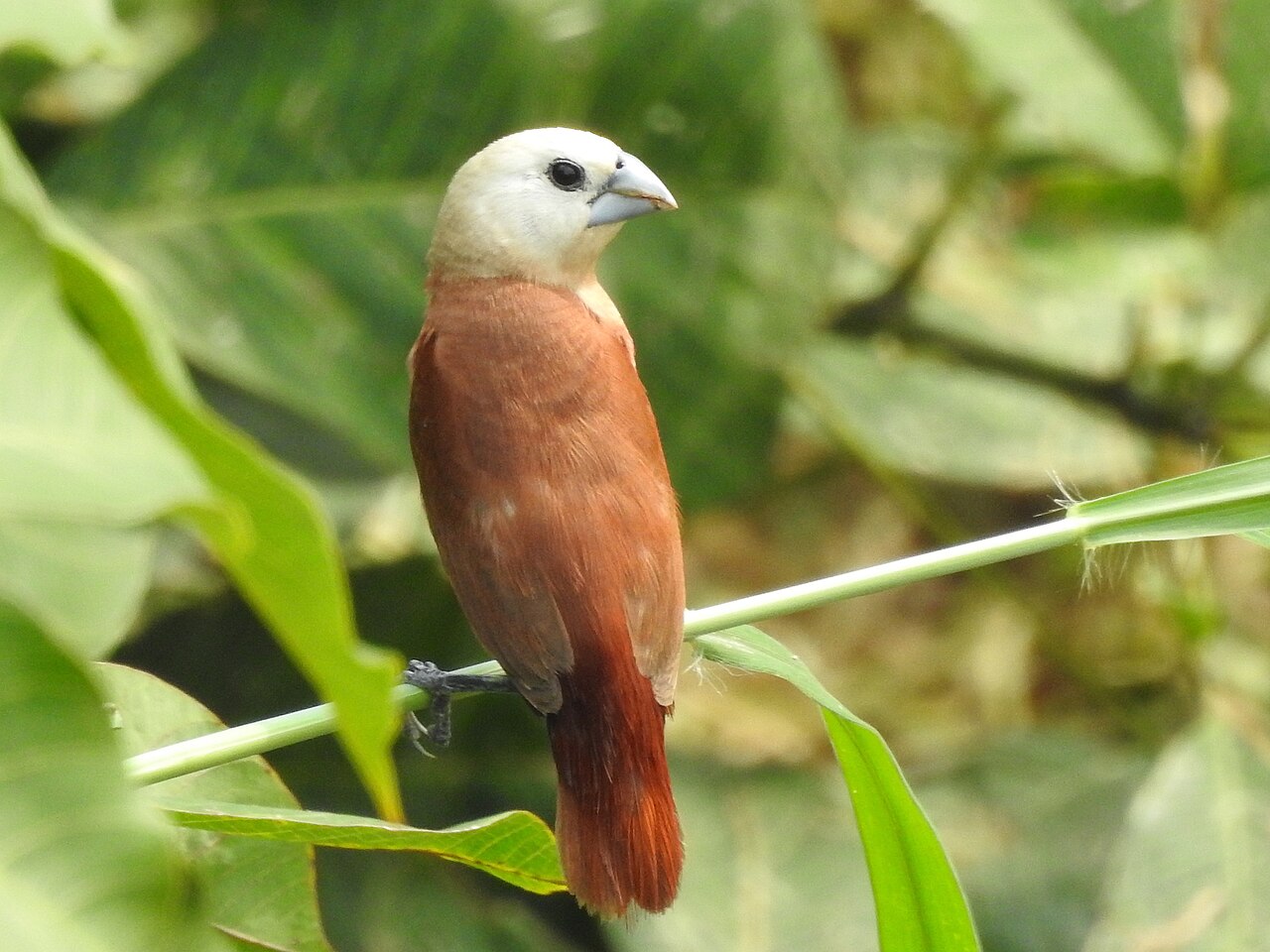
The white-headed munia (Lonchura maja) is a small passerine bird belonging to the estrildid finch family. This species is often confused with, and referred to as, the Pale-headed munia which can be differentiated by tan coloured flanks which are lighter than the brown wings and also by the absence of the black belly.
Region
Southeast Asia
Typical Environment
Occurs across the Malay Peninsula and the Greater Sunda Islands, frequenting lowland wetlands, rice paddies, grassy marshes, and open country with scattered shrubs. It often forages along the edges of reedbeds and in weedy fields, and readily uses human-modified habitats. The species is largely non-forest, favoring open, moist areas near water and agricultural plots. Local movements track seeding grasses and harvest cycles.
Altitude Range
Sea level to 1500 m
Climate Zone
Tropical
Ease of Keeping
Beginner friendly: 3/5
The white-headed munia is a gregarious estrildid finch often seen in flocks in rice fields and wetlands. It is frequently confused with the Pale-headed munia; white-headed munia shows a distinctive black belly patch that the pale-headed lacks. Both sexes look similar, and their stout, bluish-grey bill is adapted to husking tough grass seeds. They readily exploit cultivated landscapes and can assemble in large post-breeding flocks.

Temperament
social and active
Flight Pattern
short rapid wingbeats
Social Behavior
Usually in small to large flocks outside the breeding season, often mixing with other munias. Nests are ball-shaped structures of grass placed low in reeds, shrubs, or crops; both adults participate in nest building and care. Breeding can be synchronized with the availability of green seeding grasses.
Migratory Pattern
Resident
Song Description
Soft, high-pitched chips and twitters interspersed with dry rattling notes. The song is simple and repetitive, used for contact within flocks and during courtship.
Plumage
Clean white head and throat contrasting with warm brown upperparts and flanks, and a distinct black belly patch; tail darker brown to blackish. Plumage is smooth and even-toned with minimal streaking.
Diet
Primarily takes grass and sedge seeds, including green milky seeds, and readily feeds on cultivated rice. It also ingests small invertebrates, especially during breeding, for added protein. Birds husk seeds efficiently with their stout bills and may cling to seedheads or feed on the ground.
Preferred Environment
Feeds in rice paddies, wet meadows, reed margins, and weedy field edges. Often forages in flocks, moving through stands of grasses and along irrigation ditches.


