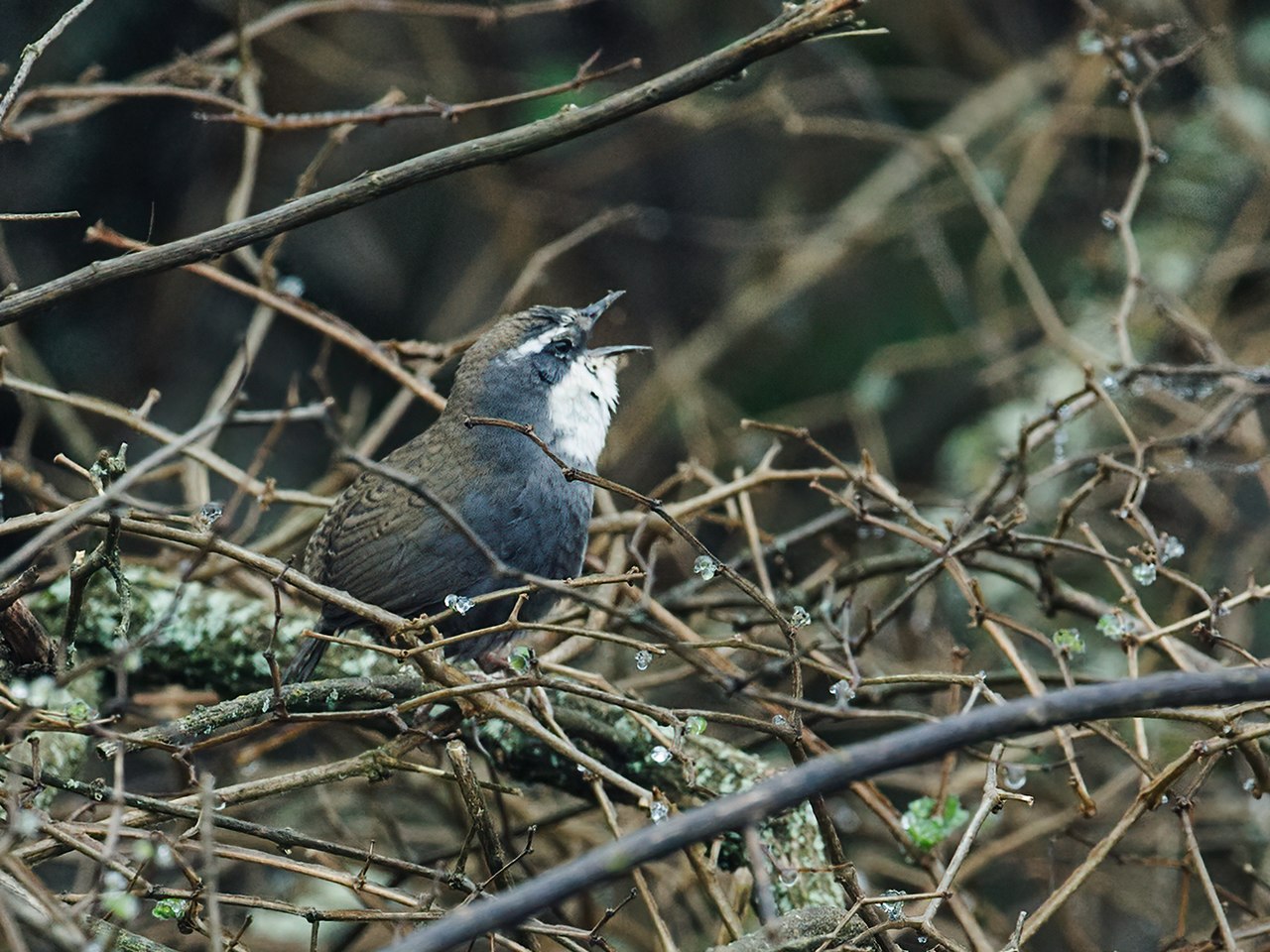
The white-browed shrike-babbler is a bird species found in the eastern Himalayas and Southeast Asia from northern Burma to southern Cambodia. Like others in the genus it is found in montane forests. Males and females have different plumages and variations occur through its range with several populations being treated as subspecies. It is part of a cryptic species complex and was earlier lumped as a subspecies of the white-browed shrike-babbler. Clements lumps this bird into the white-browed shrike-babbler.
Region
Eastern Himalayas and Southeast Asia
Typical Environment
Occurs from the eastern Himalayas through northeastern India, southern China (Yunnan and adjacent areas), Myanmar, Thailand, Laos, Vietnam, and into parts of Cambodia. It favors montane evergreen and oak–rhododendron forests, as well as well-wooded edges and mature secondary growth. Birds keep mainly to the mid- and upper canopy but may descend to lower levels at forest edges or along ridges. Often associates with mixed-species foraging parties, moving deliberately through epiphyte-laden branches and dense foliage.
Altitude Range
600–2600 m
Climate Zone
Highland
Ease of Keeping
Beginner friendly: 1/5
A member of the shrike-babbler complex, this species shows marked sexual dimorphism and considerable geographic variation, with several recognized subspecies. It inhabits montane broadleaf and mixed forests where it often joins mixed-species flocks. Despite babbler-like habits, genetic studies place shrike-babblers with vireos (family Vireonidae). It typically forages methodically in the mid- to upper canopy, using a short, hooked bill to pick insects from foliage.


Doi Ang Khang Mountain – Thailand

Illustration of a male P. a. aeralatus

Female of subspecies validirostris at Namdapha National Park
Temperament
alert and active
Flight Pattern
short rapid wingbeats with quick, direct dashes between perches
Social Behavior
Usually found in pairs or small family groups, regularly joining mixed-species canopy flocks. Breeding pairs are territorial, building a neat cup nest placed in a fork or on a slender horizontal branch. Both sexes participate in nesting duties, and juveniles may linger near parents after fledging.
Migratory Pattern
Partial migrant
Song Description
Song consists of clear, sweet, whistled phrases delivered at intervals, often from mid-canopy perches. Calls include sharp ticking notes and soft contact chips when moving with mixed flocks.
Plumage
Compact, shrike-like passerine with a bold white supercilium, short hooked bill, and contrasting wing pattern. Males show cleaner, crisper contrasts with gray to olive upperparts and distinct wing patches; females are duller olive-brown with a paler brow and less-defined wing markings.
Diet
Primarily feeds on arthropods such as caterpillars, beetles, and spiders gleaned from leaves, twigs, and clusters of dead foliage. Will occasionally take small berries and other soft fruits, especially outside the breeding season. Foraging is deliberate, with frequent pauses to inspect leaf undersides and epiphyte mats.
Preferred Environment
Forages in the mid- to upper canopy of mature montane forest, along forest edges, and in well-vegetated ravines. Often follows mixed-species flocks along ridgelines and through mossy, epiphyte-rich branches.