
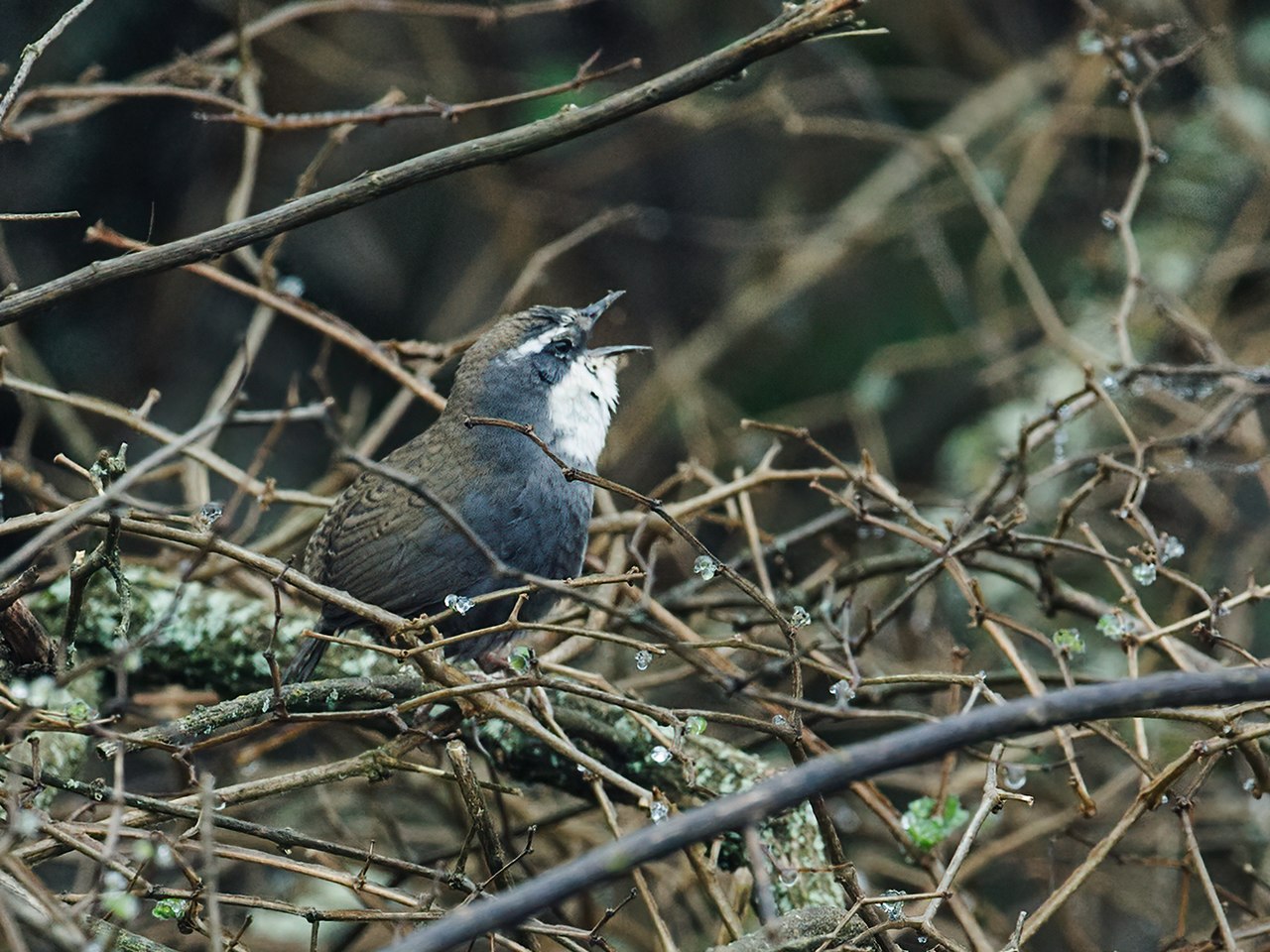
The white-browed tapaculo is a species of bird in the family Rhinocryptidae. It is found in northwestern Argentina.
Region
Argentine Yungas, Southern Andes
Typical Environment
Occurs in the humid montane forests and cloud-forest edges of the Yungas in northwestern Argentina, from Jujuy south through Salta and Tucumán to Catamarca. It favors dense understory, including bamboo thickets, tangled shrubbery, and steep ravines. Often near streams, landslides, and secondary growth where cover is thick. It keeps close to the ground, using natural tunnels and root mats to move unseen.
Altitude Range
1000–2600 m
Climate Zone
Highland
Ease of Keeping
Beginner friendly: 1/5
A shy understory specialist, the white-browed tapaculo is more often heard than seen, identified by its distinctive white eyebrow and rapid, rhythmic song. It skulks through dense tangles in the Andean Yungas, often keeping its tail cocked. As with many Scytalopus, voice is crucial for identification because plumage differences are subtle. It is endemic to northwestern Argentina.


Temperament
secretive and territorial
Flight Pattern
short rapid wingbeats; typically runs and hops through cover
Social Behavior
Usually solitary or in pairs, defending small territories year-round. Nests are placed low and concealed, often in earthen banks or cavities with a mossy or fibrous dome and side entrance. Courtship and pair-bonding are reinforced by duet-like exchanges and close-range calling.
Migratory Pattern
Resident
Song Description
Song is a fast, even series of sharp notes or chips that can accelerate slightly, delivered from hidden perches. Calls include dry ticks and scolds used in contact and alarm. The repetitive rhythm carries well through dense vegetation.
Plumage
Mostly dark slaty-gray with warm brown to rufous-brown flanks and rear underparts showing fine barring; back can show brownish tones. A clean white supercilium (eyebrow) contrasts with the darker face. Feathers appear soft and matte, aiding camouflage in shadowy understory.
Diet
Primarily small arthropods such as beetles, ants, spiders, and larvae. Forages by gleaning from leaf litter, probing mossy roots, and pecking among fallen branches. Occasionally takes small invertebrates from low foliage and bamboo culms.
Preferred Environment
Feeds on or near the ground in dense understory, especially in bamboo and along shaded stream banks. Uses cover to move between foraging patches, rarely venturing into open areas.


