

The western plantain-eater, also known as the grey plantain-eater or western grey plantain-eater, is a large member of the turaco family, a group of large arboreal near-passerine birds restricted to Africa.
Region
West Africa
Typical Environment
Common across coastal and inland West Africa in open woodland, forest edge, savanna with scattered trees, farmlands, and gardens. Frequently encountered in urban parks and around villages where fruiting trees are abundant. Often follows riparian corridors and mosaic habitats with palms and figs. It readily adapts to human-altered landscapes provided tall perches and fruit sources are available.
Altitude Range
Sea level to 1500 m
Climate Zone
Tropical
Ease of Keeping
Beginner friendly: 2/5
The western plantain-eater is a large, noisy turaco of West Africa that thrives around towns, farms, and open woodland. It is an important seed disperser, especially for figs and other fruiting trees. Unlike many colorful turacos, it is mostly gray-brown and lacks red wing feathers, but shows striking pale flashes in the wings and tail during flight. Pairs often duet loudly at dawn and dusk.


At Nashville Zoo

At Wildlife World Zoo, Arizona, USA
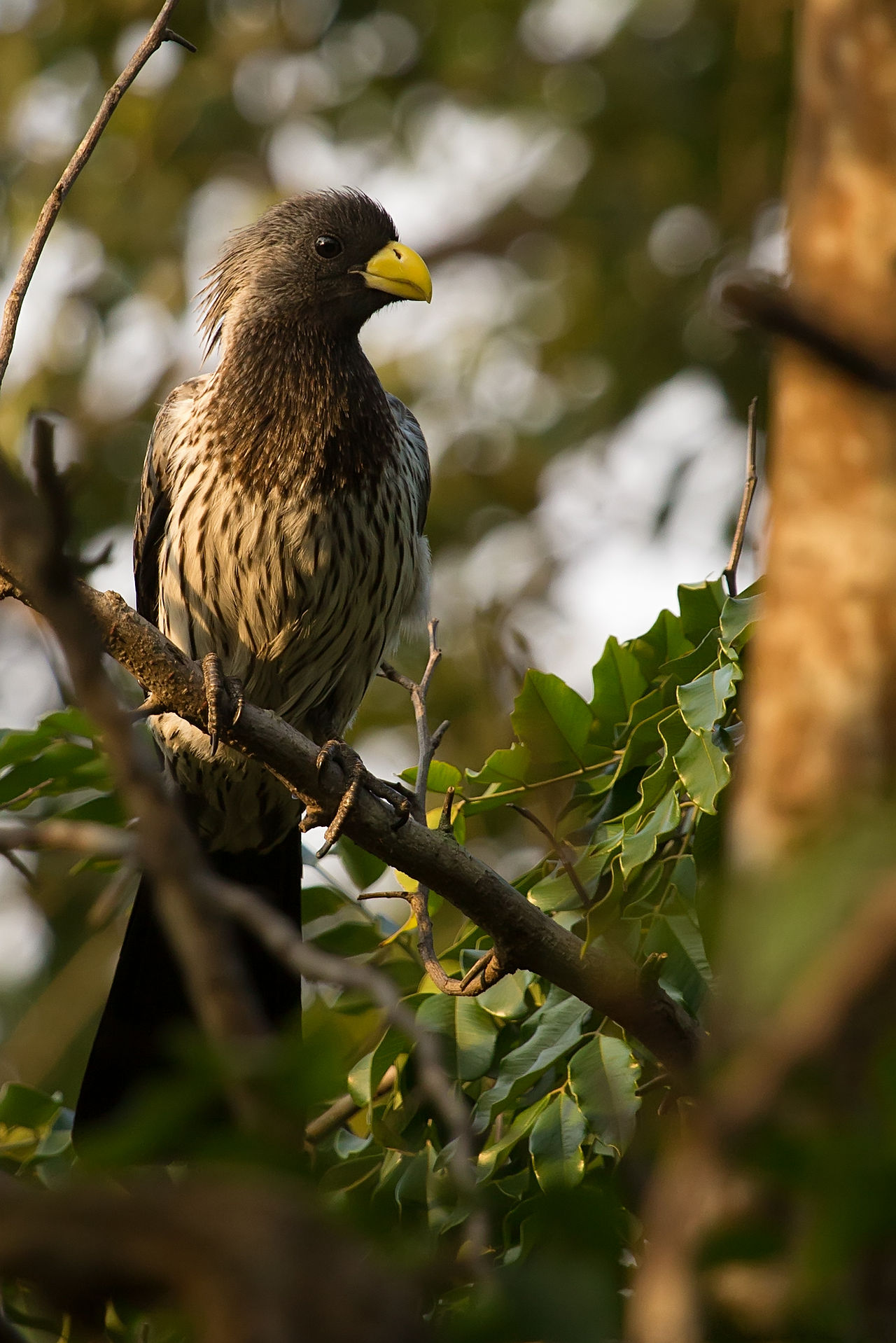
At University of Ghana, Accra, Ghana
Temperament
social and noisy
Flight Pattern
short rapid wingbeats with glides between trees
Social Behavior
Usually seen in pairs or small family groups, often perched conspicuously and calling. Monogamous pairs build a shallow stick nest in trees and share incubation and chick-rearing. They are vigilant and often use prominent perches to scan for danger before flying to fruiting trees.
Migratory Pattern
Resident
Song Description
Loud, raucous croaks and cackles that carry over long distances, often delivered in rhythmic sequences. Duets between pair members are common, especially at dawn and dusk, giving accelerating, grating calls.
Plumage
Coarsely streaked and mottled gray-brown with paler, lightly streaked underparts and a long, graduated tail. Prominent shaggy crest and thick, slightly decurved bill. In flight, shows pale flashes in the wings and a whitish tail tip.
Diet
Primarily eats fruit such as figs, oil palm fruits, berries, and cultivated bananas/plantains. Also takes buds, flowers, and young leaves when fruit is scarce. Occasionally supplements the diet with small invertebrates. Swallows fruit whole and later disperses seeds.
Preferred Environment
Feeds high in fruiting trees at forest edge, along rivers, in farmland with scattered trees, and in gardens and parks. Often visits planted fruit trees near human settlements.


