

The western house martin, sometimes called the common house martin, northern house martin or, particularly in Europe, just house martin, is a migratory passerine bird of the swallow family which breeds in Europe, north Africa and across the Palearctic; and winters in sub-Saharan Africa and tropical Asia. It feeds on insects which are caught in flight, and it migrates to climates where flying insects are plentiful. It has a blue head and upperparts, white rump and pure white underparts, and is found in both open country and near human habitation. It is similar in appearance to the two other martin species of the genus Delichon, which are both endemic to eastern and southern Asia. It has two accepted subspecies.
Region
Palearctic (breeding) and sub-Saharan Africa (wintering)
Typical Environment
Breeds widely across Europe, North Africa, and much of the temperate Palearctic, favoring open country near water, farmland, villages, and towns. Nests are typically attached to buildings or cliffs under sheltered ledges. In the non-breeding season it winters mainly in sub-Saharan Africa, with some populations reaching tropical Asia. It forages over fields, wetlands, lakeshores, and urban green spaces, often near insect-rich airflows.
Altitude Range
0–3000 m
Climate Zone
Temperate
Ease of Keeping
Beginner friendly: 1/5
Western house martins build neat mud cup nests under eaves, often returning to the same sites year after year and expanding or repairing old nests. Their bright white rump is a key field mark that separates them from swallows and sand martins in fast aerial flocks. They are highly social, feeding and nesting in colonies, and readily use artificial nest cups provided on buildings.


At an official bird ringing station

Gathering mud Verkhniye Mandrogi, Russia

A mother flying back to a full nest in the eaves of a house in Kent, England

Collecting mud

Collecting mud for nests in Denmark

Delichon urbicum – MHNT

Delichon urbicum meridionale - Algeria- MHNT
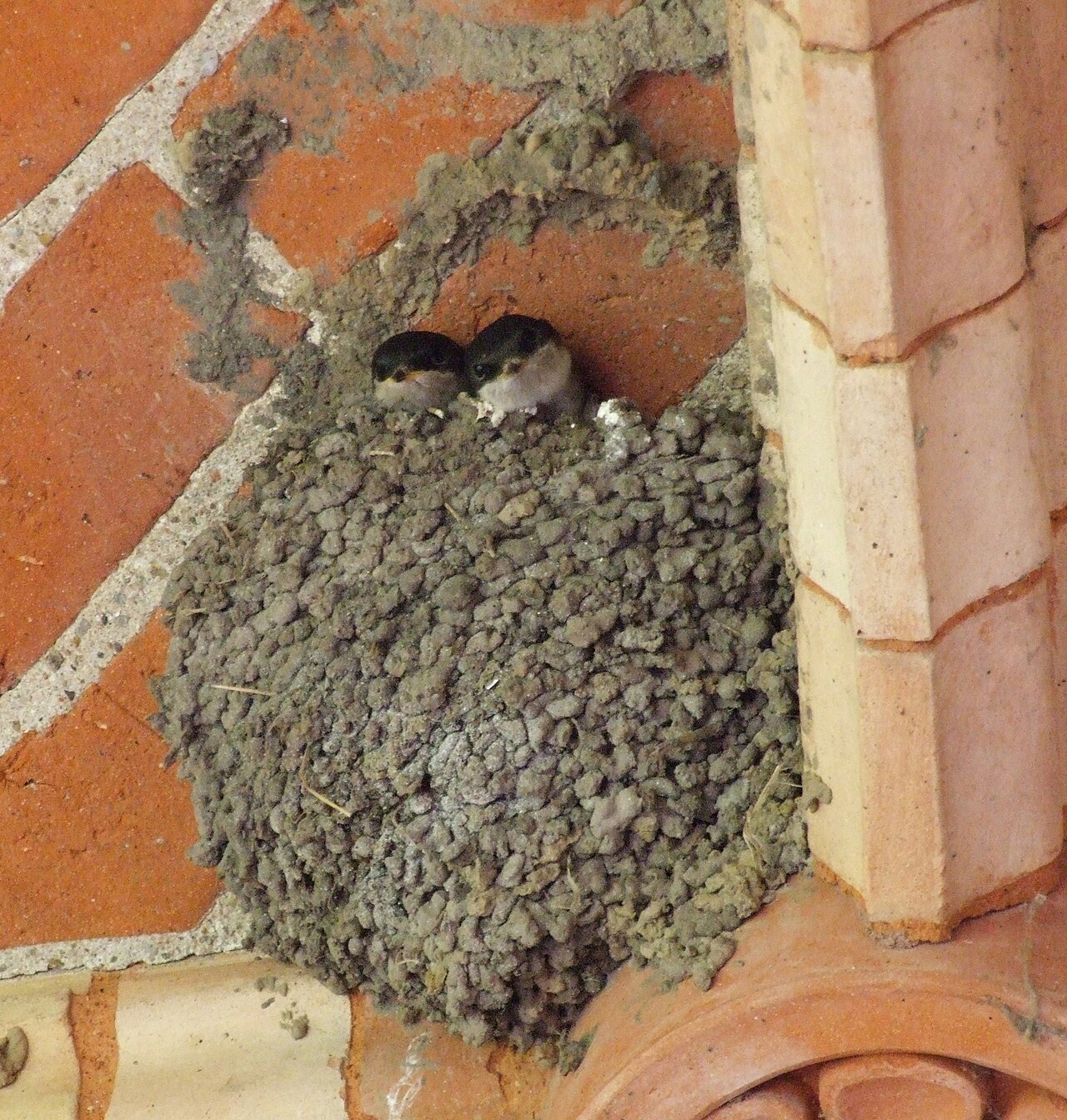
Nest with chicks

A female house martin flea

Nest with board to prevent fouling below

Coat of arms of Richard II featuring five martlets
Temperament
social and active
Flight Pattern
agile flier with quick, fluttering wingbeats and short glides
Social Behavior
Strongly colonial, often nesting in clusters on buildings and bridges. Typically monogamous, with both partners collecting mud and lining the nest with feathers. Pairs may raise two broods in good seasons and frequently reuse or refurbish previous nests. Outside the breeding season, they forage and roost in flocks.
Migratory Pattern
Seasonal migrant
Song Description
Soft, twittering song and conversational chirps delivered near nests and in flight. Flight calls are short, dry trills and ‘prrit’-like notes used to keep contact within flocks.
Plumage
Glossy blue-black upperparts with a conspicuous white rump and clean white underparts; tail shallowly forked.
Diet
Catches small aerial insects on the wing, including flies, aphids, leafhoppers, and other tiny Diptera and Hemiptera. Often feeds at varying heights depending on wind, temperature, and insect swarms. In cool or windy weather it forages lower, skimming over water and fields; in warm calm conditions it ranges higher. It drinks by skimming water surfaces and occasionally picks floating prey.
Preferred Environment
Hunts over open habitats such as farmland, pasture, lakes, rivers, coastal cliffs, and urban parks. Frequently concentrates where insects are abundant, including leeward sides of woods, above water bodies, and around buildings that create updrafts.


