

The western jackdaw, also known as the Eurasian jackdaw, the European jackdaw, or simply the jackdaw, is a passerine bird in the crow family. Found across Europe, western Asia and western North Africa; it is mostly resident, although northern and eastern populations migrate south in the winter. Four subspecies are recognised, which differ mainly in the colouration of the plumage on the head and nape. Linnaeus first described it formally, giving it the name Corvus monedula. The common name derives from the word jack, denoting "small", and daw, a less common synonym for "jackdaw", and the native English name for the bird.
Region
Western Palearctic
Typical Environment
Occurs across most of Europe, western Asia, and parts of North Africa. Favors open and semi-open landscapes, including farmland, pastures, coastal cliffs, woodland edges, parks, and towns. Common in urban areas where suitable nesting cavities are available. Avoids dense unbroken forest and true deserts. Often associates with livestock and follows ploughs to feed.
Altitude Range
0–2500 m
Climate Zone
Temperate
Ease of Keeping
Beginner friendly: 2/5
A highly intelligent corvid, the western jackdaw forms long-term pair bonds and often nests in cavities such as tree holes, cliffs, and chimneys. It adapts well to human environments and gathers in large, noisy communal roosts. Its pale, silvery eyes and grey nape make it easy to distinguish from other crows. Vocal and inquisitive, it uses a wide range of calls and shows problem-solving behavior.


Adult

Juvenile

C. m. monedula in Sweden. This subspecies has a whitish partial collar.

Adult C. m. spermologus, showing the rictal bristles cover much of the bill.

Juvenile C. m. spermologus, Newcastle upon Tyne, England.

Partially leucistic individual with white feathers in Naantali cemetery, Naantali, Finland

Western jackdaw calling in flight on Inisheer, Ireland

A western jackdaw on Inisheer, Ireland
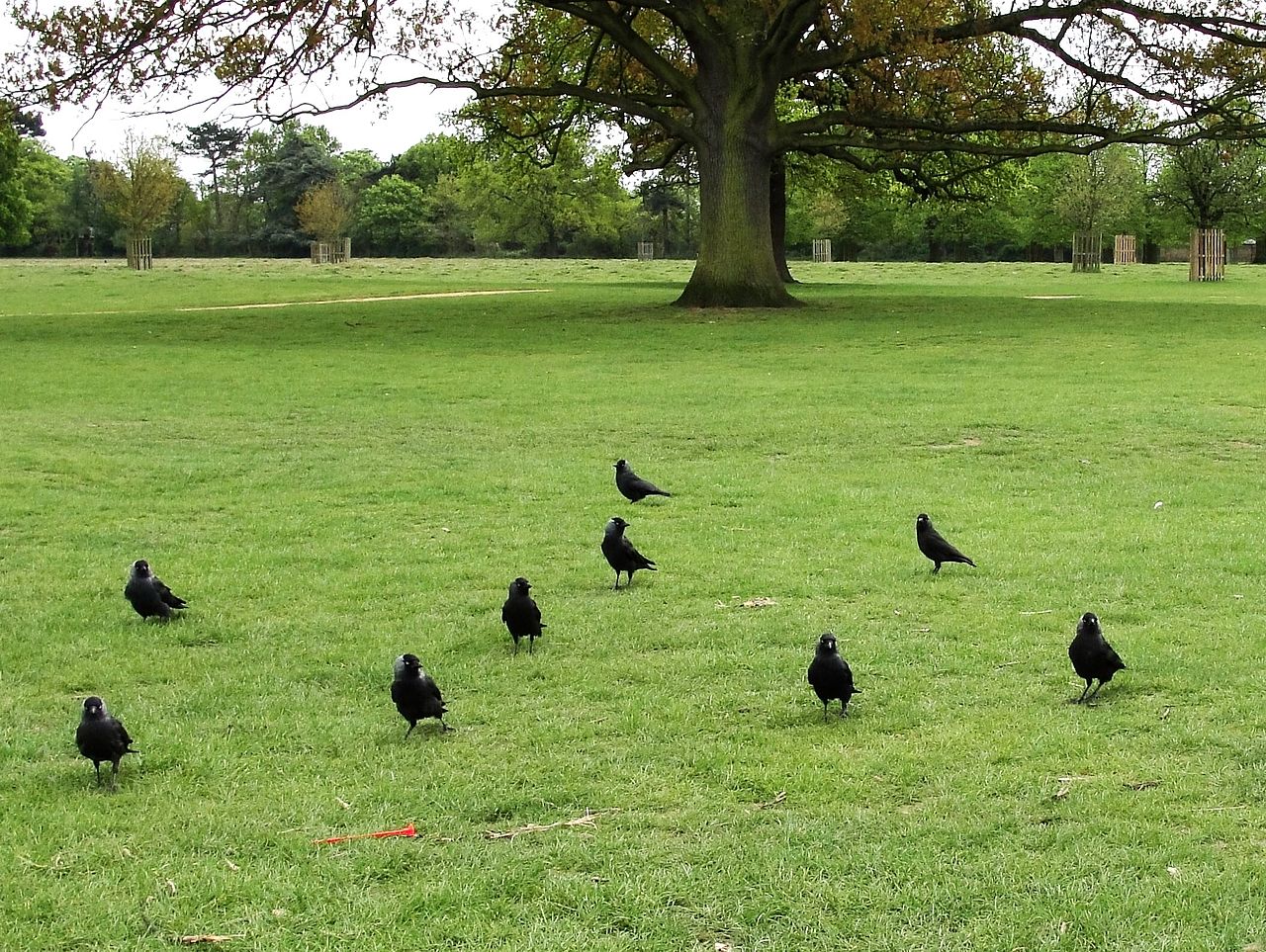
A family group in Bushy Park, London.

A western jackdaw in flight.

Occupying a hole in a wall at Conwy Castle, Wales.

Nest with a chick and eggs.

Eggs, Collection Museum Wiesbaden

Fledgling C. m. spermologus in southern England.

C. m. soemmerringii, foraging in pasture in Russia.
![Harrison Weir's 1881 illustration of a vain jackdaw wearing peacock feathers for "The Bird in Borrowed Feathers" (also known as "The Vain Jackdaw") fable[98]](https://upload.wikimedia.org/wikipedia/commons/thumb/f/f9/Borrowed_plumes.jpg/500px-Borrowed_plumes.jpg)
Harrison Weir's 1881 illustration of a vain jackdaw wearing peacock feathers for "The Bird in Borrowed Feathers" (also known as "The Vain Jackdaw") fable[98]

A jackdaw pictured in the coat of arms of the Sauvo municipality


Temperament
social and active
Flight Pattern
strong direct flight with quick wingbeats; agile wheeling in flocks
Social Behavior
Forms lifelong monogamous pairs and often breeds in loose colonies, frequently using cavities in buildings, cliffs, or tree holes. Roosts communally in large numbers outside the breeding season. Both parents incubate and feed the young. Highly gregarious, often seen foraging in mixed flocks with other corvids.
Migratory Pattern
Partial migrant
Song Description
Produces sharp, metallic chacks and yaks, with chattering sequences in social contexts. Vocal repertoire is varied but lacks a melodious song; calls are used for cohesion and alarm. Flock interactions are noisy and continuous.
Plumage
Glossy black with a contrasting grey to silvery nape and sides of the neck; feathers sleek and tight. Subtle sheen on mantle and wings.
Diet
Omnivorous, taking insects, larvae, spiders, earthworms, and snails, as well as grains, seeds, and berries. Also scavenges carrion and human food scraps, and may occasionally take eggs or nestlings. Opportunistic and adaptable, exploiting seasonal and urban food sources. Often forages in short swards where invertebrates are accessible.
Preferred Environment
Feeds in open fields, grazed pastures, coastal grasslands, parks, and urban streets or waste sites. Frequently follows agricultural activity and forages near livestock to pick invertebrates stirred up by movement.


