

The tree pipit is a small passerine bird that breeds throughout most of Europe and the Palearctic as far east as the East Siberian Mountains. It is a long-distance migrant, migrating in winter to Africa and southern Asia. The scientific name is from Latin: anthus is the name of a small bird of grasslands, and the specific trivialis means "common".
Region
Europe and Palearctic
Typical Environment
Breeds widely across most of Europe and into the Palearctic, reaching east to western Siberia. Prefers open woodlands, forest edges, clear-cuts, heathlands, and young plantations with scattered trees and patches of bare ground. In winter it migrates to sub-Saharan Africa and parts of South Asia, using open savannas, lightly wooded country, and agricultural landscapes. Avoids dense closed-canopy forests and very treeless expanses during breeding. Often occurs near glades and rides that offer perches for song flights.
Altitude Range
Sea level to 2000 m
Climate Zone
Temperate
Ease of Keeping
Beginner friendly: 1/5
Tree pipits perform a distinctive parachuting song flight, rising steeply before gliding down with spread wings and tail while singing. They nest on the ground in concealed vegetation, despite often being associated with trees for perching and display. Outside the breeding season they shift to more open savanna and farmland habitats. They can be confused with Meadow Pipits, but their song flight and bolder facial pattern help separate them.


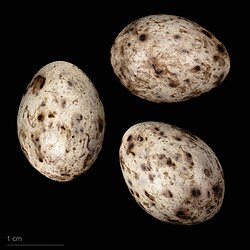
A tree pipit nest found in clearfell habitat, Northern England, holding a clutch of six eggs of the darker variation.




Temperament
wary and territorial in breeding season
Flight Pattern
short rapid wingbeats with fluttering parachute descents; low, undulating flights between perches
Social Behavior
Typically monogamous and territorial while breeding, with males displaying from song posts and during aerial song flights. Nests are placed on the ground, well hidden among grasses or low vegetation. Clutches usually contain 4–6 eggs, and pairs may raise two broods in good seasons.
Migratory Pattern
Seasonal migrant
Song Description
A bright, accelerating series of trills and phrases delivered during a characteristic parachuting display. Also gives thin tseep contact calls and sharper alarm notes. Song is more melodious and structured than that of the Meadow Pipit.
Plumage
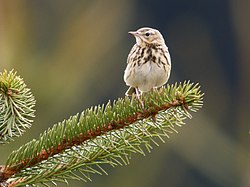
Brown, finely to coarsely streaked upperparts with buff underparts bearing bold breast streaks that thin toward the flanks. Clean buff face with marked malar stripe and pale supercilium. White outer tail feathers are conspicuous in flight.
Diet
Primarily eats insects and other small invertebrates such as beetles, flies, caterpillars, spiders, and ants. During migration and in winter it may also take small seeds and berries opportunistically. Forages mostly by walking and picking prey from the ground or low vegetation. Occasionally hawks short distances for flying insects.
Preferred Environment
Feeds in open patches within woodland, forest rides, clearings, heath, and rough grassland with scattered trees. In winter, uses lightly wooded savannas, stubble fields, and field margins where ground cover is sparse to moderate.


