

The tawny frogmouth is a species of frogmouth native to the Australian mainland and Tasmania and found throughout. It is a big-headed, stocky bird often mistaken for an owl due to its nocturnal habits and similar colouring.
Region
Australia (including Tasmania)
Typical Environment
Widespread across mainland Australia and Tasmania in a variety of wooded habitats including eucalypt forest, open woodland, mallee, and riparian corridors. Common in parks, suburban gardens, and along road edges where open perches and prey are abundant. Generally avoids dense, closed-canopy rainforest interiors and the most treeless deserts. Roosts by day on exposed branches and hunts at night from low to mid-level perches.
Altitude Range
Sea level to 1500 m
Climate Zone
Other
Ease of Keeping
Beginner friendly: 2/5
Often mistaken for an owl, the tawny frogmouth is actually a nocturnal member of the frogmouth family with a huge, frog-like gape used to catch prey. By day it perches motionless along a branch, relying on superb bark-like camouflage and a stiff, upright posture to avoid detection. Pairs are typically lifelong monogamous, and both parents share nest duties. They adapt well to towns and gardens, where they help control insects.


Rufous morph
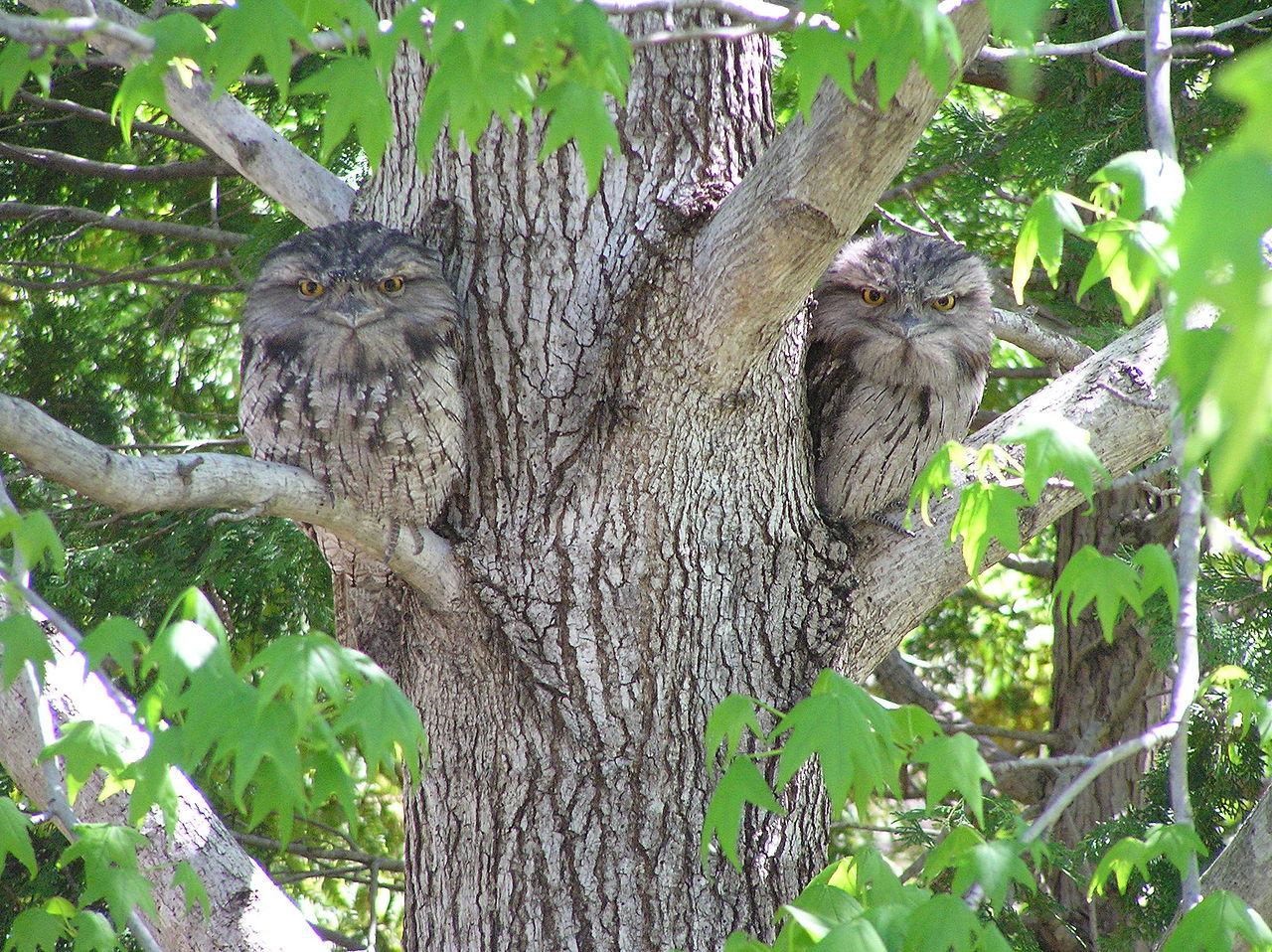
Camouflaged tawny frogmouths blend in with colour and texture of tree bark in Sydney.

Camouflaged tawny frogmouth couple in afternoon sun, Melbourne

Family of four in alarm position, emulating broken branches

Tawny frogmouth skull


Pair of tawny frogmouths in Brisbane Botanical Gardens

Perching on a balcony in Sydney, Australia
Temperament
sedentary, pair-bonded and territorial
Flight Pattern
short, silent flights with rapid wingbeats and low, gliding passes
Social Behavior
Usually seen singly or as bonded pairs that may roost side by side; pairs often remain on long-term territories. Both sexes build a flimsy stick platform in a horizontal fork. The male typically incubates during daylight while the female takes night shifts, and both feed the chick. When threatened, adults adopt a stiff, elongate posture to resemble a broken branch.
Migratory Pattern
Resident
Song Description
Low, resonant oom-oom-oom calls repeated at intervals, often heard at night and before dawn. Also produces bill snaps, growls, and soft grunts during close encounters or when alarmed.
Plumage
Dense, mottled and streaked grey-brown plumage with fine black barring that mimics tree bark; feathers are soft and cryptic with a shaggy texture.
Diet
Primarily large nocturnal insects such as moths, beetles, grasshoppers, and cicadas, taken by sallying from a perch or pouncing to the ground. They also consume spiders and other arthropods, and occasionally small vertebrates like frogs, mice, or small reptiles. Prey is swallowed whole using the expansive gape and guiding bristles around the bill.
Preferred Environment
Hunts from low exposed perches along forest edges, clearings, and urban parks where prey is easier to detect. Frequently forages near streetlights that attract insects and along roadsides. Uses quiet, short sallies to snatch prey from the air, foliage, or ground.


