

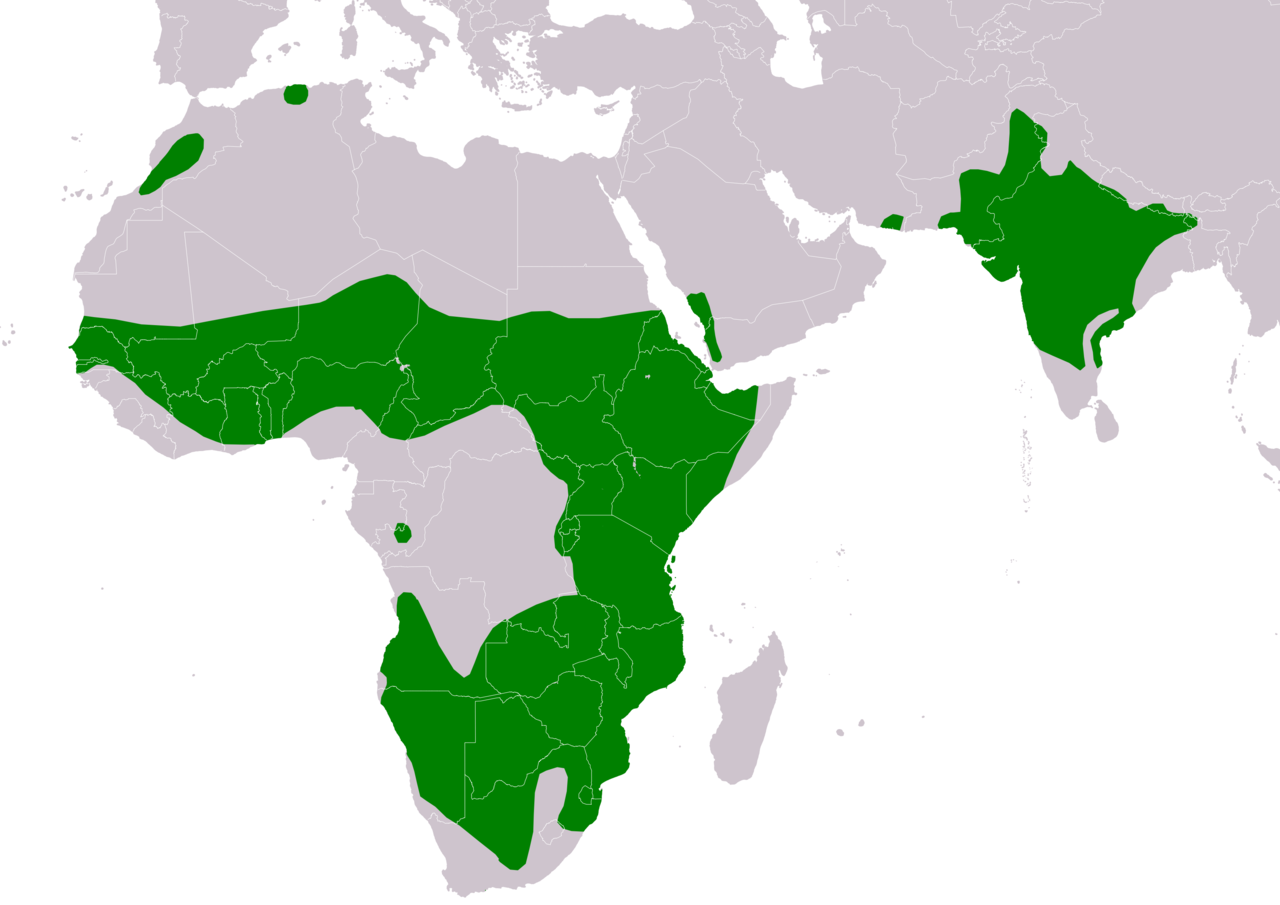
The tawny eagle is a large bird of prey. Like all eagles, it belongs to the family Accipitridae. Its heavily feathered legs mark it as a member of the subfamily Aquilinae, also known as booted eagles. Tawny eagles have an extensive but discontinuous breeding range that constitutes much of the African continent as well as the Indian subcontinent, with rare residency in the southern Middle East. Throughout its range, it favours open dry habitats such as semideserts, deserts steppes, or savanna plains. Despite its preference for arid areas, the species seldom occurs in areas where trees are entirely absent. It is a resident breeder which lays one to three eggs in a stick nest most commonly in the crown of a tree. The tawny eagle is perhaps the most highly opportunistic of all Aquilinae, and often scavenges on carrion or engages in kleptoparasitism towards other carnivorous animals but is also a bold and active predator, often of relatively large and diverse prey. It is estimated that tawny eagles can reach the age of 16 years old. Nonetheless, precipitous declines have been detected throughout the tawny eagle's range. Numerous factors, particularly loss of nesting habitat due to logging and global warming, as well as persecution and other anthropogenic mortality are driving the once numerous tawny eagle perhaps to the brink of extinction.
Region
Sub-Saharan Africa and the Indian Subcontinent
Typical Environment
It favors open, dry habitats such as savannas, semi-deserts, desert steppe, and sparsely wooded plains. Scattered trees or pylons are important for perching and nesting, so it typically avoids areas that are entirely treeless. It also uses agricultural mosaics and pastoral lands where prey and carrion are available. Dense forests and humid, closed-canopy habitats are largely avoided. Near human activity it may exploit roadkill, dumps, and abattoirs.
Altitude Range
Sea level to 4000 m
Climate Zone
Tropical
Ease of Keeping
Beginner friendly: 1/5
The tawny eagle is a highly opportunistic raptor that readily combines active hunting with scavenging and even kleptoparasitism. It often attends carcasses alongside vultures and can dominate smaller scavengers. Its fully feathered legs mark it as a booted eagle. Major threats include habitat loss, electrocution on power lines, poisoning, and direct persecution.


A tawny eagle sitting on the ground displaying typical features: a mid-sized eagle with a long neck, well-feathered legs, well-proportioned frame and large bill lacking a deep gape.

The distinctly darker subspecies native to India and elsewhere in Asia, A. r. vindhiana.

Close-up showing gape extending only to below the middle of the eye

A streaked morph of the nominate subspecies of tawny eagle.

A richly rufous-colored tawny eagle.

The slightly darker northern and central African subspecies, A. r. belisarius, in flight displaying the species typical flight profile.

A tawny eagle perched in Rajasthan in India.

Tawny eagles are often at home in the arid and yet rich bushveld.

A tawny eagle in flight.

With a black-backed jackal, road traffic victim in Ethiopia.

A tawny eagle with its prey, a rock monitor.

A tawny eagle is mobbed by a blacksmith lapwing; these eagles are a potential menace to many different kinds of birds.

A tawny eagle perched amongst white-backed vultures, with which they are often obligated to share carrion in Africa.

A tawny eagle perched with a young bateleur. The ecology of these species is often broadly similar but the tawny eagle usually dominates the bateleur in food competition.

A tawny eagle in India flies with two black kites.

Aquila rapax – MHNT

Aquila rapax belisarius – MHNT

An unusually light juvenile tawny eagle from India.

A tawny eagle in the Serengeti.
Temperament
solitary and territorial
Flight Pattern
soaring glider with occasional deep wingbeats
Social Behavior
Usually seen alone or in pairs, soaring over territories and visiting carcasses where loose aggregations may form. Pairs are typically monogamous and maintain large territories. Nests are substantial stick platforms placed high in trees (or occasionally on pylons or cliffs), with 1–3 eggs laid and strong parental care.
Migratory Pattern
Resident to partial migrant
Song Description
Generally quiet away from the nest, but during breeding gives harsh barks and whistling yelps. Near the nest it may produce repeated, mewing calls and rasping notes during displays or when alarmed.
Plumage
Variable tawny to sandy-brown plumage with darker flight feathers and tail; head and nape often paler, giving a washed or golden look. Juveniles tend to be paler and more streaked. Feathers extend down the legs (booted), and wings are broad with splayed primaries.
Diet
An opportunistic predator and scavenger taking mammals (hares, rodents), birds (gamebirds, waterfowl, pigeons), reptiles, and large insects. It frequently scavenges carrion, including roadkill and livestock remains, and may pirate food from other raptors. Around fires or ploughs it exploits flushed prey. It can subdue relatively large prey compared to its size.
Preferred Environment
Hunts over open savanna, grassland, and semi-desert, using soaring flight to scan or perching on trees and pylons. It often attends carcasses in pastoral areas, rubbish dumps, and along roads. Perches with good visibility are favored for ambush and surveillance.


