

The Tanimbar corella, also known as Goffin's cockatoo or Tanimbar cockatoo, is a species of cockatoo endemic to forests of Yamdena, Larat, and Selaru, all islands in the Tanimbar Islands archipelago in Indonesia. It has been introduced to the Kai Islands, Indonesia, Puerto Rico, and Singapore. This species was only formally described in 2004, after it was discovered that the previous formal descriptions pertained to individuals of a different cockatoo species, Ducorps' or Solomons cockatoo. Tanimbar corellas are the smallest of the white cockatoos. It is classified as near threatened due to deforestation and cage-bird trade. It breeds well in captivity and a large avicultural population exists.
Region
Wallacea (eastern Indonesia)
Typical Environment
Occurs naturally on Yamdena, Larat, and Selaru in the Tanimbar Islands, inhabiting monsoon forest, semi-evergreen woodland, mangroves, and secondary growth. It readily uses human-modified landscapes such as coconut groves, gardens, and plantations and forages along forest edges. Introduced populations are established on the Kai Islands (Indonesia), in Puerto Rico, and in Singapore. Roosting occurs in tall trees, and it often commutes between roosts and feeding sites across open country.
Altitude Range
Sea level to 500 m
Climate Zone
Tropical
Ease of Keeping
Beginner friendly: 2/5
Also known as Goffin's cockatoo, it is the smallest of the white cockatoos and is highly intelligent, capable of complex problem-solving and even crafting simple tools in experiments. It is endemic to Indonesia’s Tanimbar Islands but has established introduced populations elsewhere. The species was taxonomically clarified in 2004 after earlier formal descriptions were found to refer to a different cockatoo. Although common in aviculture and breeding readily in captivity, wild populations are pressured by habitat loss and capture for the pet trade.


In flight, Yamdena, Tanimbar, Indonesia
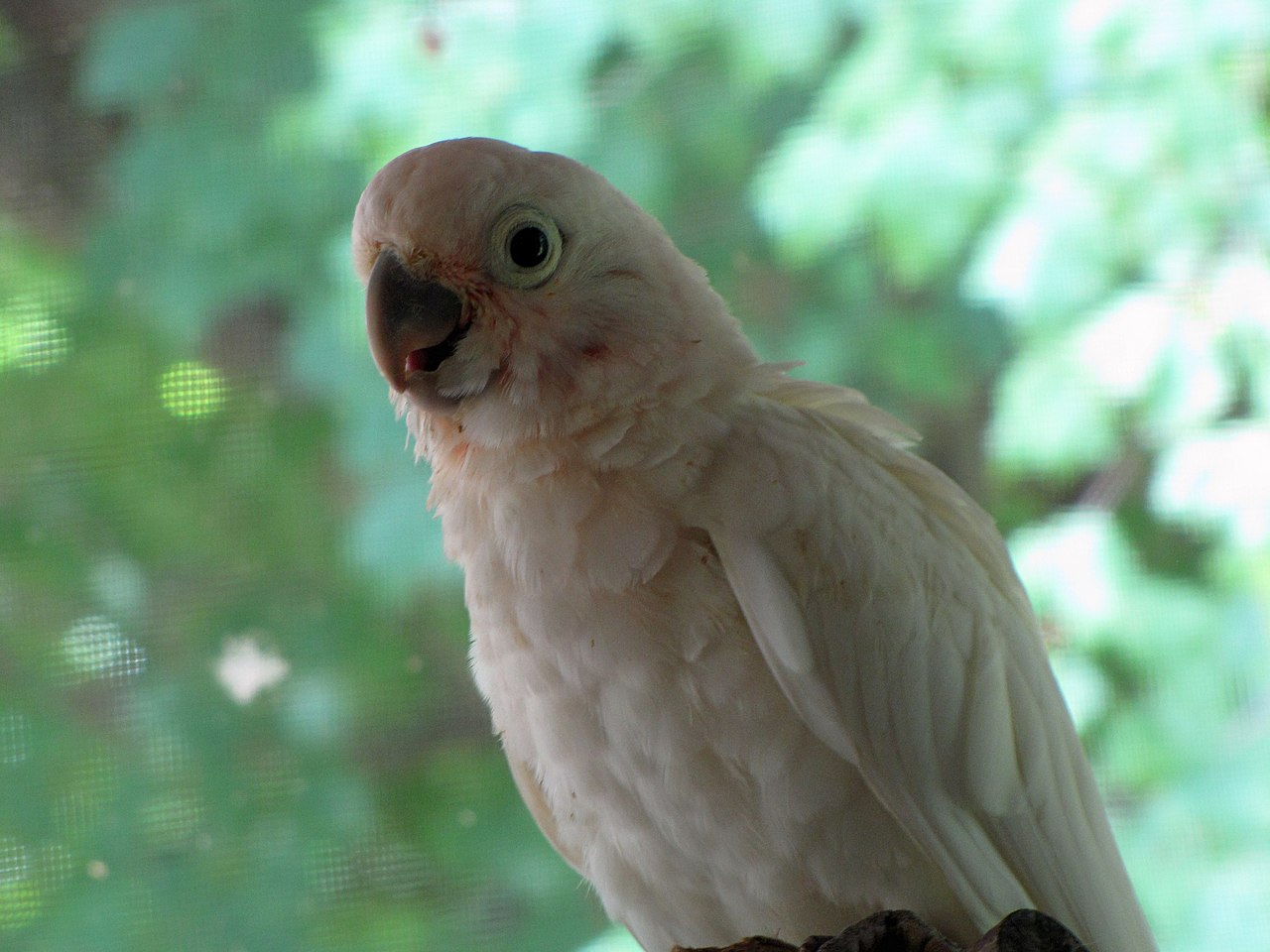
A pet juvenile

In an aviary

Pet flying in a harness
Temperament
social and active
Flight Pattern
strong flier with rapid wingbeats
Social Behavior
Typically found in pairs or small flocks, sometimes gathering in larger groups at feeding sites or communal roosts. A cavity nester, it breeds in tree hollows; both parents share incubation and chick rearing. Courtship involves mutual preening and display of the short crest.
Migratory Pattern
Resident
Song Description
Vocalizations are loud, nasal screeches and raspy calls typical of cockatoos, used to maintain contact in flight and at roosts. At close range they also emit softer chatter and whistles, with a varied repertoire in captive birds.
Plumage
Mostly white with a faint salmon-peach suffusion around the face and at the base of the bill; underwings and undertail show a subtle peach tint. Feathers are smooth and compact; crest is short and rounded.
Diet
Feeds on seeds, nuts, fruits, and berries, including figs and cultivated crops such as maize and papaya. It also takes flower buds and occasionally insect larvae, especially when provisioning chicks. Known for dexterous manipulation of food with the feet and bill.
Preferred Environment
Forages in the canopy and mid-story of forest, at woodland edges, and in agricultural mosaics. Frequently visits plantations, gardens, and coconut groves, and may descend to the ground to pick fallen fruits and seeds.


