
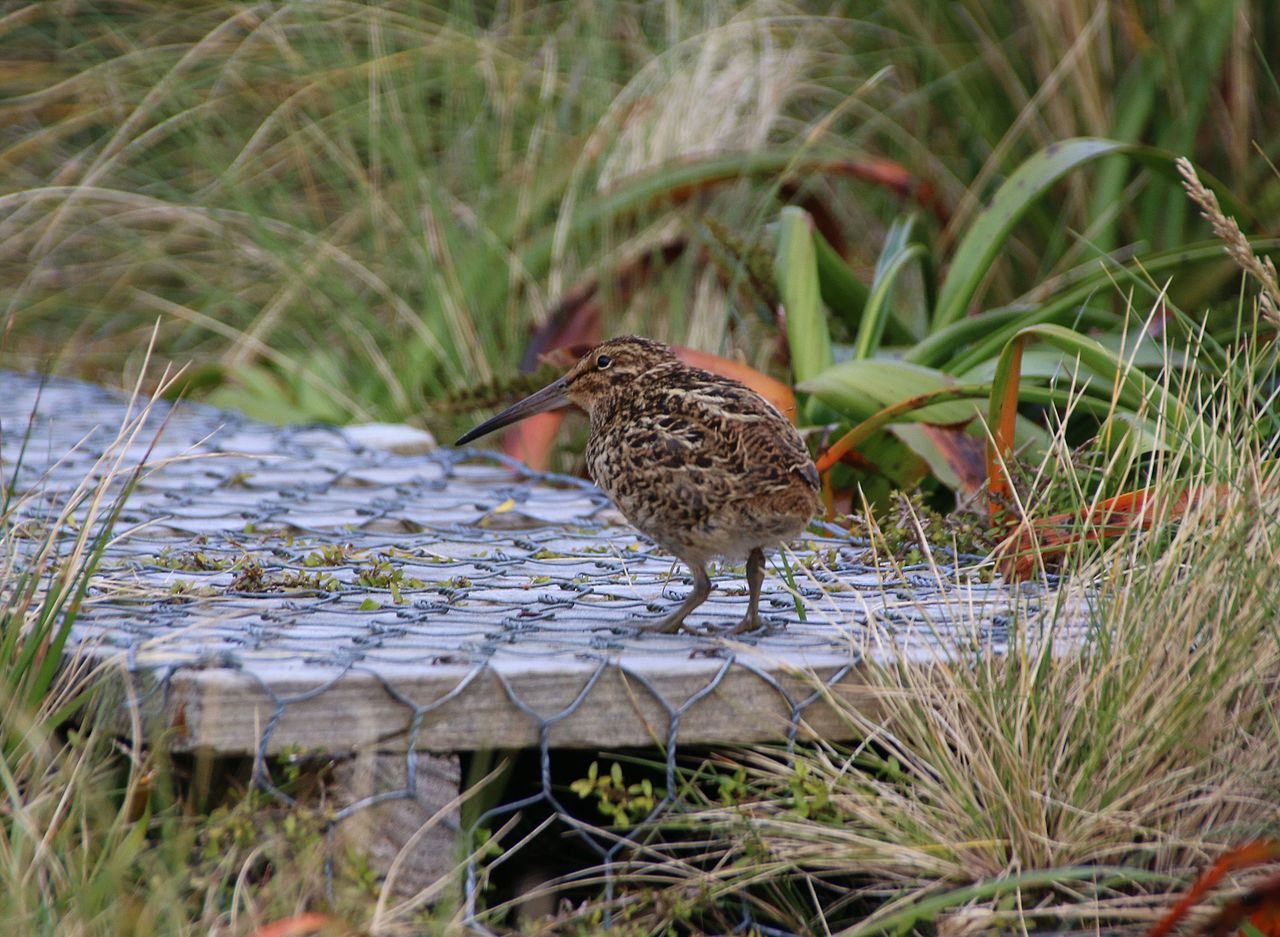
The Subantarctic snipe is a species of snipe endemic to New Zealand's subantarctic islands. The Maori call it "Tutukiwi". The nominate race C. a. aucklandica is found on the Auckland Islands. Other subspecies include C. a. meinertzhagenae from the Antipodes Islands, and C. a. perseverance from Campbell Island / Motu Ihupuku. The former subspecies from the Snares Islands has been separated as a full species, the Snares snipe, as have the extinct South Island and North Island snipes.
Region
New Zealand Subantarctic Islands
Typical Environment
Occurs on remote, treeless islands south of New Zealand, especially the Auckland, Antipodes, and Campbell Islands. It inhabits dense tussock grasslands, coastal herbfields, megaherb communities, and low shrublands with soft soils. Bogs, seepages, and peaty ground are preferred feeding areas where probing is easy. Birds range from coastal slopes to upland plateaus wherever cover is available. They avoid exposed rocky shorelines but may feed along sheltered stream margins and damp clearings.
Altitude Range
Sea level to 600 m
Climate Zone
Polar
Ease of Keeping
Beginner friendly: 1/5
Known to Māori as tutukiwi, this island snipe performs a remarkable nocturnal aerial display called the hakawai, producing eerie roaring sounds with its tail feathers. It survives on predator-free subantarctic islands after related mainland snipes went extinct following mammalian introductions. Several subspecies occur on separate island groups, including the Auckland, Antipodes, and Campbell Islands. Its superb camouflage and crepuscular habits make it rarely seen despite being locally common.


Temperament
secretive and wary
Flight Pattern
short rapid wingbeats with zig-zag flush flight
Social Behavior
Generally monogamous and territorial during breeding, nesting on the ground in dense tussock or herbfields. Clutches are small and chicks are precocial, leaving the nest soon after hatching. Males perform dramatic nocturnal display flights and defend small territories. Outside breeding, birds may forage singly or in pairs but remain dispersed.
Migratory Pattern
Resident
Song Description
Usually quiet, giving soft chips and contact notes from cover. During nocturnal display flights, males produce the famous roaring and drumming 'hakawai' sound generated by air rushing through modified tail feathers, accompanied by thin whistles.
Plumage
Finely mottled and barred brown with buff and black patterning that provides excellent camouflage; head shows distinct striping and the underparts are barred.
Diet
Feeds mainly on soil and leaf-litter invertebrates such as amphipods, beetles, flies, larvae, worms, and spiders. It probes soft peat and damp ground with its long bill, using sensitive bill tips to detect prey. Occasional small seeds or plant material may be ingested incidentally. Foraging is typically slow and methodical under dense cover to reduce exposure.
Preferred Environment
Damp tussock clearings, bogs, seepages, and the edges of streams where probing is easiest. Frequently uses dense vegetation and megaherbs for concealment while feeding. On predator-free islands it may also forage in more open patches near cover.


