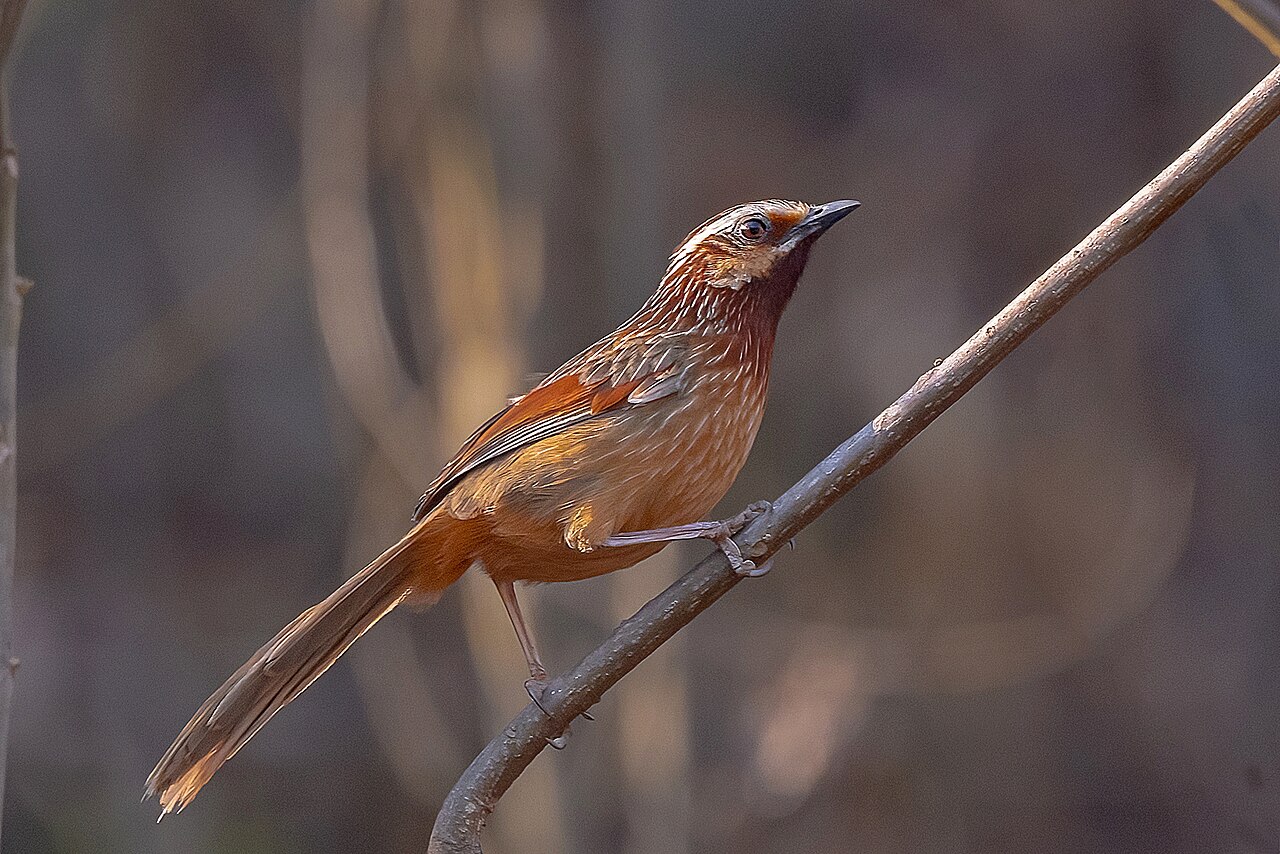
The striped flufftail is a species of bird in the flufftail family Sarothruridae. It is also known as the red-tailed flufftail. The species is closely related to the Madagascar flufftail. The species has a disjunct distribution across the Afromontane of southeastern Africa, with two subspecies. The nominate subspecies S. a. affinis is found in eastern South Africa and Eswatini. S. a. antonii, named for German ornithologist Anton Reichenow, is found in eastern Zimbabwe and Mozambique, Malawi, southern Tanzania, Kenya and the south of South Sudan.
Region
Afromontane Eastern and Southern Africa
Typical Environment
This species has a disjunct Afromontane distribution. The nominate S. a. affinis occurs in eastern South Africa and Eswatini, largely along the Drakensberg and adjacent highlands. The northern subspecies S. a. antonii ranges through eastern Zimbabwe and Mozambique to Malawi, southern Tanzania, Kenya, and into the southern parts of South Sudan. It occupies dense, moist montane grasslands, bracken and heath, sedge-filled seeps, and marshy edges near forest. It favors tall tussock grasses and often uses recently burned areas as they regenerate.
Altitude Range
800–3200 m
Climate Zone
Highland
Ease of Keeping
Beginner friendly: 1/5
The striped flufftail is an exceptionally secretive rail-like bird that spends most of its time creeping through dense, wet montane grass. It often becomes more detectable after grassland fires, when it vocalizes and forages in fresh regrowth. Birders typically locate it by its distinctive accelerating ticking calls rather than by sight. Habitat loss through inappropriate burning regimes, drainage, and afforestation poses ongoing threats.

Temperament
secretive and skulking
Flight Pattern
short rapid wingbeats, reluctant low flights
Social Behavior
Usually solitary or in pairs, keeping to dense cover. Ground-nesting in concealed cups among tussocks or sedges. Pairs likely monogamous for the season, with breeding activity often linked to rains and post-fire regrowth. Territorial calling peaks at dawn and dusk.
Migratory Pattern
Resident
Song Description
Typical voice is a series of thin, metallic tik notes that accelerate into a trill, often given from deep cover. Duets may occur, with notes sounding ventriloquial. Calling increases after rainfall and in recently burned grasslands.
Plumage
Compact, short-tailed and rail-like with dense, barred/striped plumage suited to grassland cover. Males are sooty to blackish with fine white spotting and striping, a rufous-chestnut crown and tail; females are warm brown with bold black and buff barring. Underparts show streaking/spotting that helps it vanish into shadowed grass.
Diet
Feeds mainly on small invertebrates such as ants, termites, beetles, grasshoppers, caterpillars, spiders, and small snails. It gleans and probes among leaf litter, grass bases, and shallow muddy edges. Seeds and other plant matter are taken occasionally but form a minor part of the diet.
Preferred Environment
Forages within dense, moist montane grass, sedge beds, and bracken, especially near seeps and marshy margins. Frequently uses the protective cover and rich prey availability of fresh post-burn regrowth.