

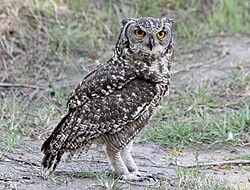
The spotted eagle-owl, also known as the African spotted eagle-owl and the African eagle-owl, is a medium-sized species of owl, one of the smallest of the eagle owls. Its length is 45 cm (18 in) and its weight is from 454 to 907 grams. It has a 100 to 140 cm wingspan. The facial disk is off-white to pale ochre and the eyes are yellow. It has prominent ear-tufts, and the upper body is dusky brown, the lower parts off-white with brown bars. Prior to 1999 the spotted eagle-owl was considered conspecific with the greyish eagle-owl, but now it is classed as a separate species.
Region
Sub-Saharan Africa
Typical Environment
Occurs widely from dry savannas and open woodlands to rocky outcrops, scrub, farmland, and urban parks and gardens. Avoids dense rainforest but tolerates semi-desert and mosaic habitats with scattered trees or cliffs. Frequently seen roosting in trees or on buildings during the day. Readily occupies areas near humans where prey is abundant.
Altitude Range
Sea level to 2500 m
Climate Zone
Subtropical
Ease of Keeping
Beginner friendly: 1/5
This adaptable owl thrives from savannas to towns and often hunts around streetlights where insects and small prey gather. Pairs are typically monogamous and perform duets of deep hoots to maintain their territory. Nests are simple scrapes on the ground, rock ledges, tree cavities, or building ledges, usually with two eggs. It has excellent camouflage by day and near-silent flight at night.


A spotted eagle-owl feeding on a rat

A spotted eagle-owl is feeding young owlets inside an owl house made from recycled plastic. Photographed at the Owl Rescue Centre in the North West Province of South Africa.


Temperament
solitary and territorial
Flight Pattern
silent flier with strong, rounded wingbeats
Social Behavior
Usually found as territorial pairs that roost close together and call in duet. Monogamous, with simple nests on the ground, ledges, or cavities, sometimes on buildings. Both parents attend the young, which leave the nest before fully flying and are fed nearby.
Migratory Pattern
Resident
Song Description
Deep, resonant hoots given in repeated sequences; pairs often duet with a rhythmic back-and-forth. Also produces hisses, growls, and clacking when alarmed or at the nest.
Plumage
Upperparts dusky brown with pale mottling; underparts off-white to pale ochre with bold brown barring. Facial disk pale with darker rim; prominent ear-tufts. Feathers dense and soft for silent flight.
Diet
Takes small mammals such as rodents, shrews, and bats; also birds, reptiles, amphibians, and large insects like beetles and moths. Hunts mainly from a perch with short sallies to capture prey on the ground or in low vegetation. Will scavenge occasionally and may take prey attracted to artificial lights. Regurgitates pellets of indigestible material.
Preferred Environment
Edges of open habitats, rocky slopes, and urban green spaces where perches overlook open ground. Frequently forages near streetlights and farmyards where prey is concentrated.


