

The spotted crake is a small waterbird of the family Rallidae. The scientific name is derived from Venetian terms for small rails.
Region
Palearctic (Europe and western Asia)
Typical Environment
Breeds across temperate Europe and western Asia in shallow freshwater marshes, fens, and wet meadows with dense emergent vegetation such as reeds and sedges. On migration and in winter it occurs in a broader range of wetlands, including rice fields, flooded grasslands, and brackish marsh edges. Winters mainly in sub-Saharan Africa, the Middle East, and the Indian subcontinent. It favors areas with shallow water and muddy margins, where it can remain concealed while foraging. Occurrence can be patchy and closely tied to water levels and habitat condition.
Altitude Range
Sea level to 1500 m
Climate Zone
Temperate
Ease of Keeping
Beginner friendly: 1/5
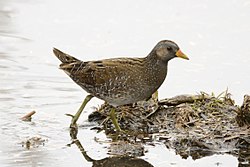
The spotted crake is a small, secretive rail that is far more often heard than seen, especially at night when its distinctive repetitive whiplash call carries across marshes. It frequently flicks its short tail, flashing white undertail coverts as it moves through dense vegetation. When flushed, it flies low with whirring wings before dropping quickly back into cover. During migration it can appear suddenly at small, temporary wetlands and coastal reedbeds.




Temperament
secretive and skulking
Flight Pattern
short rapid wingbeats; low, fluttering flight when flushed
Social Behavior
Breeds solitarily or in widely spaced pairs, each defending a territory within dense marsh vegetation. The nest is a well-concealed cup of reeds or sedges over shallow water. Clutches are relatively large, and both parents share incubation and chick care; the downy chicks are precocial and leave the nest soon after hatching.
Migratory Pattern
Seasonal migrant
Song Description
The male’s primary advertisement call is a repetitive, sharp 'hwit' or 'whip' given at intervals, most often at night. It also gives soft purrs and ticking notes from cover. Calls can travel far across wetlands and are key to detecting the species.
Plumage
Upperparts dark brown with buff and white spots and streaks; underparts bluish-grey on the breast grading to brown with bold white spots and finely barred flanks. The tail is short and often flicked, showing white undertail coverts. Feathers appear slightly glossy with fine patterning that provides excellent camouflage in reedbeds.
Diet
Feeds mainly on small aquatic and terrestrial invertebrates such as insects, spiders, snails, and worms. It also takes seeds of aquatic plants and occasionally small amphibians. Foraging is by picking from surfaces, probing soft mud, and gleaning among stems and floating vegetation. Diet composition shifts seasonally with prey availability and habitat conditions.
Preferred Environment
Edges of shallow pools, muddy margins, and among dense reeds and sedges where cover is close at hand. Will also use flooded meadows, rice paddies, and ditch margins during migration and winter.


