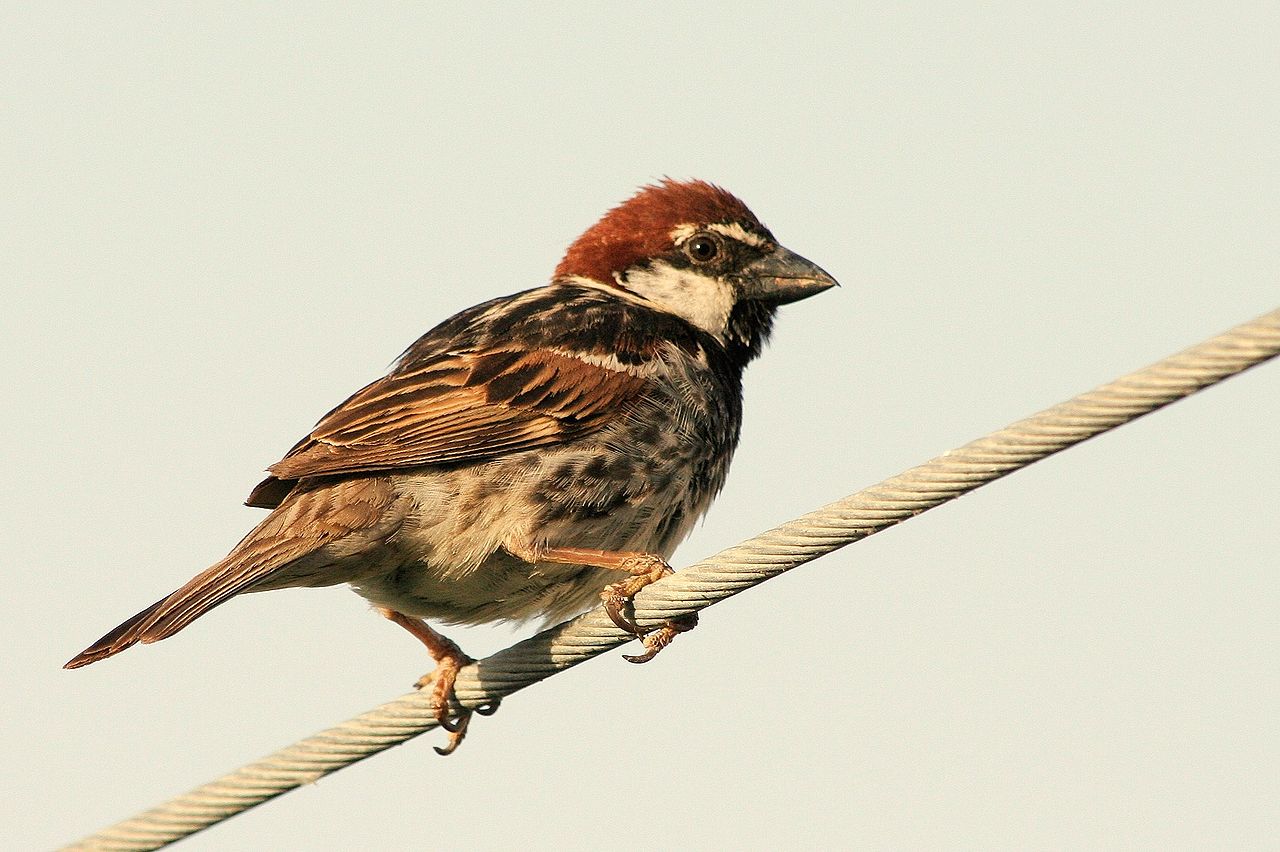
The Spanish sparrow or willow sparrow is a passerine bird of the sparrow family Passeridae. It is found in the Mediterranean region and south-west and central Asia. It is very similar to the closely related house sparrow, and the two species show their close relation in a "biological mix-up" of hybridisation in the Mediterranean region, which complicates the taxonomy of this species.
Region
Mediterranean Basin and Southwest to Central Asia
Typical Environment
Widespread around the Mediterranean, extending through North Africa, the Middle East, and into southwestern and central Asia. It favors open agricultural landscapes, orchards, steppe, and scrubby areas with access to water. Colonies are frequently established in villages and farmsteads, and in reedbeds near wetlands. It avoids dense forests and very high mountains. In winter, some populations move south or to lower elevations to exploit food-rich areas.
Altitude Range
Sea level to 2000 m
Climate Zone
Temperate
Ease of Keeping
Beginner friendly: 2/5
Also called the willow sparrow, it closely resembles the house sparrow but males show a chestnut crown and heavier underpart streaking. It often nests colonially in trees, reedbeds, or even in the bases of large raptor or stork nests. Extensive hybridisation with the house sparrow occurs in parts of the Mediterranean, contributing to taxonomic complexity (e.g., the Italian sparrow). It thrives in traditional farmlands and can form large post-breeding flocks.


Female in the Canary Islands (Note the streaked breast)


Sonogram of a male Spanish sparrow's song

An illustration by John Gould of a male Spanish sparrow (above) and an Italian sparrow pair

Distribution of the Spanish and Italian sparrows

A male in Sardinia

A male and a female of the eastern subspecies (P. h. transcaspicus) in southeastern Turkey

A male of the eastern subspecies (P. h. transcaspicus) in Israel

A nest in an acacia hedge in Es Sénia, Algeria

A male in a nest in Lesbos, Greece

Eggs
Temperament
social and active
Flight Pattern
short rapid wingbeats with strong, direct flights
Social Behavior
Highly gregarious, often forming dense nesting colonies in trees, palms, and reedbeds. Pairs are socially monogamous within seasons, with males advertising nest sites and bringing nesting material. Outside the breeding season, they gather in sizable flocks to forage and roost communally.
Migratory Pattern
Partial migrant
Song Description
A series of sharp, metallic chirps and cheeps, generally harsher and more insistent than the house sparrow. Males call persistently from exposed perches near colonies, with constant chatter at breeding sites.
Plumage
Male with chestnut crown, white cheeks, bold black bib, and heavily streaked flanks and underparts; back is coarsely streaked. Female is brown and streaked above with a paler eyebrow and duller, lightly streaked underparts. Both sexes show a stout conical bill and relatively plain wings compared to some sparrows.
Diet
Primarily seeds and grains from wild grasses and crops, supplemented by buds and small fruits. During the breeding season, adults take numerous insects and other invertebrates to feed growing chicks. They opportunistically glean spilt grain and forage around barns and threshing areas.
Preferred Environment
Open farmland, cereal fields, orchards, and edges of villages, as well as reedbeds near water. Often feeds on the ground or low vegetation, exploiting human-modified landscapes.