

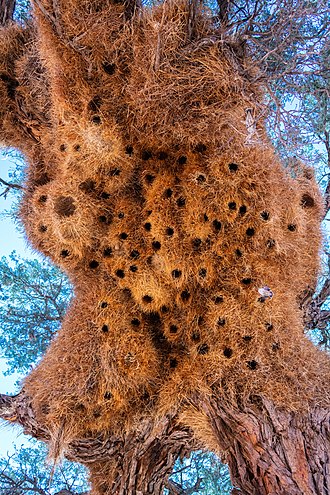
The sociable weaver is a species of bird in the weaver family, endemic to Southern Africa. It is the only species in its genus Philetairus. It is found in South Africa, Namibia, and Botswana, but its range is centered within the Northern Cape Province of South Africa. The species builds large, compound, community nests, a rarity among birds. These nests are perhaps the most spectacular structure built by any bird.
Region
Southern Africa
Typical Environment
Occurs in arid and semi-arid savannas of the Kalahari region of South Africa, Namibia, and Botswana, centered on the Northern Cape. Prefers open thornveld and dry grasslands where large camel thorn (Vachellia erioloba) and other sturdy trees or utility poles can support communal nests. Colonies are typically established near reliable food and water sources but can persist far from water in suitable habitat. Nests are used throughout the year as roosts and breeding sites.
Altitude Range
0–1600 m
Climate Zone
Arid
Ease of Keeping
Beginner friendly: 1/5
Sociable weavers build enormous communal nests that can house hundreds of birds and persist for decades, with multiple generations maintaining them. The nests provide year‑round insulation from extreme Kalahari heat and cold. Other species, such as pygmy falcons and various owls, often co-occupy the chambers. Colonies exhibit cooperative breeding, with helpers assisting in raising young.


An adult and juvenile in the Kgalagadi Transfrontier Park



Temperament
highly social and colony-dwelling
Flight Pattern
short rapid wingbeats
Social Behavior
Lives in large colonies that cooperate in nest building and maintenance. Many groups show cooperative breeding, with non-breeding helpers assisting at nests. Communal nests contain many chambers used for roosting and breeding and are defended collectively.
Migratory Pattern
Resident
Song Description
Soft, buzzing trills and chirps given frequently as contact calls within colonies. Males deliver slightly more elaborate trills near nest entrances during display and pair bonding.
Plumage
Overall buffy-brown with a finely barred back and a scaly, chevron-patterned breast. Distinctive black throat bib and facial mask contrast with pale cheeks and underparts. Wings and tail are darker with pale edging.
Diet
Consumes a mix of seeds and insects, shifting more to insects such as termites, ants, and larvae during the breeding season. Forages mostly on the ground and low vegetation, gleaning seeds of grasses and forbs. Opportunistic feeding around rainfall events when insect abundance rises.
Preferred Environment
Feeds in open savanna, thornveld, and dry grassland near colony trees or poles. Often forages in loose groups radiating from the communal nest, returning frequently to rest and preen.


