
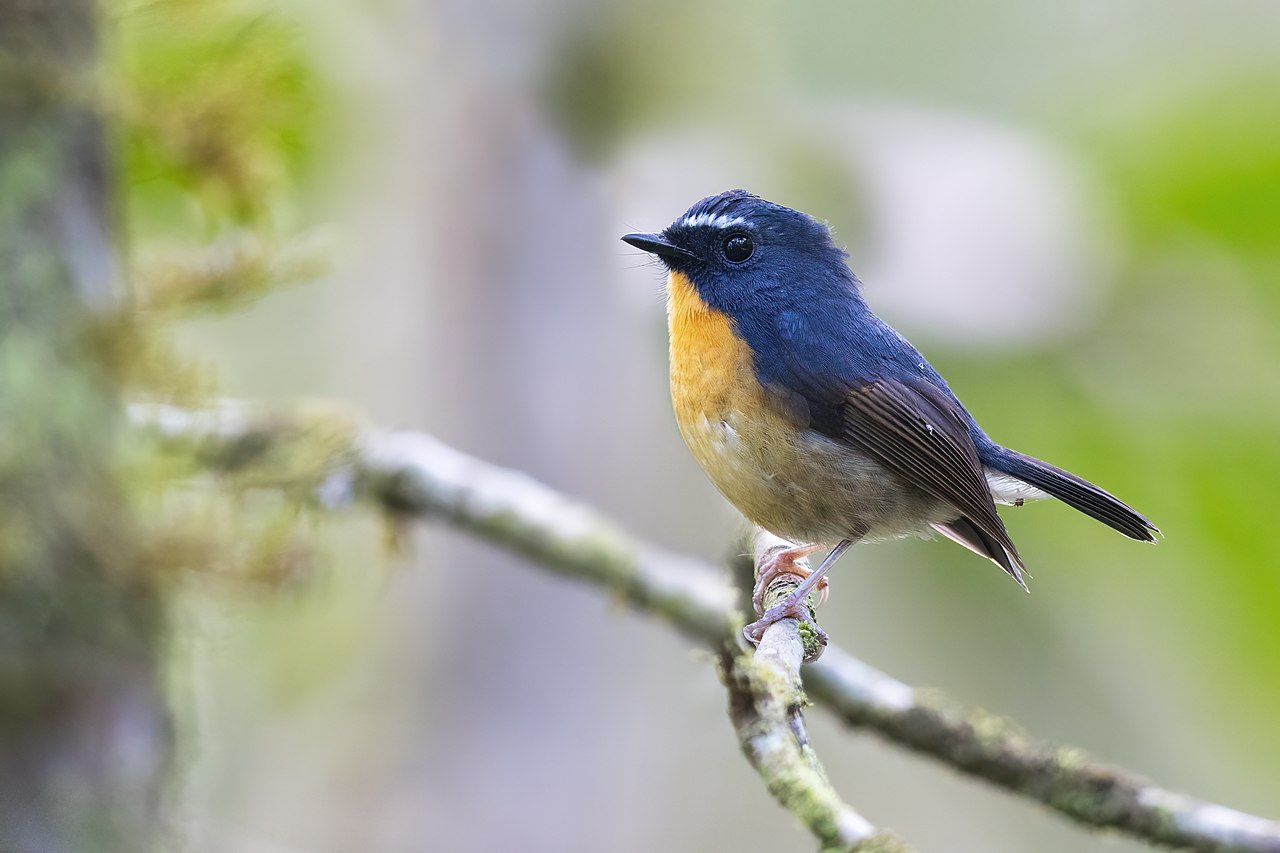
The snowy-browed flycatcher is a species of bird in the Old World flycatcher family Muscicapidae.
Region
South and Southeast Asia
Typical Environment
Found from the Himalayan foothills and Northeast India through Myanmar and southern China to Thailand, Laos, Vietnam, and the Malay Peninsula, and on Sumatra, Borneo, and Java. It prefers subtropical to tropical moist montane forests with dense understory. Birds often keep to shaded ravines, bamboo thickets, and mossy forest edges. Occurs in both primary and mature secondary forest, especially near streams.
Altitude Range
600–2700 m
Climate Zone
Highland
Ease of Keeping
Beginner friendly: 1/5
A small montane flycatcher, the male shows a crisp white brow above dark blue upperparts and a rich rufous-orange breast. Females are drabber brown with a pale eyebrow and warm buffy underparts. It frequents shaded understory and stream gullies in mossy forests and often makes brief sallies to snatch insects. The species performs local altitudinal movements, descending slightly in cooler seasons.

Temperament
solitary and territorial
Flight Pattern
short rapid wingbeats with quick sallies from low perches
Social Behavior
Usually seen alone or in pairs in the breeding season, holding small territories in dense understory. Nests are cup-shaped, often tucked into mossy banks, root tangles, or crevices on shaded slopes. Typical clutches are small, and both parents attend the young. Outside breeding, it may join mixed-species flocks loosely while foraging.
Migratory Pattern
Partial migrant
Song Description
Song is a series of thin, sweet, high-pitched whistles delivered from a low, shaded perch. Calls include soft ticks and short, sibilant notes that can be hard to locate in dense vegetation.
Plumage
Male with dark blue upperparts, bright rufous-orange throat and breast, and a bold white supercilium; female brown-olive above with buffy underparts and a pale eyebrow. Both sexes have relatively plain wings and a neat, compact appearance.
Diet
Primarily takes small insects such as flies, beetles, ants, and caterpillars, as well as spiders and other arthropods. Forages by sallying from low perches, hovering briefly to glean from leaves, and occasionally picking prey from the ground. May take small berries opportunistically, especially outside the breeding season.
Preferred Environment
Feeds in the shaded understory of montane evergreen and mossy forests, along stream edges, and in bamboo or fern thickets. Often chooses perches 1–3 meters above ground with good vantage for short sallies.


