

The snow bunting is a passerine bird in the family Calcariidae. It is an Arctic specialist, with a circumpolar Arctic breeding range throughout the northern hemisphere. There are small isolated populations on a few high mountain tops south of the Arctic region, including the Cairngorms in central Scotland and the Saint Elias Mountains on the southern Alaska-Yukon border, as well as the Cape Breton Highlands. The snow bunting is the most northerly recorded passerine in the world.
Region
Circumpolar Arctic
Typical Environment
Breeds across the high Arctic of North America, Greenland, Iceland, Svalbard, northern Scandinavia, and Siberia. Winters south into northern temperate zones of Eurasia and North America, frequenting coasts, fields, and open country. Small, isolated resident or breeding populations occur on high mountain tops south of the Arctic, including the Cairngorms, Saint Elias Mountains, and Cape Breton Highlands. Prefers open, treeless terrain with sparse vegetation, rocky outcrops, and snow-free patches for feeding.
Altitude Range
Sea level to 2500 m
Climate Zone
Polar
Ease of Keeping
Beginner friendly: 1/5
An Arctic specialist, the snow bunting breeds farther north than any other passerine. Males often arrive on breeding grounds weeks before snow melts and sing from exposed rocks. They have feathered tarsi that help insulate against extreme cold. Small alpine populations persist far south of the Arctic in places like Scotland’s Cairngorms and Alaska–Yukon’s Saint Elias Mountains.


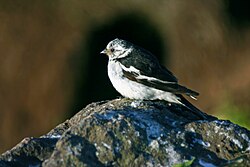
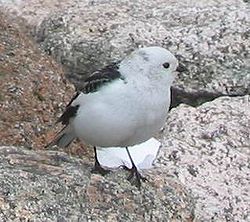
A female snow bunting wintering atop Mount Agamenticus in York, ME.

Snow bunting young using a building as protection

The same chicks eight days later




Temperament
social and active
Flight Pattern
strong, bounding flight
Social Behavior
Forms loose to large flocks in winter, often mixing with other seed-eating birds. On breeding grounds, pairs are territorial and nest in rock crevices or cavities lined with fine grasses, hair, and feathers. Males arrive early and sing to advertise territories; both parents feed the young.
Migratory Pattern
Seasonal migrant
Song Description
A clear, tinkling series of sweet, bell-like notes and trills, delivered from perches or in short song flights. Calls include soft buzzes and a sharp, metallic chew or tew, often given in flight.
Plumage
Breeding males are strikingly white with black on the back and wing tips; females and nonbreeding birds are more buffy-brown and streaked above with bold white wing panels. Winter plumage shows warmer buff tones on the head and upperparts. In all plumages, extensive white in the wings and tail is conspicuous in flight.
Diet
Eats mainly seeds of grasses, sedges, and weedy plants outside the breeding season. During spring and summer, switches to insects and other invertebrates, especially for nestlings. Also takes spilled grain and forages along coastal wrack lines for arthropods when available.
Preferred Environment
Forages on the ground in open tundra, windswept ridges, coastal margins, stubble fields, and roadsides. Seeks out snow-free patches and disturbed areas where seeds and insects are concentrated.


