

The snow goose is a species of goose native to North America. Both white and dark morphs exist, the latter often known as blue goose. Its name derives from the typically white plumage. The species was previously placed in the genus Chen, but is now typically included in the "gray goose" genus Anser.
Region
North America
Typical Environment
Breeds across the high Arctic of Canada, Alaska, and Greenland on coastal tundra and low-lying wet meadows. During migration and winter, it spreads across the central and eastern United States, the Gulf Coast, and northern Mexico. Wintering flocks use coastal marshes, inland wetlands, estuaries, and agricultural fields. It is also recorded along the Pacific and Atlantic flyways at major stopover refuges. Small introduced or vagrant populations occur occasionally outside its core range.
Altitude Range
Sea level to 1500 m
Climate Zone
Polar
Ease of Keeping
Beginner friendly: 2/5
Snow geese occur in two color morphs: the common white morph and the darker “blue goose” morph with a white head. They migrate in large, noisy V-formations between Arctic breeding grounds and temperate wintering areas. Their grubbing for roots and rhizomes can heavily alter tundra vegetation, which has led to population management in some regions.


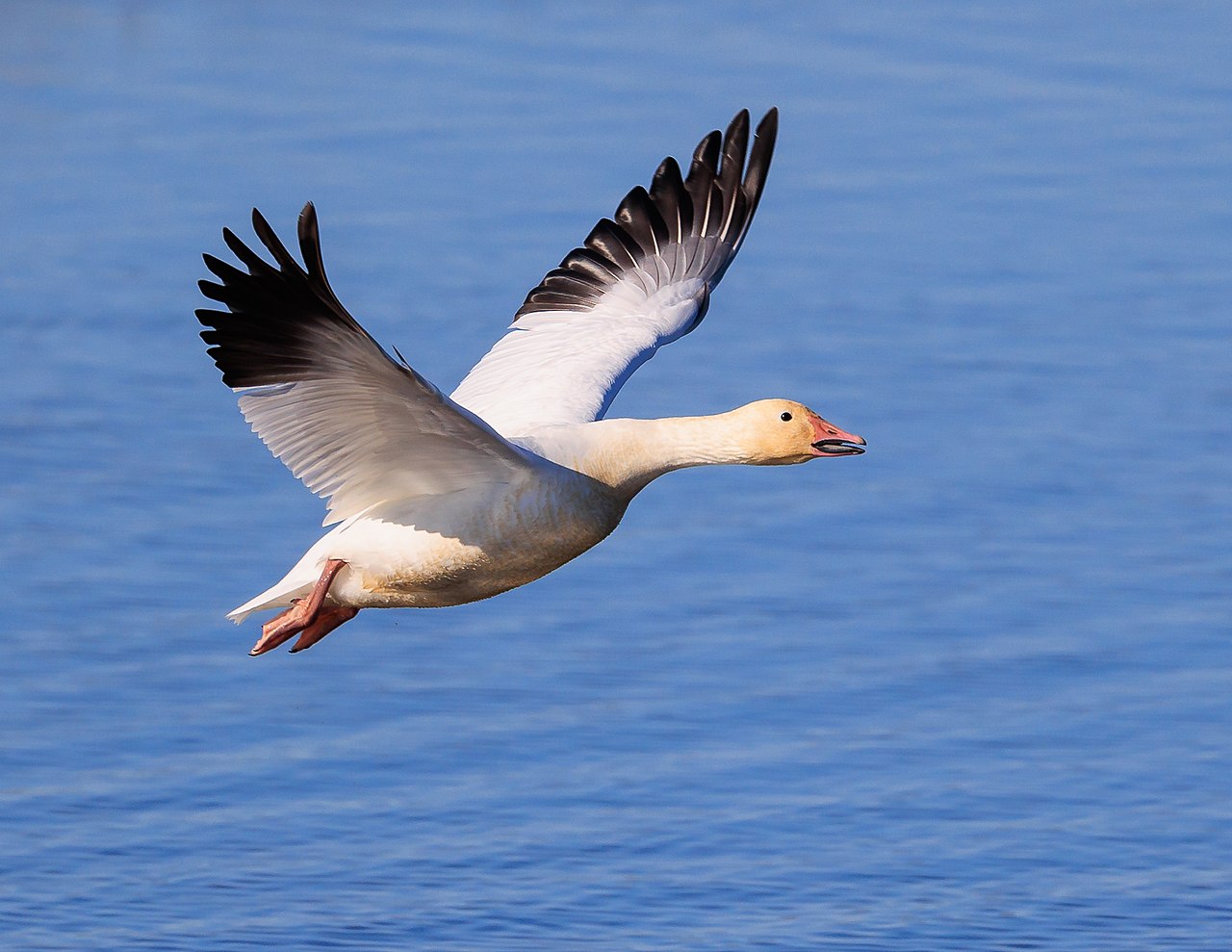
Snow goose at the Gray Lodge Wildlife Area in Northern California




Temperament
social and wary
Flight Pattern
strong flier with steady wingbeats; often in V-formations
Social Behavior
Highly gregarious outside the breeding season, forming very large flocks. Pairs are largely monogamous and may remain together for years, nesting in colonies on the tundra. Both parents guard the nest and lead goslings to feeding areas soon after hatching.
Migratory Pattern
Seasonal migrant
Song Description
Loud, nasal honks and yelps that carry over long distances, often given in chorus during flight. Calls are higher-pitched and more yapping than many other geese and are used to maintain flock cohesion.
Plumage
White morph is largely white with contrasting black primaries; blue morph has slate-gray to bluish body with a white head and upper neck. Juveniles are gray-brown and gradually molt to adult tones. Feathers are dense and insulating, suited to cold, with a neat, sleek appearance.
Diet
Primarily consumes grasses, sedges, rushes, and other marsh plants, along with roots, rhizomes, and bulbs obtained by grubbing. In agricultural areas it readily takes waste grain and new shoots. During migration and winter it often feeds intensively in fields, sometimes clipping vegetation close to the ground. On breeding grounds, it grazes tender tundra plants and digs for subterranean parts.
Preferred Environment
Feeds in shallow wetlands, tidal marsh edges, mudflats, and adjacent grassy fields. Agricultural landscapes such as rice, corn, and wheat stubble are heavily used in winter. In the Arctic it forages on low tundra near ponds and coastal flats.


