
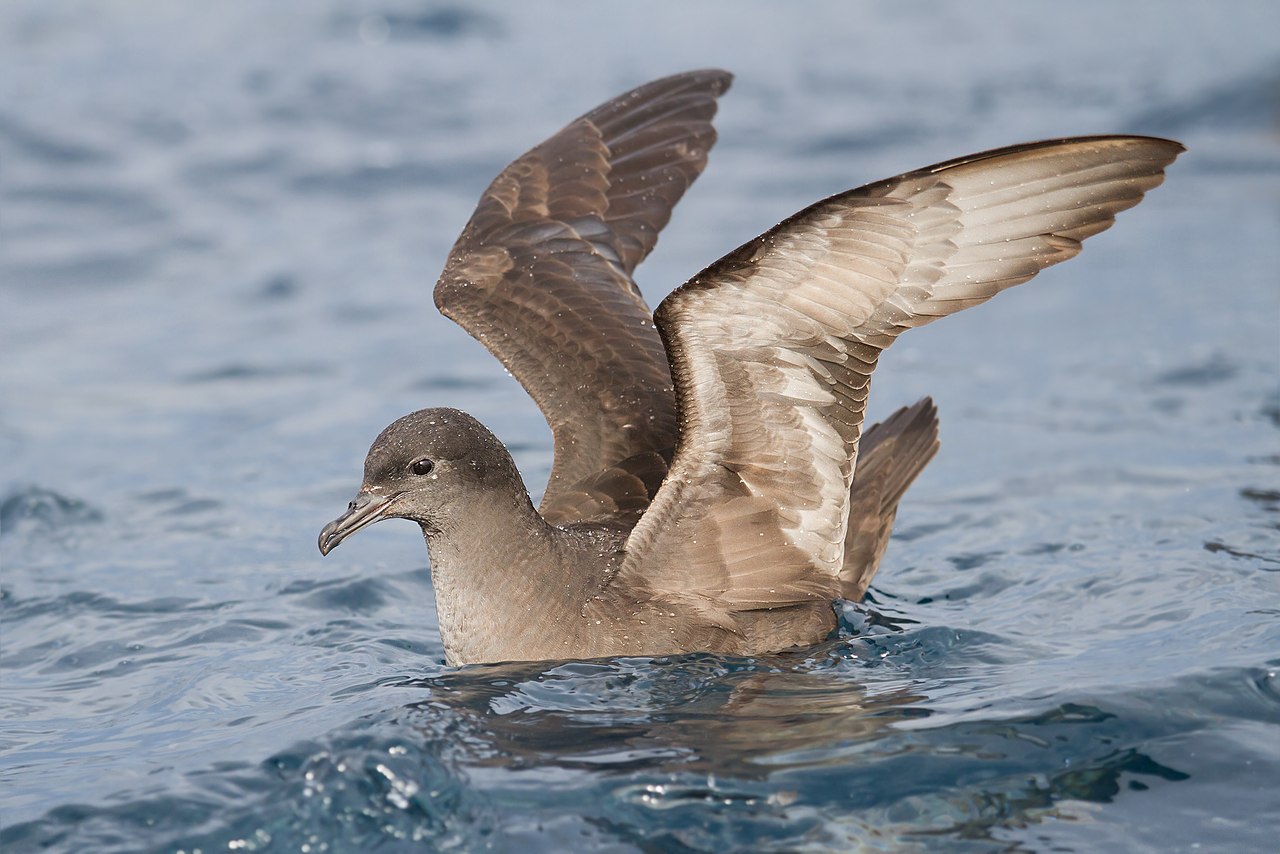
The short-tailed shearwater or slender-billed shearwater, also called yolla or moonbird, and commonly known as the muttonbird in New Zealand, is the most abundant seabird species in Australian waters, and is one of the few Australian native birds in which the chicks are commercially harvested. It is a migratory species that breeds mainly on small islands in Bass Strait and Tasmania and migrates to the Northern Hemisphere for the boreal summer.
Region
Australasia and North Pacific
Typical Environment
Breeds on offshore islands around Tasmania and in the Bass Strait, where it nests in burrows in coastal heath and tussock grassland. Outside the breeding season it ranges widely across the North Pacific, including the Bering Sea and waters off Japan, Alaska, and the Aleutians. At sea it is highly pelagic, concentrating over productive shelf edges and upwelling zones. During migration it follows coastal and offshore routes along eastern Asia and the western Pacific.
Altitude Range
Sea level to 100 m
Climate Zone
Temperate
Ease of Keeping
Beginner friendly: 1/5
Also known as the yolla or moonbird and commonly called muttonbird, it is the most abundant seabird in Australian waters. It breeds in vast colonies in Tasmania and the Bass Strait and undertakes a remarkable trans-equatorial migration to the North Pacific. Chicks have historically been harvested by Indigenous and commercial muttonbirders under regulated systems. These birds are long-lived for their size and show strong natal and site fidelity to their burrows.


Adult near Burrow on Bruny Island. The photograph was taken at night.

Fledgling, Austins Ferry, Tasmania, Australia
Temperament
social and active
Flight Pattern
short rapid wingbeats interspersed with long arcing glides close to the wave-tops
Social Behavior
A highly colonial burrow-nester, returning to the same sites and often the same burrows each year. Pairs form long-term bonds, share incubation, and feed the chick with rich stomach oil. Adults are mostly nocturnal around colonies, arriving after dusk to avoid predators.
Migratory Pattern
Seasonal migrant
Song Description
At colonies it gives eerie moans, coos, and wails, mostly at night. Calls are subdued or absent while at sea, where the species is generally silent.
Plumage
Mostly uniform sooty-brown with slightly paler undersides and a subtle pale panel on the underwing. Feathers appear smooth and sleek, adapted for marine conditions. Tail is short and wedge-shaped.
Diet
Feeds primarily on krill, especially Nyctiphanes australis, along with small fish and squid. It often forages in large flocks over productive waters and may follow predatory fish or fishing vessels. Captures prey by surface seizing and pursuit diving, commonly reaching depths of 10–20 m and occasionally deeper.
Preferred Environment
Pelagic waters over continental shelves, shelf breaks, and upwelling zones. Frequently forages in cold, nutrient-rich areas such as the Bering Sea during the boreal summer.


