

The short-toed treecreeper is a small passerine bird found in woodlands through much of the warmer regions of Europe and into north Africa. It has a generally more southerly distribution than the other European treecreeper species, the common treecreeper, with which it is easily confused where they both occur. The short-toed treecreeper tends to prefer deciduous trees and lower altitudes than its relative in these overlap areas. Although mainly sedentary, vagrants have occurred outside the breeding range.
Region
Western Palearctic
Typical Environment
Occurs across much of the warmer parts of Europe and into North Africa, with a generally more southerly and lowland distribution than the Common Treecreeper. It favors mature deciduous and mixed broadleaf woodlands, including oak, chestnut, and cork-oak stands, as well as parks, orchards, and hedgerow landscapes. In parts of Iberia and the Mediterranean it may also use open pine or mixed woodlands. Prefers well-spaced trees with abundant flaky bark and deadwood. Typically avoids dense, dark conifer plantations.
Altitude Range
Sea level to 1800 m
Climate Zone
Temperate
Ease of Keeping
Beginner friendly: 1/5
A specialist bark-gleaner, it creeps up tree trunks using stiff tail feathers for support and a slender, decurved bill to pick insects from crevices. It is notoriously difficult to distinguish from the Common Treecreeper; voice, wing pattern, and slightly longer bill help. Its song is a clearer, more melodious cascade than its northern cousin. Most populations are sedentary, though wanderers occur outside the breeding range.


Certhia brachydactyla dorotheae, Cyprus

Cork oak is a preferred nesting tree in Spain.

Eggs of Certhia brachydactyla MHNT
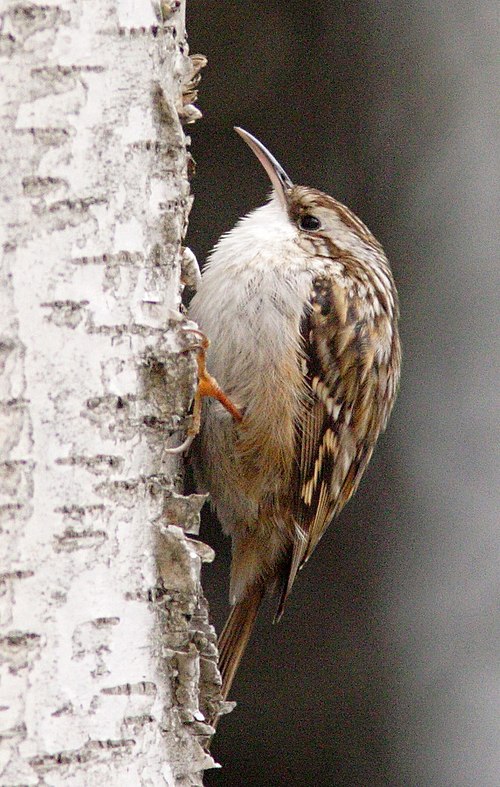
Adult foraging on a trunk
Temperament
solitary and secretive
Flight Pattern
short undulating flights between trees; climbs upward in spirals on trunks
Social Behavior
Usually seen singly or in pairs, sometimes joining mixed-species flocks in winter. Nests behind loose bark or in crevices, constructing a cup of twigs, bark strips, and feathers. Pairs defend small territories during breeding and may raise two broods in good years.
Migratory Pattern
Resident
Song Description
A sweet, fluty, and cascading series of clear notes, often descending and more melodious than the Common Treecreeper’s song. Calls include thin, high tseee or seee notes given while foraging.
Plumage
Mottled brown upperparts with fine pale streaks and speckling; clean whitish underparts with a buff wash on flanks; stiff, pointed tail feathers used as a prop against bark.
Diet
Feeds mainly on small arthropods such as beetles, ants, caterpillars, and spiders gleaned from bark fissures. Uses its fine curved bill to probe under flakes of bark and into cracks. In winter it may take small seeds or other plant material when insects are scarce.
Preferred Environment
Forages almost exclusively on the trunks and main branches of mature trees, working from the base upward before flying to the next tree. Prefers trees with rough, flaky bark and abundant deadwood where prey is concentrated.


