

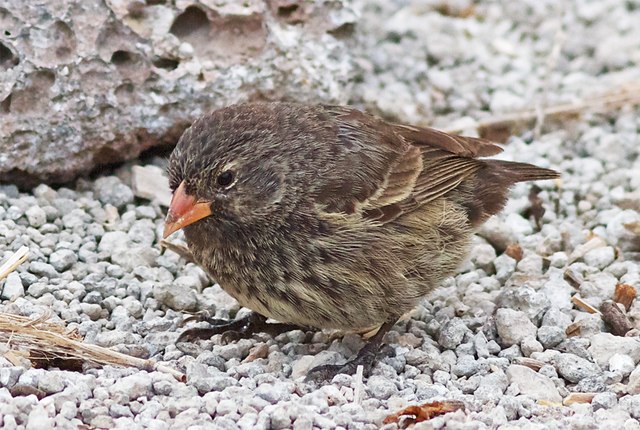
The sharp-beaked ground finch is a species of bird in the Darwin's finch group of the tanager family Thraupidae. It is classified as a least-concern species by the International Union for Conservation of Nature and it is native to the Galápagos Islands in Ecuador. It has a mass of around 20 grams (0.71 oz) and the males have black plumage, while females have streaked brown plumage. This finch was described by Richard Bowdler Sharpe in 1888.
Region
Galápagos Archipelago
Typical Environment
Occurs across several islands of the Galápagos, most common in arid and shrub-dominated zones with cacti and scattered bushes. It uses coastal areas, lava fields with sparse vegetation, and lower to mid-elevation scrub, occasionally reaching more humid uplands. On some northern islands it frequents seabird colonies where it exploits unusual food sources. Habitat use shifts seasonally with food availability, especially during El Niño events. It tolerates disturbed areas near settlements but remains largely tied to native vegetation.
Altitude Range
Sea level to 1500 m
Climate Zone
Tropical
Ease of Keeping
Beginner friendly: 1/5
One of Darwin's finches, the sharp-beaked ground finch shows notable dietary flexibility across islands. On the northern islands of Wolf and Darwin, some populations famously peck at seabirds to drink blood, a rare behavior among songbirds. Elsewhere it feeds primarily on seeds, insects, and cactus resources. Males are uniformly black while females are streaked brown, aiding identification.


Temperament
social and active
Flight Pattern
short rapid wingbeats
Social Behavior
Often forages in small groups or mixed flocks with other finches. Pairs are typically monogamous within a breeding season; males may build multiple nest frames before the female selects one. Nests are placed in shrubs or cacti and clutch size is small, with parental care by both adults.
Migratory Pattern
Resident
Song Description
Song is a thin, high-pitched series of trills and squeaks delivered from exposed perches. Calls include sharp tseep notes and soft chips used in flock contact.
Plumage
Males are uniformly sooty-black with a slight gloss; females and immatures are brown with heavy streaking on the breast and flanks and paler underparts.
Diet
Primarily eats seeds and small arthropods, switching opportunistically with seasonal availability. It takes cactus pulp, flowers, and nectar, particularly from Opuntia. On Darwin and Wolf islands, some birds peck at seabirds to drink blood and also glean ectoparasites, showcasing extreme dietary flexibility.
Preferred Environment
Forages on the ground and low vegetation in arid scrub and cactus zones, along lava flows, and in coastal areas. Around seabird colonies it feeds on detritus and interacts with nesting birds.


