

The saddle-billed stork or saddlebill is a large wading bird in the stork family, Ciconiidae. It is a widespread species which is a resident breeder in sub-Saharan Africa from Sudan, Ethiopia and Kenya south to South Africa, and in The Gambia, Senegal, Côte d'Ivoire and Chad in west Africa. It is considered endangered in South Africa.
Region
Sub-Saharan Africa
Typical Environment
Occurs widely from West Africa (Senegal and The Gambia) across Central and East Africa to southern Africa, including Ethiopia, Kenya, Tanzania, Zambia, Botswana, Mozambique, and South Africa. It favors extensive floodplains, river margins, oxbow lakes, and large freshwater marshes with open shallows. The species nests in tall trees near water and forages along muddy or grassy margins. It is scarce or absent in dense closed-canopy forests, true deserts, and heavily disturbed or overfished wetlands.
Altitude Range
0–1800 m
Climate Zone
Tropical
Ease of Keeping
Beginner friendly: 1/5
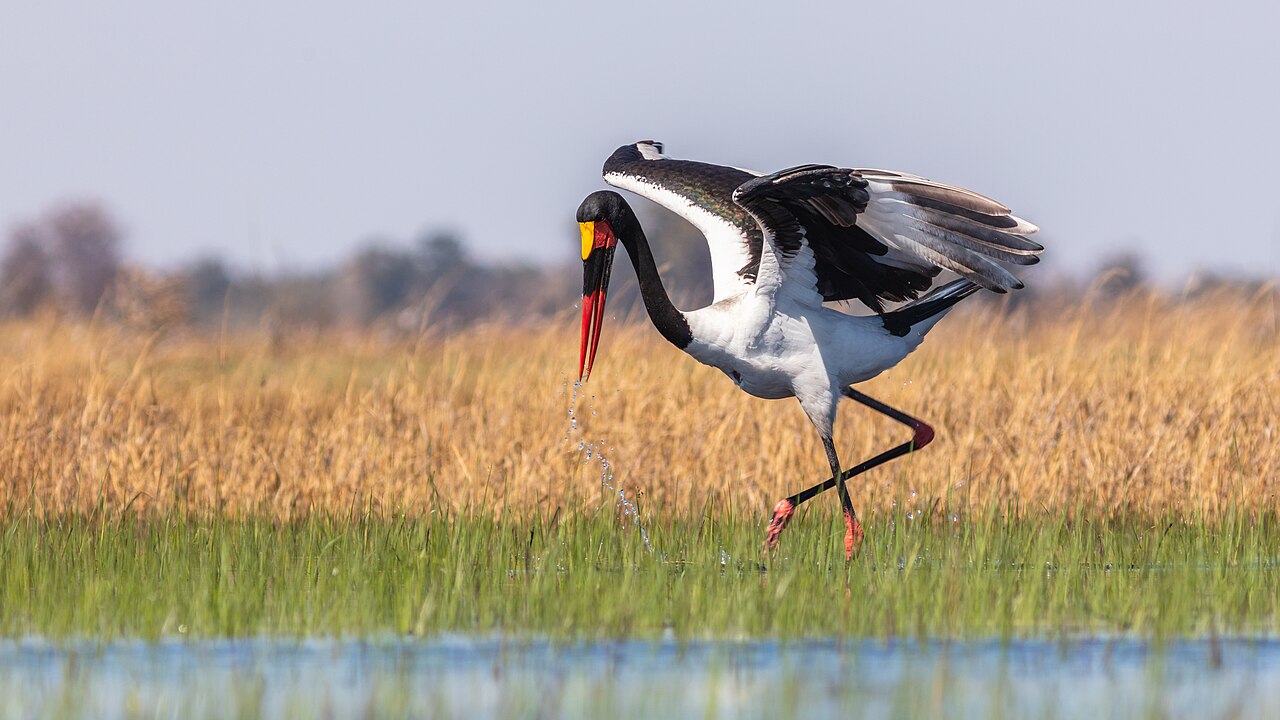
This striking stork is named for the bright yellow, saddle-shaped shield on its red-and-black bill. Males have brown eyes and small yellow wattles at the bill base, while females have yellow eyes and lack wattles. It is among Africa’s tallest birds and is typically seen solitary or in pairs patrolling large wetlands. Pairs build massive platform nests high in trees near water.


In flight

Head of male showing distinctive iris and yellow wattles, Zambia

Front view showing red patch on chest, Zambia

Temperament
solitary and territorial
Flight Pattern
soaring glider with slow, deep wingbeats
Social Behavior
Usually seen alone or in pairs, maintaining large territories around productive wetlands. Monogamous pairs build large stick platform nests high in trees near water and share incubation and chick-rearing. Chicks fledge after several weeks but may remain near parents for some time.
Migratory Pattern
Resident
Song Description
Largely silent away from the nest. At the nest it communicates with loud bill-clattering displays, accompanied by hisses and low grunts.
Plumage
Bold black-and-white pattern with glossy, iridescent black head, neck, and back contrasting with white underparts and wing panels.
Diet
Feeds mainly on fish, but also takes frogs, aquatic insects, crabs, small reptiles, and occasionally small birds or mammals. It hunts by wading slowly and striking rapidly with its powerful bill. Prey is usually swallowed whole, and larger fish are subdued and oriented head-first before swallowing.
Preferred Environment
Shallow margins of rivers, lakes, floodplains, and seasonal pans with clear sight lines. Often forages along muddy banks, exposed flats, and grassy shallows with scattered emergent vegetation.


