

The saffron finch is a tanager from South America that is common in open and semi-open areas in lowlands outside the Amazon Basin. They have a wide distribution in Colombia, northern Venezuela, western Ecuador, western Peru, eastern and southern Brazil, Bolivia, Paraguay, Uruguay, northern Argentina, and Trinidad and Tobago. It has also been introduced to Hawaii, Panama, Puerto Rico, Jamaica and elsewhere. Although commonly regarded as a canary, it is not related to the Atlantic canary. Formerly, it was placed in the Emberizidae but it is close to the seedeaters.
Region
Northern and eastern South America; introduced in parts of the Caribbean and Hawaii
Typical Environment
Native from Colombia and Venezuela south through western Ecuador and Peru, across eastern and southern Brazil, Bolivia, Paraguay, Uruguay, northern Argentina, and Trinidad and Tobago. It favors open and semi-open lowlands, including savannas, pastures, agricultural lands, and urban parks. It generally avoids dense interior rainforest such as most of the Amazon Basin. Introduced populations occur in Hawaii, Panama, Puerto Rico, Jamaica, and other localities.
Altitude Range
Sea level to 2500 m
Climate Zone
Tropical
Ease of Keeping
Beginner friendly: 4/5
Despite its name and canary-like song, the saffron finch is actually a tanager (family Thraupidae), not a true finch or domestic canary. Males are notably brighter than females, often showing an orange-tinged crown. It adapts well to human-altered landscapes and is a familiar garden bird in many parts of its range. It has been introduced to several islands, including Hawaii and parts of the Caribbean.
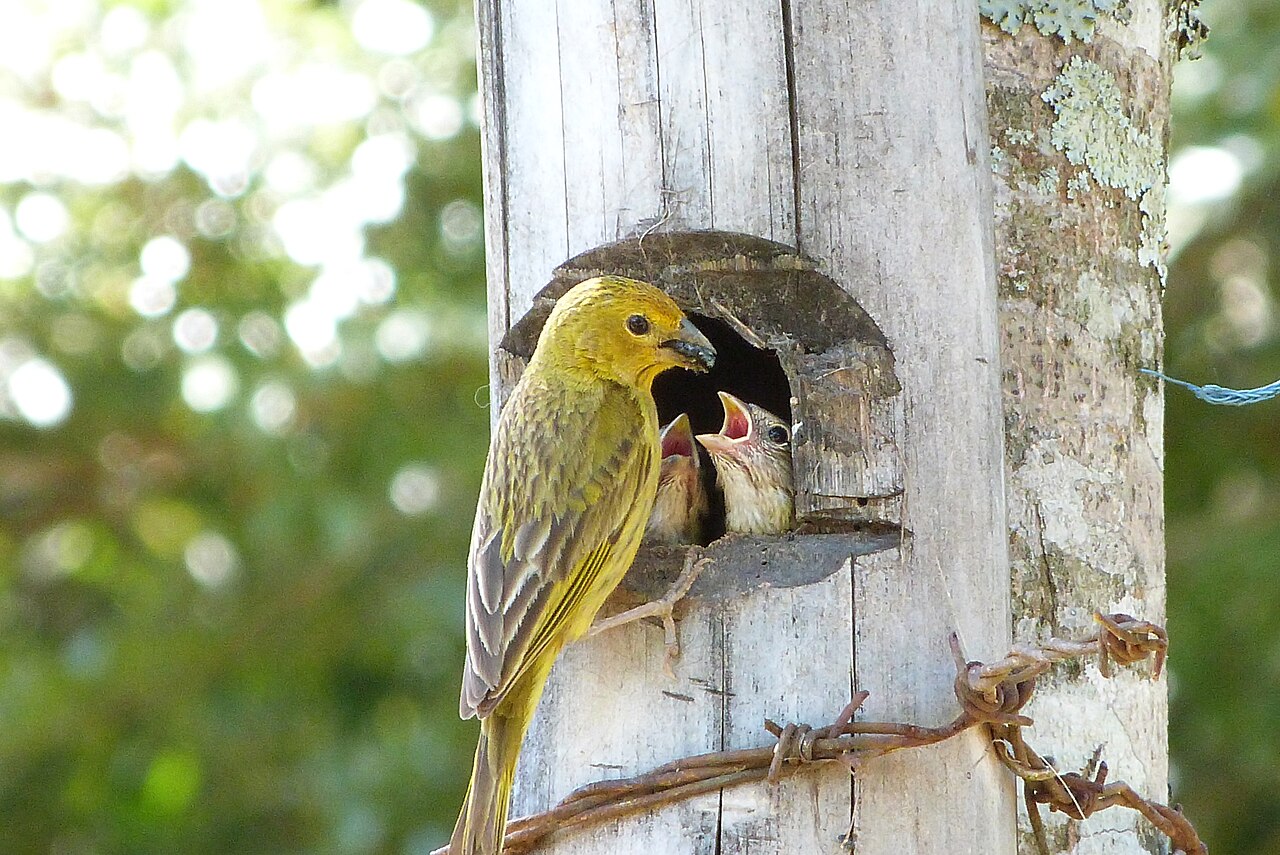


juvenile maleIn the Pantanal, Brazil

A Saffron Finch introduced to Hawaii
Temperament
social and active
Flight Pattern
short rapid wingbeats
Social Behavior
Often forms small flocks outside the breeding season and readily associates around feeding sites. Pairs nest in cavities, eaves, or shrubs, and will use nest boxes and man-made structures. Males perform display songs from exposed perches during breeding.
Migratory Pattern
Resident
Song Description
A bright, canary-like series of ringing trills and warbles delivered from prominent perches. Calls include sharp chips and twitters, often given in short bursts during social interactions.
Plumage
Males are bright saffron-yellow with an orange-tinged crown and cleaner, unmarked underparts; wings and tail slightly duller. Females are duller yellow-olive to brownish with fine streaking on the body. Plumage is smooth and sleek with minimal wing barring.
Diet
Primarily consumes grass and weed seeds, as well as cultivated grains. Also takes buds and small plant matter. Occasional insects may be eaten, especially during the breeding season to feed young. Forages mainly on or near the ground, picking seeds from plants and bare soil.
Preferred Environment
Open grassy areas, pastures, roadsides, agricultural fields, and urban lawns and gardens. Frequently visits feeders and areas with spilled grain or seed.


