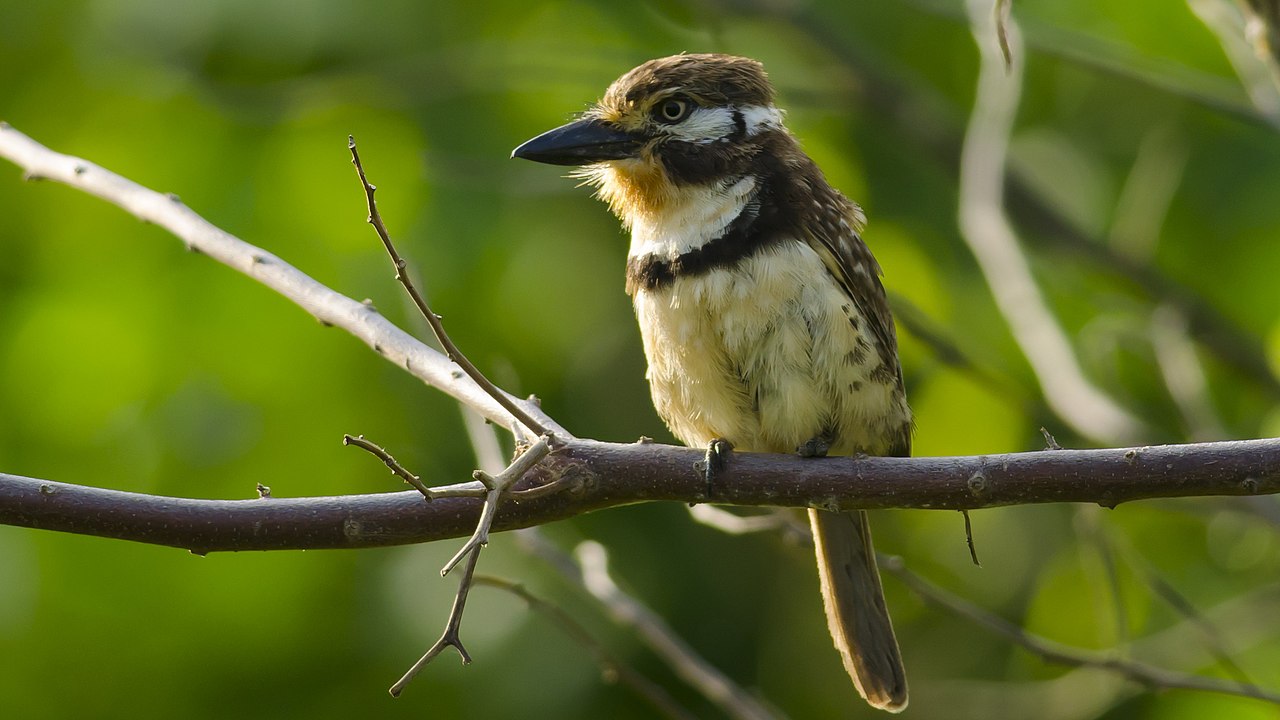
The russet-throated puffbird is a species of near-passerine bird in the family Bucconidae, the puffbirds, nunlets, and nunbirds. It is found in Colombia and Venezuela.
Region
Caribbean coast of northern South America
Typical Environment
Occurs in northern Colombia and northwestern Venezuela, especially around the Guajira Peninsula and the Maracaibo basin. It favors arid to semi-arid lowlands with thorn scrub, dry forest edges, and savanna-like pastures with scattered trees. It is also found along gallery woodlands, mangrove margins, and hedgerows near human settlements. Typically uses semi-open habitats with prominent perches for hunting.
Altitude Range
Sea level to 500 m
Climate Zone
Tropical
Ease of Keeping
Beginner friendly: 1/5
This puffbird often sits motionless on exposed perches, making sudden sallies to snatch prey—its stillness can make it surprisingly hard to spot. It nests in cavities it excavates in earthen banks or arboreal termite mounds, with both members of a pair sharing the work. Pairs frequently duet with clear, whistled notes that carry across dry scrub habitats.


Temperament
solitary and territorial
Flight Pattern
short rapid wingbeats
Social Behavior
Usually found singly or in pairs that maintain year-round territories. They nest in burrows excavated in earthen banks or in arboreal termite mounds, with both sexes sharing excavation, incubation, and care of young. Monogamous pairs often perch conspicuously while foraging and guarding territory.
Migratory Pattern
Resident
Song Description
Gives a series of clear, whistled notes that may accelerate or descend in pitch, often delivered as a duet by a pair. Also produces softer chatter and trills during close interactions.
Plumage
Warm brown upperparts with fine streaking and faint barring; underparts buffy to whitish with a distinct russet throat. Often shows a subtle dark breast line or mottling and a pale supercilium contrasting with a darker eye mask.
Diet
Primarily a sit-and-wait predator of large insects such as grasshoppers, beetles, and caterpillars. It also takes spiders and occasionally small vertebrates like lizards. Prey is usually seized in quick sallies from a perch and swallowed whole.
Preferred Environment
Forages from exposed perches along forest edges, thorn scrub, fencerows, and open pastures with scattered trees. Frequently hunts near woodland margins and along riparian corridors where prey is abundant.