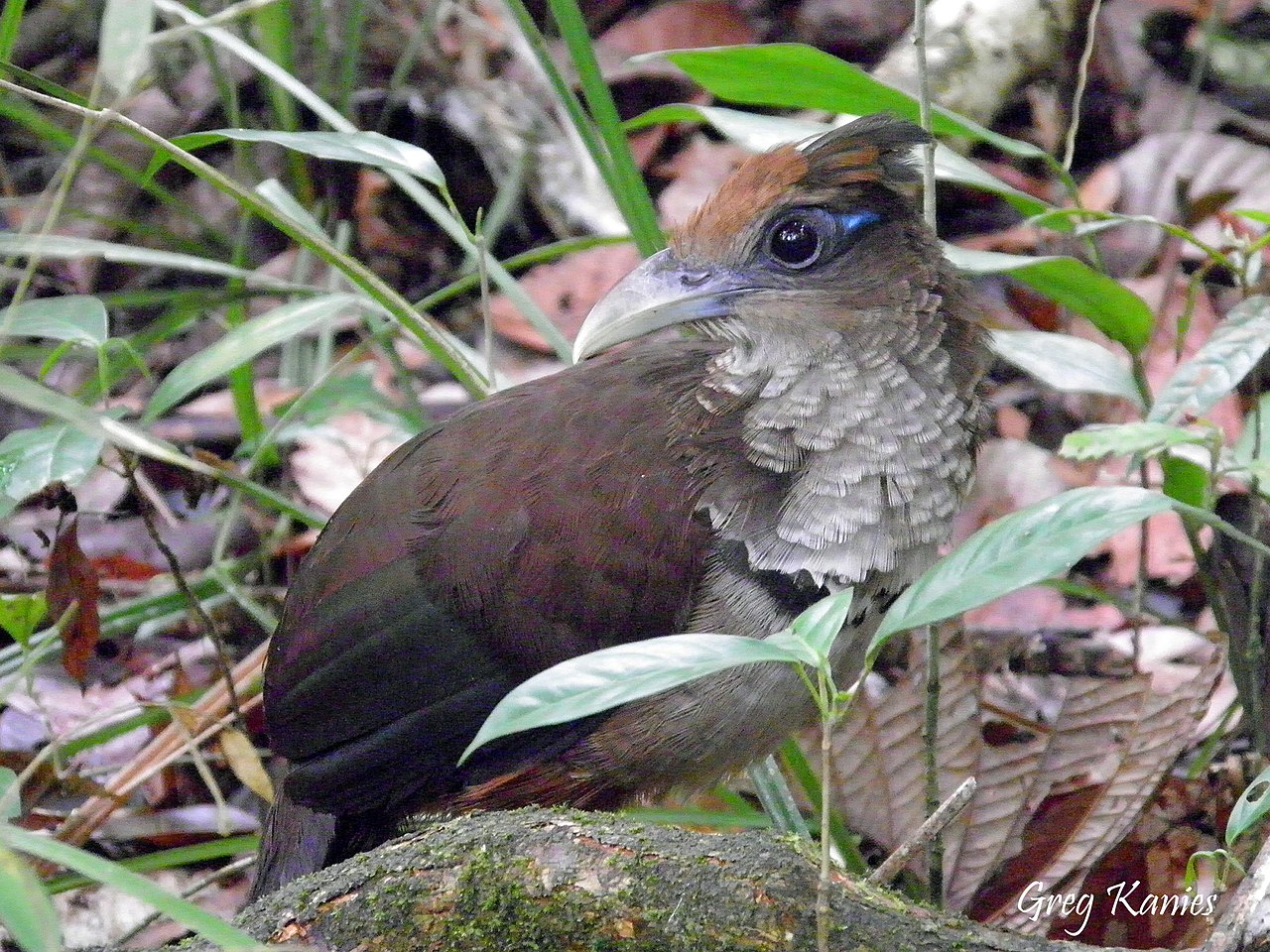
The rufous-vented chachalaca is a member of an ancient group of birds of the family Cracidae, which are related to the Australasian mound builders. It inhabits northeast Colombia and northern Venezuela where it is called guacharaca, and the island of Tobago in Trinidad and Tobago where it is known as the cocrico and is one of the country's two national birds. It is also found on Bequia and Union Island in the Grenadines where it may have been introduced.
Region
Northern South America and the southern Caribbean
Typical Environment
Occurs in northeastern Colombia and northern Venezuela, extending to the island of Tobago and introduced on Bequia and Union Island in the Grenadines. Prefers dry to semi-humid forests, thorn scrub, gallery forests, and forest edges. Readily uses secondary growth, plantations, orchards, and rural gardens. Often found near watercourses and in mosaic landscapes with trees and shrubs. Common around human-altered habitats where fruiting trees are available.
Altitude Range
Sea level to 1500 m
Climate Zone
Tropical
Ease of Keeping
Beginner friendly: 2/5
Also known as the cocrico on Tobago, this species is one of Trinidad and Tobago’s national birds. Its dawn and dusk choruses are loud, antiphonal, and often given by small groups. It plays an important role as a seed disperser in dry forests and secondary growth, and it is sometimes hunted as a game bird.



Temperament
social and noisy
Flight Pattern
short rapid wingbeats followed by glides between trees
Social Behavior
Typically forages and moves in small family parties or loose groups. Nests are shallow twig platforms placed in trees or dense shrubs. Clutches are small, and both adults guard the chicks, which are precocial and can follow adults soon after hatching. Groups often roost communally.
Migratory Pattern
Resident
Song Description
Vocalizations are loud, raucous choruses often given at dawn and dusk, featuring repeated chachala-ca phrases. Pairs or groups may call antiphonally, creating a far-carrying, rhythmic cacophony.
Plumage
Overall olive-brown to gray-brown with a paler, slightly scaled neck and breast; conspicuous rufous vent and undertail coverts. Long, graduated tail with dull rufous or chestnut tones toward the base and edges. Throat often whitish to pale buff; wings broad and dusky.
Diet
Primarily eats fruits and berries from a variety of native and cultivated plants. Also takes young leaves, buds, and flowers, and occasionally seeds. In some areas may supplement with small invertebrates, especially when feeding chicks. Its fruit-heavy diet makes it an effective seed disperser.
Preferred Environment
Feeds in the midstory and canopy of edge habitats, secondary forest, and gallery woodland. Common in orchards, cacao and citrus plantations, and village gardens with fruiting trees. Will also descend to the ground to pick fallen fruit.