
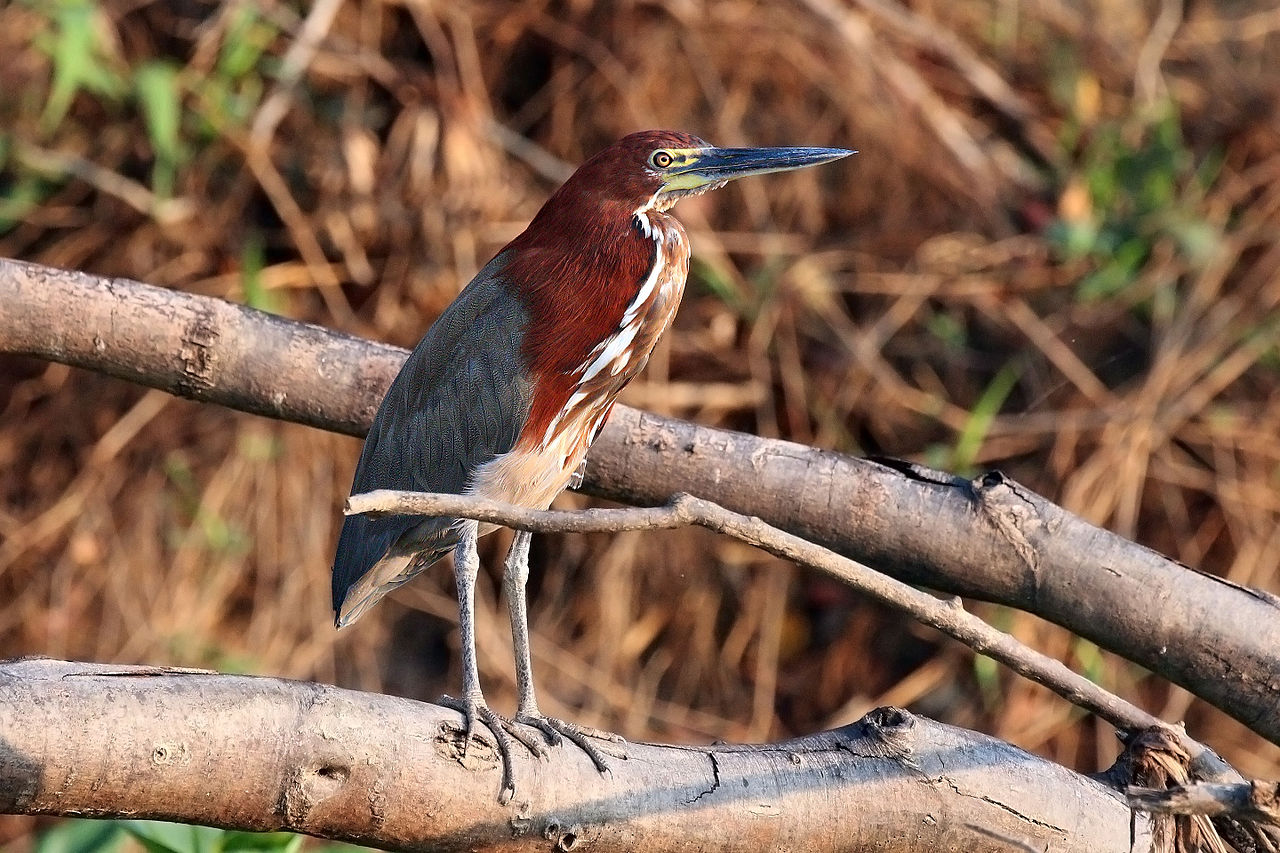
The rufescent tiger heron is a species of heron in the family Ardeidae. It is found in wetlands from Central America through much of South America.
Region
Central and South America
Typical Environment
Occurs from eastern Panama through northern and central South America, including the Amazon and Orinoco basins, the Guianas, and much of Brazil to northern Argentina, Paraguay, and Uruguay. It prefers forested rivers, oxbow lakes, swamps, marsh edges, and mangroves, usually where cover is dense. Common in the Pantanal and along shaded lowland streams in rainforest. Typically avoids fast-flowing water and very open, exposed shorelines. Often seen singly along quiet backwaters and flooded forests.
Altitude Range
Sea level to 1200 m
Climate Zone
Tropical
Ease of Keeping
Beginner friendly: 1/5
A secretive, largely crepuscular heron, the rufescent tiger heron often hunts by standing motionless at shaded water edges. Adults show rich rufous tones on the head and neck, while juveniles are boldly barred, enhancing camouflage. Its deep, booming calls carry far at dusk and dawn. It frequents quiet backwaters, oxbow lakes, and forested streams across the Neotropics.


Juvenile - Sacha Lodge - Ecuador

T. l. lineatum, young adult, Panama

Juvenile
Temperament
solitary and territorial
Flight Pattern
strong but unhurried with slow, deep wingbeats
Social Behavior
Usually encountered alone or in well-spaced pairs along quiet waterways. Nests singly or in very loose aggregations in trees near water, constructing a simple stick platform. Courtship involves low, resonant calls and display postures with neck extended. Adults are highly secretive and rely on stillness for concealment.
Migratory Pattern
Resident
Song Description
Vocalizations include deep, booming hoots and low grunts, most often at dawn and dusk. Calls carry through dense vegetation and along river corridors, aiding contact between mates in low-visibility habitats.
Plumage
Adults show rich rufous head and neck with fine streaking, olive-brown to dark brown upperparts with subtle vermiculation, and paler, finely barred underparts. Juveniles are heavily barred buff and dark brown, giving a ‘tiger-striped’ appearance. Feathers are dense and soft, aiding camouflage in dappled light.
Diet
Feeds mainly on fish, but also takes frogs, tadpoles, aquatic insects, crustaceans, and small reptiles. It hunts by standing motionless at the water’s edge or by very slow stalking, striking rapidly with its dagger-like bill. Prey is swallowed whole and often oriented head-first. Opportunistic, switching prey with seasonal water levels.
Preferred Environment
Shaded margins of slow-moving streams, oxbow lakes, flooded forests, and marshy lagoons. Frequently forages from partially submerged logs, roots, or low overhanging branches. Avoids exposed shorelines in favor of cover-rich edges.


