The rock wren is a small songbird of the wren family native to western North America, Mexico and Central America. It is the only species in the genus Salpinctes.
Region
Western North America to Central America
Typical Environment
Occurs from western Canada and the western United States through Mexico into parts of Central America. Favors arid and semi-arid rocky habitats including canyons, cliff faces, talus slopes, boulder fields, and scrubby deserts. Also uses open sagebrush, pinyon-juniper slopes, and rocky grasslands, avoiding dense forests. In winter, some populations shift to lower, more open and warmer rocky areas.
Altitude Range
Sea level to 3500 m
Climate Zone
Arid
Ease of Keeping
Beginner friendly: 1/5
The rock wren is the only species in the genus Salpinctes and is adapted to rugged, rocky landscapes. It often builds nests deep in crevices and is known to arrange small stones at the nest entrance like a tiny walkway. Rock wrens frequently bob and flick their tails while foraging among rocks. They obtain much of their water from insect prey and are seldom seen drinking.


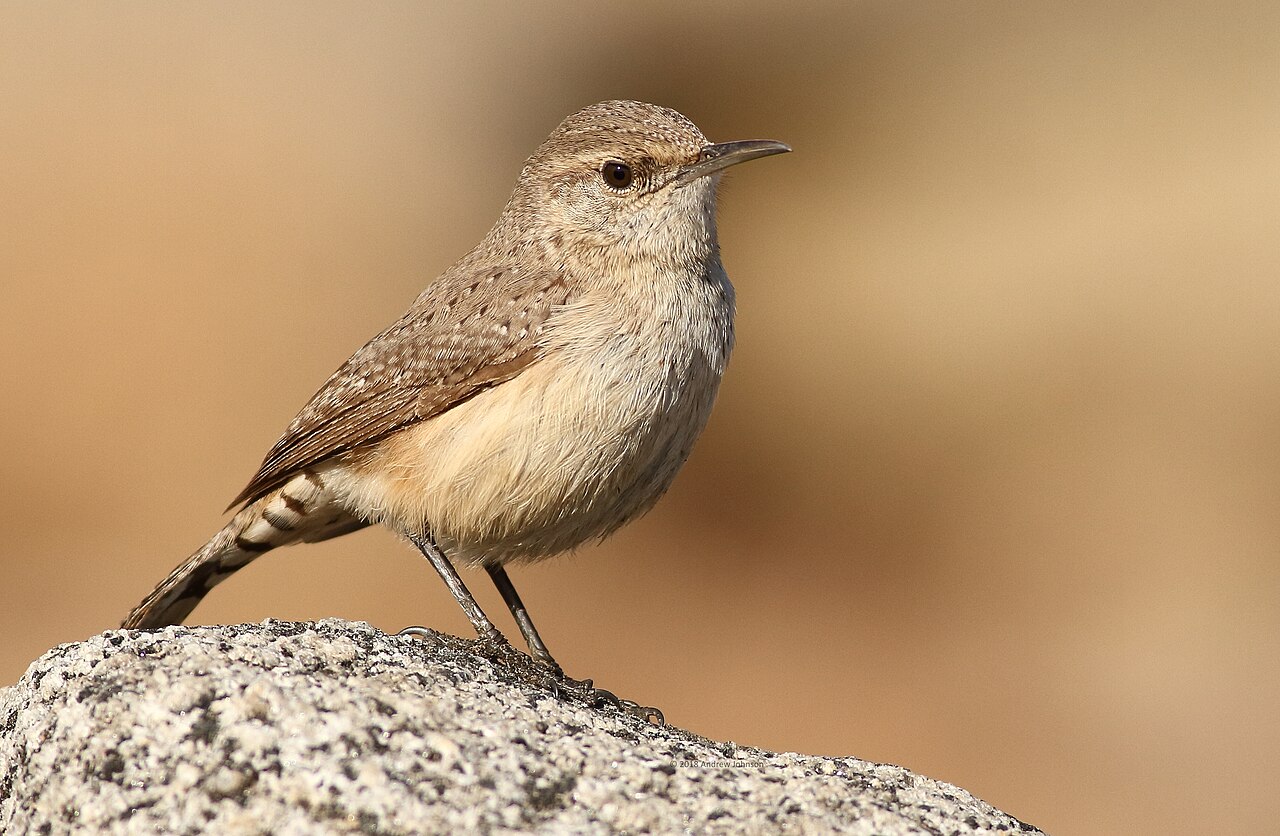
Rock Wren at Folsom Lake in Placer County, California.

A rock wren eating a bug in Cody, Wyoming.
Temperament
solitary and territorial
Flight Pattern
short rapid wingbeats, low over rocks
Social Behavior
Typically seen alone or in pairs during the breeding season, defending rocky territories. Nests are placed in rock crevices, often with a distinctive pavement of small stones at the entrance. Pairs cooperate in nest building; the female incubates while the male often delivers food and guards.
Migratory Pattern
Partial migrant
Song Description
The male delivers a bright, ringing series of varied trills, whistles, and buzzy phrases from prominent rock perches. Song repertoires are large, with phrases repeated several times before switching. Calls include sharp ticks and chatters during agitation.
Plumage
Fine, mottled gray-brown upperparts with subtle pale speckling; underparts pale buff to whitish with light spotting on the breast and flanks; tail narrowly barred.
Diet
Primarily consumes insects and other arthropods such as beetles, ants, grasshoppers, caterpillars, and spiders. Probes crevices and turns small debris to glean prey, often making short hops among rocks. Occasionally takes small seeds or berries, especially in winter, but animal prey dominates. Derives much moisture from its prey.
Preferred Environment
Feeds on rocky slopes, talus, and canyon walls where cracks and ledges harbor insects. Often forages near boulders, dry washes, and sparse shrubs, using rocks as vantage points.