

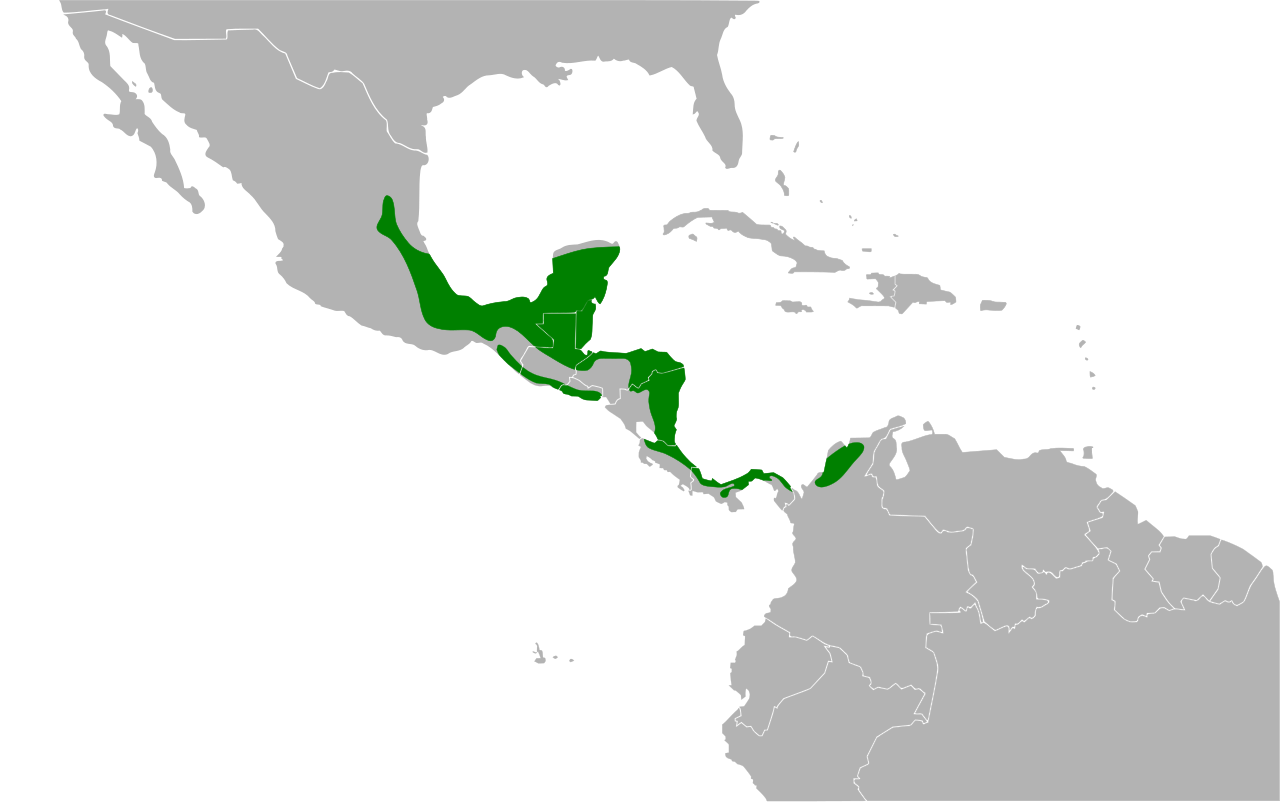
The red-throated ant tanager is a medium-sized passerine bird. This species is a resident breeder on the Caribbean slopes from southeastern Mexico to eastern Panama. It was formerly placed with the red-crowned ant tanager in the genus Habia. It was usually considered an aberrant kind of tanager and placed in the Thraupidae, but is actually closer to the cardinals (Cardinalidae). Consequently, it can be argued that referring to the members of this genus as ant tanagers is misleading, but no other common name has gained usage.
Region
Mesoamerica
Typical Environment
Found on the Caribbean (Atlantic) slopes from southeastern Mexico through Belize, Guatemala, and Honduras to eastern Panama. It favors humid lowland and foothill forests, as well as second growth, thickets, and forest edges. Often keeps to dense understory near streams and ravines. It tolerates some disturbance and may persist in semi-open woodland and overgrown plantations, provided understory cover remains.
Altitude Range
Sea level to 1200 m
Climate Zone
Tropical
Ease of Keeping
Beginner friendly: 1/5
Despite the name, this species belongs to the cardinal family (Cardinalidae), not the true tanagers. Males show a distinctive red throat, while females have a warm orange-buff throat, aiding quick sex identification. It forages in the shady understory and will occasionally attend army-ant swarms to snatch flushed insects.


Temperament
shy and skulking
Flight Pattern
short rapid wingbeats with direct, low flights through the understory
Social Behavior
Usually seen in pairs or small family groups within dense understory. Pairs defend territories and may join mixed-species flocks loosely while foraging. Nests are typically cup-shaped and placed low in shrubs or ferny cover.
Migratory Pattern
Resident
Song Description
Song consists of clear, whistled phrases delivered from low perches, often repeated with slight variation. Calls are sharp chips and tiks used to keep contact in dense cover.
Plumage
Plain dusky-olive to brownish body with a contrastingly colored throat; feathers are smooth and unpatterned, giving a uniform look in the understory shade.
Diet
Primarily takes insects and other small arthropods gleaned from leaves and twigs or snapped from the air at close range. It will also consume small fruits and berries, especially when insect prey is less abundant. Occasionally follows army-ant swarms to capture flushed invertebrates. Foraging is methodical, often just above ground level.
Preferred Environment
Feeds in the shaded understory of humid forests, along stream margins, forest edges, and dense second growth. Frequently works within tangles, viney thickets, and low saplings where cover is thick.


