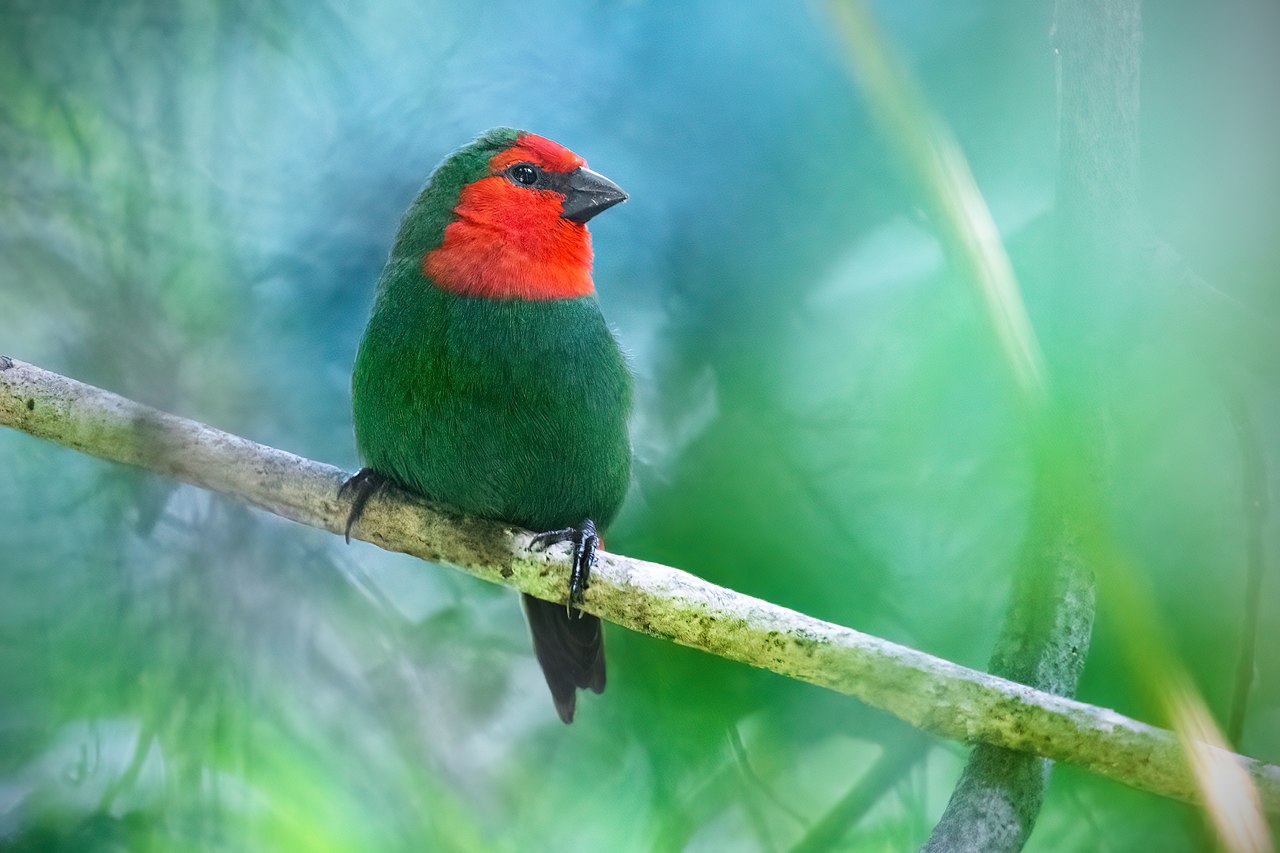
The red-throated lorikeet is a critically endangered lorikeet endemic to Fiji. It is 18 cm (7.1 in) long and is bright green overall, with red cheeks, throat and thighs.
Region
South Pacific
Typical Environment
Endemic to Fiji, historically recorded from Viti Levu, Vanua Levu, and Taveuni. It inhabits primary and mature secondary moist forest, using the upper canopy where flowering trees are abundant. The species is closely associated with native blossoms and epiphyte-rich trees. It may occasionally visit forest edges but is most often linked to intact interior forest. Recent records are lacking, and it is now presumed to persist, if at all, only in remote upland forests.
Altitude Range
Sea level to 1200 m
Climate Zone
Tropical
Ease of Keeping
Beginner friendly: 1/5
This tiny lorikeet is one of Fiji’s most elusive birds and is considered Critically Endangered, possibly on the brink of extinction. It has not been reliably documented in decades despite targeted searches, likely due to its canopy-dwelling habits and extreme rarity. Habitat loss and invasive predators are suspected key threats. Its brush-tipped tongue is specialized for feeding on nectar and pollen from native flowering trees.


Artwork by John Gerard Keulemans
Temperament
wary and active
Flight Pattern
short rapid wingbeats with swift, direct flight
Social Behavior
Usually seen in pairs or very small parties, moving quickly through the canopy while feeding at blossoms. Likely nests in tree cavities like other lorikeets, though specific nesting sites are poorly documented. Courtship and family groups are assumed similar to related lorikeets, with strong pair bonds.
Migratory Pattern
Resident
Song Description
High, thin, and sibilant calls, often sharp squeaks and rapid chattering given in flight. Vocalizations are brief and can be easily missed against canopy insect noise.
Plumage
Bright green overall with a vivid red throat, red cheeks, and red thighs; compact body with a short tail.
Diet
Primarily nectar and pollen from native flowering trees and epiphytes; also takes soft fruits and occasionally small insects. Feeds by probing blossoms with a brush-tipped tongue. It likely favors seasonal blooms and may track flowering events within its range.
Preferred Environment
Forages high in the forest canopy, especially in old-growth and montane forests rich in flowering trees. It may descend to mid-canopy at prolific blooms but rarely comes to the ground.