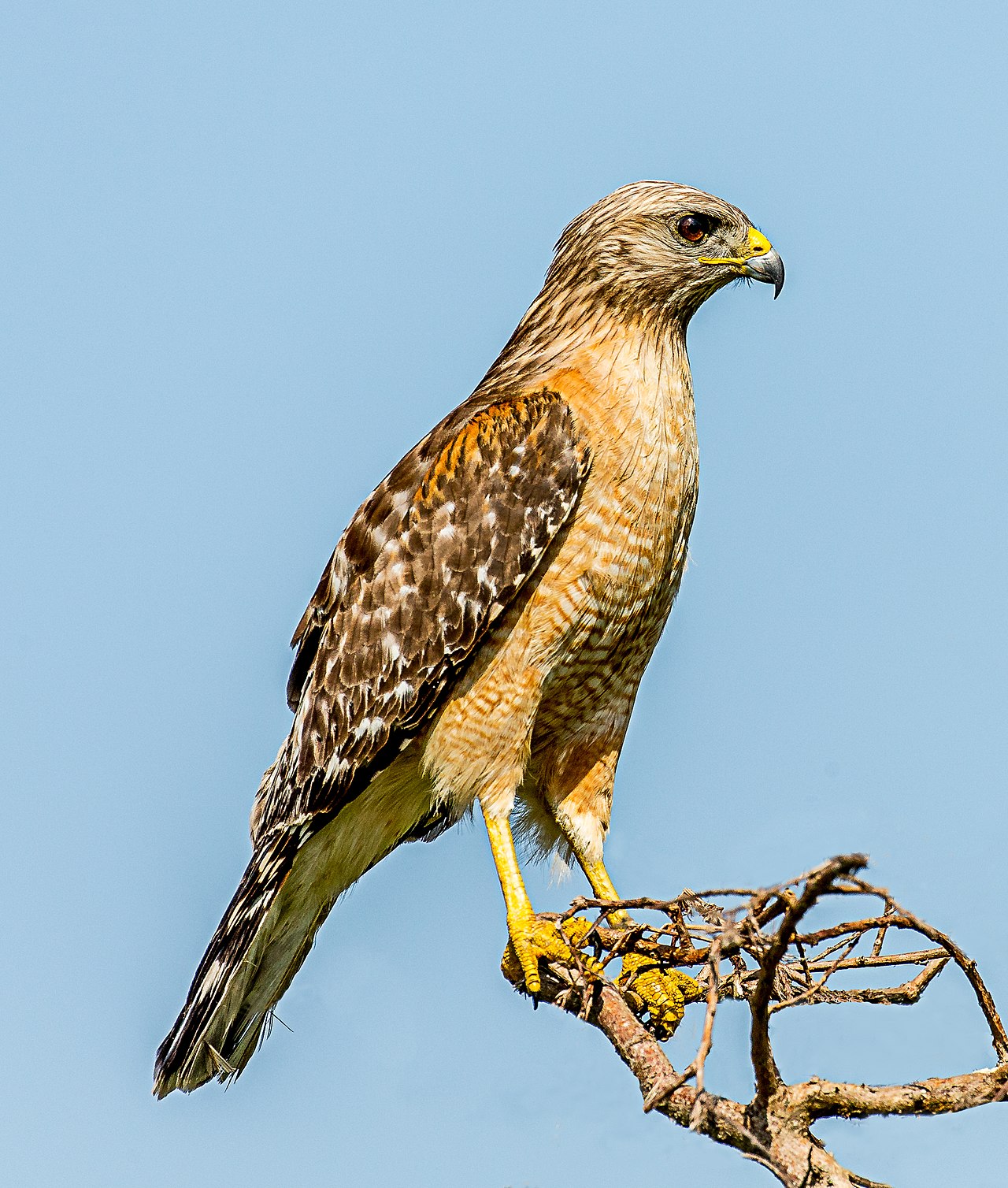
The red-shouldered hawk is a medium-sized buteo. Its breeding range spans eastern North America and along the coast of California and northern to northeastern-central Mexico. It is a permanent resident throughout most of its range, though northern birds do migrate, mostly to central Mexico. The main conservation threat to the widespread species is deforestation.
Region
North America
Typical Environment
Breeds widely in eastern North America from the Great Lakes and southern Canada south through the eastern United States, and along the coast of California into northern to northeastern-central Mexico. It is resident through most of its range, with northern breeders moving south to the central U.S. and Mexico in winter. Habitats include mature deciduous and mixed forests, especially near rivers, swamps, and wetlands. In the West, it occurs in coastal forests, riparian woodlands, and oak savannas. It readily uses wooded suburbs and parks where large trees remain.
Altitude Range
Sea level to 1500 m
Climate Zone
Temperate
Ease of Keeping
Beginner friendly: 1/5
This woodland raptor is known for its loud, ringing kee-yer call and the rich rufous barring on its chest and shoulders. It favors riparian forests and bottomlands, often nesting near water. Populations rebounded after the ban on DDT and benefit from maturing second-growth forests. In flight, pale crescent-shaped 'windows' near the wingtips help with identification.


Red-shouldered hawk taking flight at Green Cay Wetlands, Florida

In Everglades National Park.


Eating a garter snake

Female (top) and male (bottom), 1826 painting by John James Audubon

Chased by a red-tailed hawk, in California


Temperament
solitary and territorial
Flight Pattern
soaring glider with intermittent quick, stiff wingbeats
Social Behavior
Forms monogamous pairs that defend wooded territories, often reusing or refurbishing large stick nests high in canopy trees. Nests are commonly placed near water and lined with green leaves. Both adults share incubation and chick-rearing duties. Post-fledging, juveniles remain near the natal territory for several weeks.
Migratory Pattern
Partial migrant
Song Description
A loud, clear, descending kee-yer or kee-aah call, often repeated in series and carrying far through forests. During breeding season, pairs call frequently over territories. Alarm calls are sharper and more rapid.
Plumage
Rufous, finely barred underparts with darker brown upperparts; wings show bold black-and-white checkering and rufous shoulders.
Diet
Feeds mainly on small mammals like voles and mice, as well as frogs, snakes, lizards, and occasional small birds. In many areas it takes crayfish and other aquatic prey, especially in swampy habitats. Hunts primarily from perches, scanning forest edges and riparian corridors, then dropping swiftly onto prey. It may also quarter low over clearings or wade in shallow water for amphibians and crayfish.
Preferred Environment
Favors forest edges, riparian woodlands, and wetland margins where cover and open hunting lanes meet. In suburban landscapes, it hunts from tall trees along streams, ponds, and parks.