
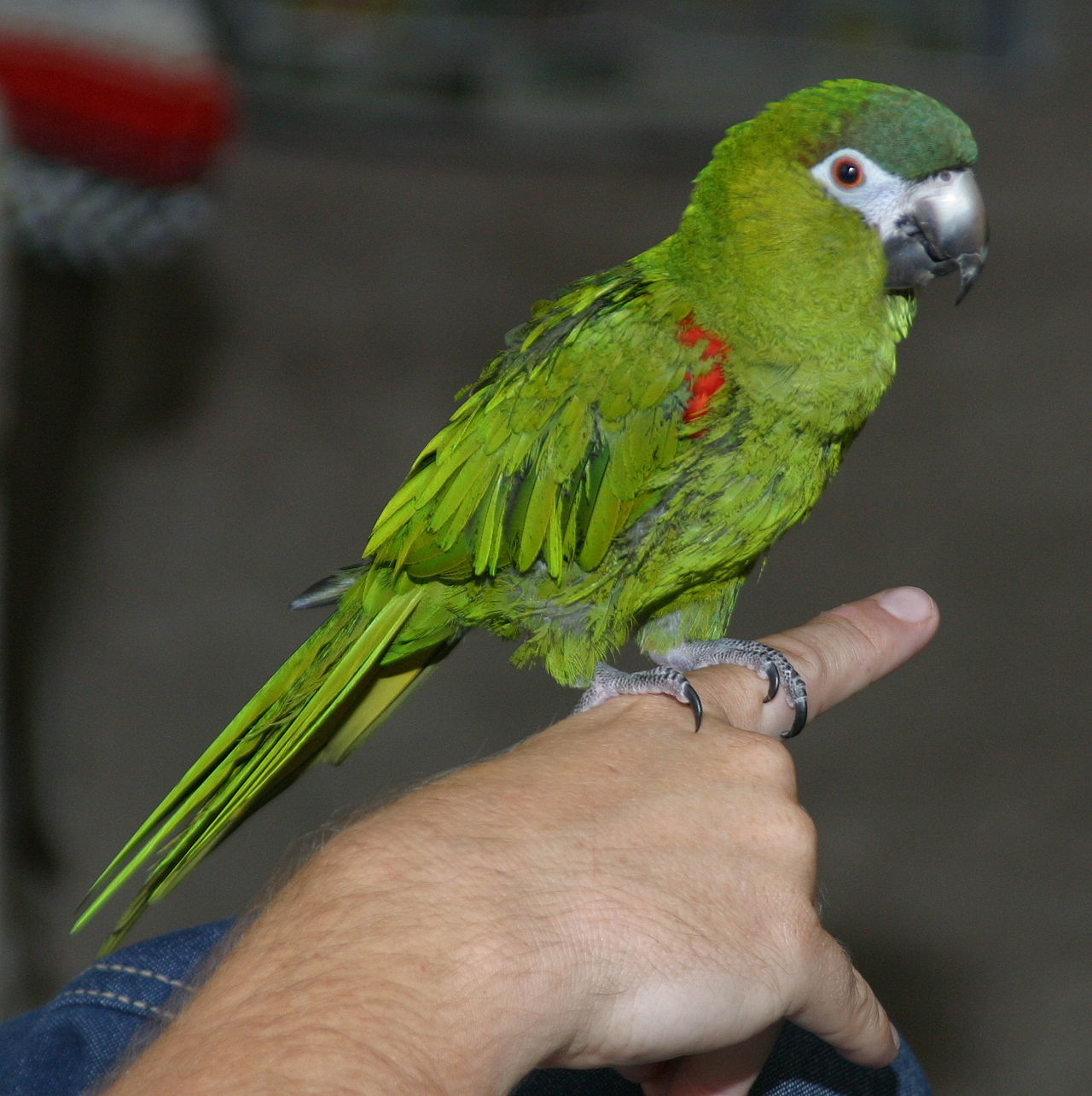
The red-shouldered macaw is a small green South American parrot, a member of a large group of Neotropical parrots called macaws. The species is named for the red coverts on its wings. It is the smallest macaw, being 30–35 cm (12–14 in) in length – similar in size to the Aratinga parakeets. It is native to the tropical lowlands, savannahs, and swamplands of Brazil, the Guianas, Bolivia, Venezuela, and far south-eastern Peru. There are three subspecies: The noble macaw, Hahn's macaw, and the long-winged macaw. The long-winged macaw is a poorly distinct third subspecies that has longer wings, but is otherwise similar to the noble macaw. The Hahn's subspecies is named for German zoologist Carl-Wilhelm Hahn, who in 1834 began compiling Ornithologischer Atlas oder naturgetreue Abbildung und Beschreibung der aussereuropäischen Vögel.
Region
Amazon Basin and Guiana Shield
Typical Environment
Occurs across northern and central South America, including Brazil, the Guianas, Venezuela, far southeastern Peru, and northern Bolivia. It favors tropical lowlands with a mosaic of savannas, gallery forests, swamplands, and forest edges. Often found in palm-rich habitats and seasonally flooded woodlands, and may frequent agricultural areas and wooded savannas. It uses tree cavities for nesting and communal roosts in tall trees near water or open clearings.
Altitude Range
Sea level to 1200 m
Climate Zone
Tropical
Ease of Keeping
Beginner friendly: 3/5
The red-shouldered macaw is the smallest macaw, notable for the red patch on its wing coverts. It includes three subspecies, commonly known as the noble macaw, Hahn's macaw, and the long-winged macaw. Popular in aviculture for its intelligence and ability to mimic, it remains a wild species rather than a true domesticate. Its bare facial skin and strong bill are characteristic of macaws.


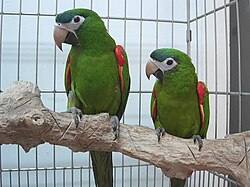
Diopsittaca nobilis (MHNT)


Temperament
social and active
Flight Pattern
swift direct flight with rapid wingbeats
Social Behavior
Usually seen in pairs or small flocks, sometimes gathering at communal roosts. Monogamous pairs nest in natural tree cavities or old woodpecker holes. They are alert, vocal, and maintain close contact calls while foraging. Family groups may remain together after fledging.
Migratory Pattern
Resident
Song Description
Calls are sharp, high-pitched screeches and chatters typical of small macaws. Vocalizations carry over long distances in open habitats, with more subdued, conversational notes used within pairs or small groups.
Plumage
Predominantly bright green with contrasting red wing coverts at the bend of the wing and bluish highlights on the forehead and outer wings.
Diet
Feeds primarily on seeds, nuts, fruits, berries, and palm kernels. It also consumes flower buds and shoots when available. Diet varies seasonally with fruiting cycles, and birds may travel between feeding trees or palm groves. They crack hard seeds with a powerful bill and manipulate food deftly with their feet.
Preferred Environment
Forages in the canopy and at forest edges, along rivers, and in savannas with scattered trees and palms. Frequently visits palm stands and semi-open woodlands, and may enter plantations or orchards where food is abundant.


