

The red-capped parrot is a species of broad-tailed parrot native to southwestern Australia. It was described by Heinrich Kuhl in 1820, with no subspecies recognised. It has long been classified in its own genus owing to its distinctive elongated beak, though genetic analysis shows that it lies within the lineage of the Psephotellus parrots and that its closest relative is the mulga parrot. Not easily confused with other parrot species, it has a bright crimson crown, green-yellow cheeks, and a distinctive long bill. The wings, back, and long tail are dark green, and the underparts are purple-blue. The adult female is very similar though sometimes slightly duller than the male; her key distinguishing feature is a white stripe on the wing under-surface. Juveniles are predominantly green.
Region
Southwest Australia
Typical Environment
Occurs in eucalypt forests, woodlands, and adjacent farmlands from the Perth region through the southwest to the south coast. Strongly associated with marri and jarrah forests, but also uses sheoak, banksia, and mixed woodland. Regularly visits orchards, parks, and suburban areas with mature trees. Nests in tree hollows and often forages high in the canopy, descending occasionally to feed on dropped seed pods.
Altitude Range
Sea level to 800 m
Climate Zone
Temperate
Ease of Keeping
Beginner friendly: 3/5
This striking parrot is endemic to southwestern Australia and is adapted to feed on the tough seeds of marri and other eucalypts with its unusually long, narrow bill. It often forages quietly high in the canopy and can be overlooked despite its vivid crimson crown and purple-blue underparts. Females closely resemble males but show a distinctive white stripe on the underwing. They nest in deep hollows of mature eucalypts, especially marri and jarrah.


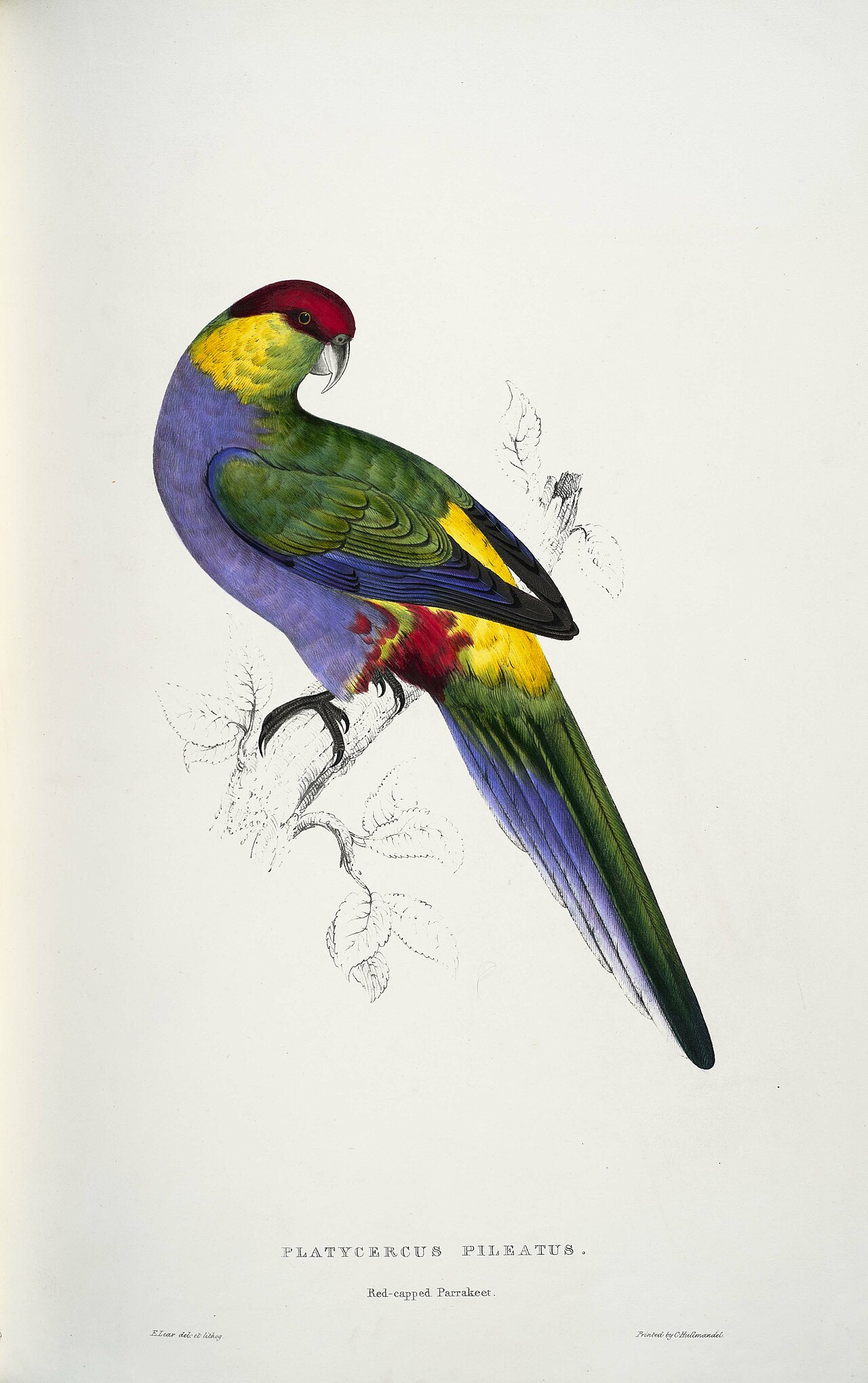
Lear's 1832 illustration

Adult female, showing green spotting of red flanks

Juvenile in Perth, Australia

Adult feeding on Calothamnus
Temperament
social and active
Flight Pattern
strong flier with rapid, direct wingbeats
Social Behavior
Usually seen in pairs or small family groups; larger flocks may form at abundant food sources. Breeds in natural hollows of large eucalypts, where the female incubates while the male provides food. Likely monogamous, with both parents feeding the young. Nesting typically occurs late winter to spring in the southwest.
Migratory Pattern
Resident
Song Description
Vocalizations include soft chattering and clear, whistled contact notes, often given in flight. Calls are less harsh than many rosellas and can be subdued when birds are foraging high in foliage.
Plumage
Glossy dark-green upperparts with a bright crimson cap, yellow‑green cheeks, and purple‑blue underparts; long dark-green tail with bluish tinge.
Diet
Primarily feeds on seeds from marri (Corymbia calophylla) and other eucalypts, using its long bill to pry seeds from hard capsules. Also takes seeds of sheoaks, acacias, and banksias, as well as blossoms, nectar, and some fruits. Occasionally consumes soft plant material or small invertebrates incidentally while foraging.
Preferred Environment
Forages mostly in the canopy and mid‑storey of eucalypt forests and woodlands, especially in marri and jarrah. Will also feed along edges of farmland, in orchards, and in urban parks with mature trees.


