

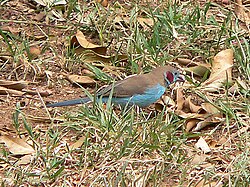
The red-cheeked cordon-bleu or red-cheeked cordonbleu is a small passerine bird in the family Estrildidae. This estrildid finch is a resident breeding bird in drier regions of tropical Sub-Saharan Africa. Red-cheeked cordon-bleu has an estimated global extent of occurrence of 7,700,000 km2.
Region
Sub-Saharan Africa
Typical Environment
Occurs widely across dry savannas, thorn scrub, and open woodland from the Sahel to East Africa. Frequently uses human-altered habitats including villages, gardens, and farms. Avoids dense rainforest and very high montane zones but can be abundant around waterholes and irrigated fields. Outside the breeding season it often forms small flocks and forages on the ground.
Altitude Range
Sea level to 2000 m
Climate Zone
Tropical
Ease of Keeping
Beginner friendly: 4/5
Males show a distinctive red cheek patch, while females lack or show only a faint wash, making the species an easy example of sexual dimorphism. During courtship the male often holds a grass stem while performing a bobbing dance and soft song. They adapt well to human-modified landscapes and are commonly kept in aviculture, though they are not domesticated.



Temperament
social and active
Flight Pattern
short rapid wingbeats
Social Behavior
Lives in pairs or small groups; outside breeding season it may join mixed-species foraging parties. Nests are domed, grass structures placed in shrubs or low trees. Both parents share incubation and chick-rearing duties.
Migratory Pattern
Resident
Song Description
A soft, high-pitched twittering song with delicate trills and chips, often delivered during a display. Males frequently sing while holding a grass stem and bobbing. Calls include thin seee and tinkling notes.
Plumage
Powder-blue face, throat, and breast with warm brown upperparts and buff to fawn belly; males show a bright red cheek patch.
Diet
Primarily consumes small grass seeds and other tiny grains taken from the ground or low plants. Supplements diet with small insects such as termites, ants, and other arthropods, especially when feeding young. Will visit feeding sites near human settlements and glean spillage from livestock areas.
Preferred Environment
Forages on short grass, open ground, and along paths, field margins, and farmyards. Often feeds near shrubs that provide quick cover and near water sources during dry periods.


