

The red-capped robin is a small passerine bird native to Australia. Found in drier regions across much of the continent, it inhabits scrub and open woodland. Like many brightly coloured robins of the family Petroicidae, it is sexually dimorphic. Measuring 10.5–12.5 cm (4.1–4.9 in) in length, the robin has a small, thin, black bill, and dark brown eyes and legs. The male has a distinctive red cap and red breast, black upperparts, and a black tail with white tips. The underparts and shoulders are white. The female is an undistinguished grey-brown. This species uses a variety of songs, and males generally sing to advertise territories and attract females. Birds are encountered in pairs or small groups, but the social behaviour has been little studied.
Region
Mainland Australia
Typical Environment
Occurs widely across the arid and semi-arid interior, favoring open eucalypt woodland, acacia (mulga) and mallee scrub, and lightly timbered farmland with sparse understory. It uses edges, clearings, and recently disturbed or open habitats where low perches are available. Avoids dense, closed forests and very treeless deserts. Breeding typically occurs where scattered shrubs and low branches provide nest sites. Local movements track rainfall and insect abundance.
Altitude Range
Sea level to 1200 m
Climate Zone
Arid
Ease of Keeping
Beginner friendly: 1/5
This striking little robin is endemic to Australia’s drier inland, where males use their vivid red cap and breast in territorial and courtship displays. It hunts from low perches, sallying to the ground to snatch insects. Nests are neat cup structures bound with spider silk and camouflaged with bark and lichen. Despite the male’s bold colors, the species can be inconspicuous, often sitting quietly before darting out to feed.


Adult male, showing white shoulder markings

Female (or immature), southwestern Queensland
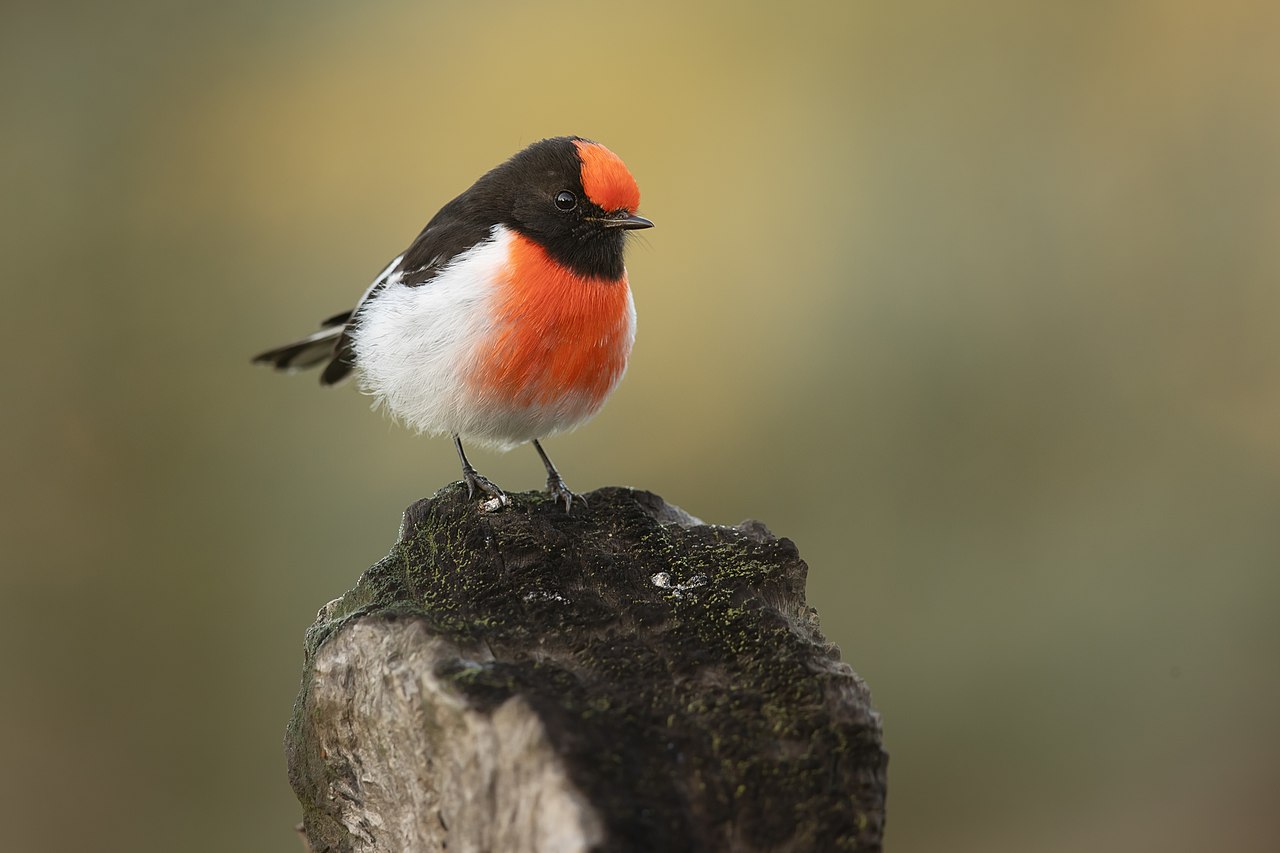
Red-capped Robin in New South Wales
Temperament
solitary and territorial
Flight Pattern
short rapid wingbeats
Social Behavior
Usually encountered singly or in pairs; pairs defend small breeding territories. The cup nest is placed low in a fork or on a horizontal branch and camouflaged with lichen and bark. The female undertakes most incubation while the male provides food and later helps feed nestlings. Outside breeding, small loose groups may form in good foraging areas.
Migratory Pattern
Partial migrant
Song Description
Song is a series of clear, high, tinkling notes and thin trills, often delivered from an exposed perch. Males sing more frequently during the breeding season to advertise territory and attract females.
Plumage
Male with glossy black upperparts, bright red cap and breast, white lower underparts and shoulder patches, and black tail with white tips; female is grey-brown above with pale underparts and subtle warm tones, lacking the male’s red.
Diet
Feeds mainly on small insects and other arthropods, including beetles, ants, wasps, flies, and spiders. Foraging is typically from a low perch, followed by quick sallies to the ground or short hover-gleans from foliage. Prey is spotted visually and seized in brief, direct flights. It benefits from open ground and sparse leaf litter that make prey easier to detect.
Preferred Environment
Open woodland and scrub with scattered low perches such as shrubs, fallen branches, and fence lines. Frequently uses edges, tracks, and lightly grazed areas, and may exploit recently burned or disturbed patches where insects are concentrated.


