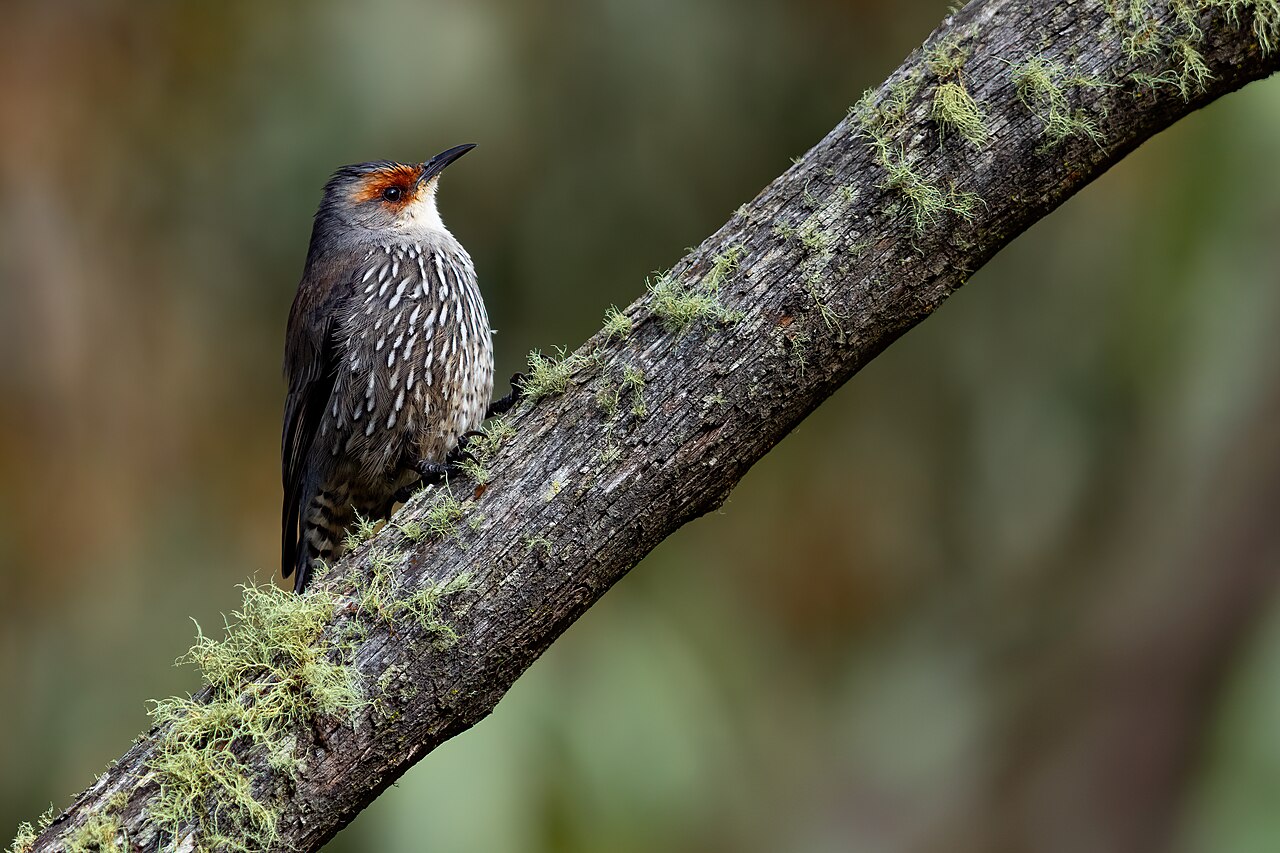
The red-browed pardalote is a small brightly coloured insectivorous passerine, endemic to Australia. A gleaning specialist, they forage primarily in eucalypt trees . The Latin word rubricatus means 'red-ochred' which is descriptive of their orange-red eyebrow. Other common names include red-browed diamondbird, bellbird, cape red-browed, pale red-browed, fawn-eyed, fawn-eyebrowed and pallid or red-lored pardalote.
Region
Northern Australia
Typical Environment
Occupies eucalypt woodlands, open savanna with scattered trees, and riparian corridors dominated by river red gum and other eucalypts. It favors the outer canopy and mid-story where lerps and small arthropods are abundant. Populations occur patchily from northwestern Western Australia across the Northern Territory into northern and western Queensland. Locally nomadic movements track flowering and insect outbreaks. Occurs in semi-arid to tropical landscapes, often near watercourses and sandstone escarpments.
Altitude Range
Sea level to 800 m
Climate Zone
Tropical
Ease of Keeping
Beginner friendly: 1/5
The red-browed pardalote is a tiny eucalypt specialist that gleans insects, especially psyllids and their sugary lerps, from foliage and twigs. Its vivid orange-red eyebrow gives the species its name and makes it surprisingly conspicuous at close range. Pairs often excavate nesting burrows in sandy banks or use tree hollows, lining them with bark strips. Its clear, bell-like calls have earned it the nickname “bellbird” in parts of Australia.


Red-browed pardalote (Pardalotus rubricatus) distribution map (green area)
Temperament
social and active
Flight Pattern
short rapid wingbeats
Social Behavior
Usually seen in pairs or small family groups and loosely associates with mixed-species foraging parties in eucalypt canopies. Monogamous pairs defend a small nesting area while foraging more widely. Nests are placed in tree hollows or in burrows excavated into sandy or earthen banks, lined with fine bark and plant fibers. Both sexes share incubation and chick rearing.
Migratory Pattern
Partial migrant
Song Description
Clear, ringing, bell-like notes delivered in spaced series, often a repeated ‘tink’ or ‘ding’. Calls also include soft chips and trills used for contact within pairs and family groups.
Plumage
Compact, smooth-plumaged passerine with olive-tinged upperparts and paler buff underparts. Crown dark grey with fine white spots; wings dark with white spots and a narrow wing bar. Face warm buff with a striking orange-red supercilium and a pale lore. Throat and breast washed yellow, fading to buff on the belly; tail dark with pale tips.
Diet
Feeds primarily on small insects and their larvae, especially psyllids and the sugary lerps they produce on eucalypt leaves. Also takes small beetles, spiders, and other arthropods gleaned from foliage, bark, and fine twigs. Occasionally consumes nectar or honeydew while foraging among blossoms. Foraging is meticulous, with frequent hang-gleaning and short hops along branches.
Preferred Environment
Forages high in the mid to outer canopy of eucalypts, particularly along watercourses and in open woodland. Will descend to lower shrubs and saplings during insect outbreaks and along edges and clearings.