

The rainbow bee-eater is a bird species in the bee-eater family Meropidae.
Region
Australasia
Typical Environment
Occurs across much of mainland Australia, absent or scarce in the far interior deserts and usually rare in Tasmania. During the non-breeding season many birds move north into northern Australia, New Guinea, and eastern Indonesia. Prefers open woodlands, forest edges, river corridors, farmlands, and coastal dunes, usually where bare, sandy soils are available for nesting burrows. Often seen perched on exposed branches, fences, and power lines near open foraging space.
Altitude Range
Sea level to 1200 m
Climate Zone
Tropical
Ease of Keeping
Beginner friendly: 1/5
The rainbow bee-eater is a vividly colored member of the bee-eater family Meropidae. It specializes in catching bees and wasps on the wing, then removes stings by repeatedly striking the insect against a perch. Pairs excavate long nesting burrows in sandy banks or flat ground, sometimes forming loose colonies. It is one of the few bee-eaters occurring in Australia and nearby New Guinea.



Temperament
social and active
Flight Pattern
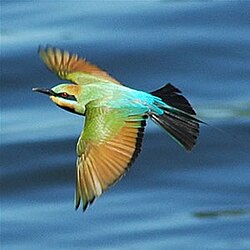
swift aerial hunter with rapid wingbeats and short glides
Social Behavior
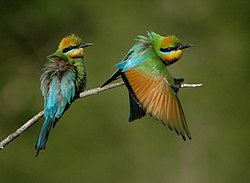
Often found in pairs or small groups, sometimes forming loose colonies at nesting sites. Both sexes excavate tunnel nests in sandy banks or flat ground and share incubation and feeding of chicks. Generally monogamous within the breeding season and maintains small perching territories for foraging.
Migratory Pattern
Seasonal migrant
Song Description
Produces high, musical trills and rolling prree or prrt notes, often given in flight. Calls are bright and ringing, carrying well over open country.
Plumage
Glossy green upperparts with a turquoise-blue rump, orange-rufous crown and nape, yellow throat bordered below by a narrow black band, and green to blue underparts. Long central tail streamers (longer in males) and dark wings with green coverts. Sleek, streamlined appearance with fine texture and iridescent sheen.
Diet
Feeds mainly on flying Hymenoptera (bees and wasps), but also takes dragonflies, butterflies, beetles, and other aerial insects. Prey are captured by sallying out from exposed perches. Stingers and venom sacs are removed by striking and rubbing the insect against the perch before swallowing.
Preferred Environment
Hunts over open habitats such as woodland edges, clearings, riverbanks, dunes, and farmland. Frequently forages near water and along linear openings like roads and fencelines where insects concentrate.


