

The African pygmy falcon —or simply pygmy falcon—is a diminutive raptor native to eastern and southern Africa. It is the sole species in its monotypic genus, Polihierax. The pygmy falcon is the smallest bird of prey on the African continent, and among the smallest raptors on earth; only the Asian falconets are smaller, weighing roughly 30-40 grams less and measuring about 5 cm shorter from head-to-tail.
Region
Eastern and Southern Africa
Typical Environment
Occurs from the Horn of Africa through Kenya and Tanzania to Namibia, Botswana, Zimbabwe, and northwestern South Africa. Prefers arid and semi-arid savannas, thorn scrub, and open Acacia woodlands. Common around colonies of sociable weavers and other weaverbirds, whose nests it uses for shelter and breeding. Also uses scattered trees and bushes in semi-desert and Kalahari dune systems.
Altitude Range
Sea level to 2000 m
Climate Zone
Arid
Ease of Keeping
Beginner friendly: 1/5
The pygmy falcon is the smallest raptor in Africa and the sole species in its genus, Polihierax. It famously nests in the communal nests of sociable weavers, commandeering chambers for roosting and breeding. Despite its tiny size, it is a bold predator that takes insects, lizards, and small birds.


The male bird to the upper left has its face turned away, showing its white false "eye spots".

Illustration of male and female.

A pair at Serengeti National Park, Tanzania. Male on left and female (brown back) on the right.
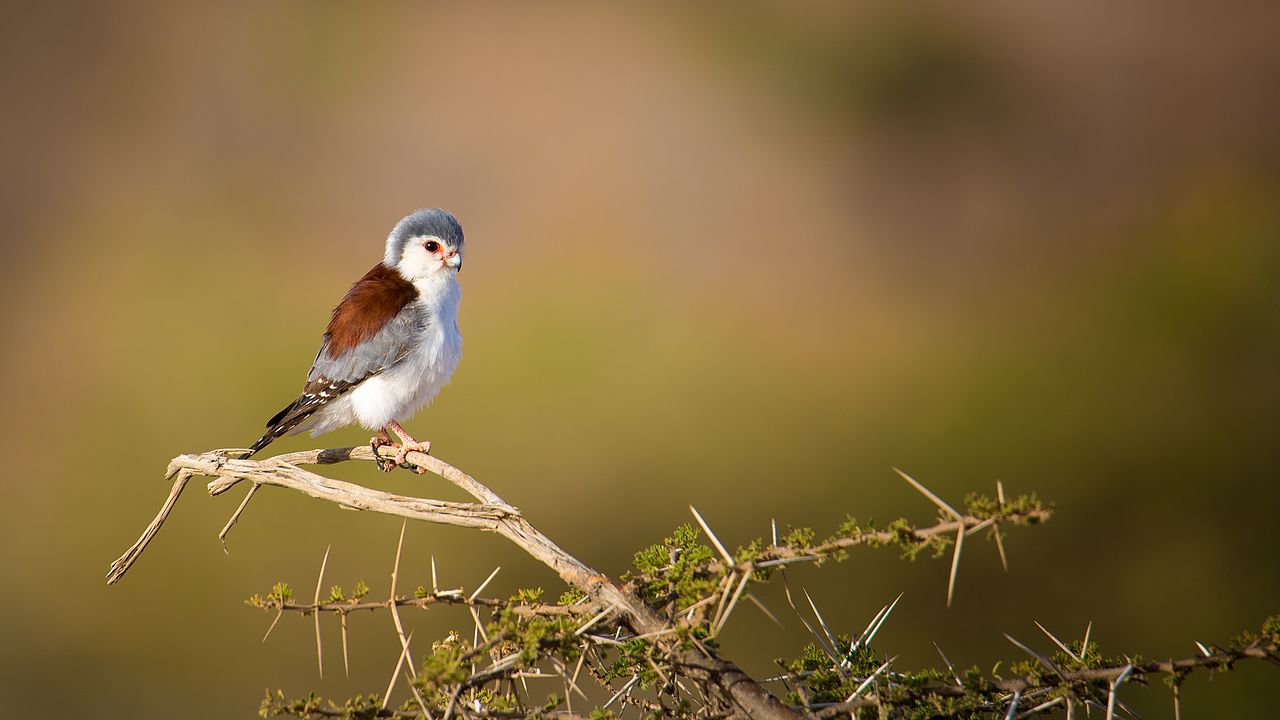
Pygmy falcon, female, at Buffalo Springs National Reserve, Kenya.
Temperament
bold and active
Flight Pattern
short rapid wingbeats with swift dashes between perches
Social Behavior
Typically seen singly or in pairs that maintain territories around weaver colonies. Nests and roosts inside chambers of sociable weaver nests, occasionally using sparrow-weaver nests or tree cavities. Clutch usually 2–4 eggs; both sexes share incubation and chick rearing.
Migratory Pattern
Resident
Song Description
Gives high-pitched chittering calls and sharp kik-kik notes, especially near the nest. Alarm calls are rapid, repeated chatters; quieter whistles are used between mates.
Plumage
Compact, short-tailed falcon with clean white underparts and contrasting dark flight feathers; upperparts gray in males and rich chestnut mantle in females. Tail shows bold black-and-white barring. Face is mostly white with a dark eye-stripe and fine black markings around the ear coverts.
Diet
Takes large insects such as beetles, grasshoppers, and termites, along with small lizards and geckos. Will opportunistically prey on small birds and nestlings and occasionally small rodents. Hunts from exposed perches with short sallies to the ground or nearby vegetation, and will hawk insects on the wing.
Preferred Environment
Feeds along edges of thorn savanna, around weaver colonies, and in open Acacia stands. Often uses fence posts, dead snags, and power lines as hunting perches.


