

The pygmy cormorant is a member of the Phalacrocoracidae (cormorant) family of seabirds. It breeds in south-eastern Europe and south-western Asia. It is partially migratory, with northern populations wintering further south, mostly within its breeding range. It is a rare migrant to western Europe.
Region
Southeast Europe and Southwest Asia
Typical Environment
Prefers lowland freshwater habitats such as lakes, slow-flowing rivers, floodplains, deltas, and marshes with extensive reedbeds. Frequently uses flooded willow and tamarisk thickets for roosting and nesting. In winter it also occupies sheltered lagoons and brackish backwaters. Requires calm, fish-rich waters with ample perches and nearby cover, and generally avoids exposed marine coasts.
Altitude Range
Sea level to 1000 m
Climate Zone
Temperate
Ease of Keeping
Beginner friendly: 1/5
One of the smallest cormorants, it often perches on reeds or low branches and spreads its wings to dry after diving. It nests colonially in reedbeds or flooded shrubs and trees. Conservation efforts to protect wetlands in parts of Europe have helped this species rebound locally.


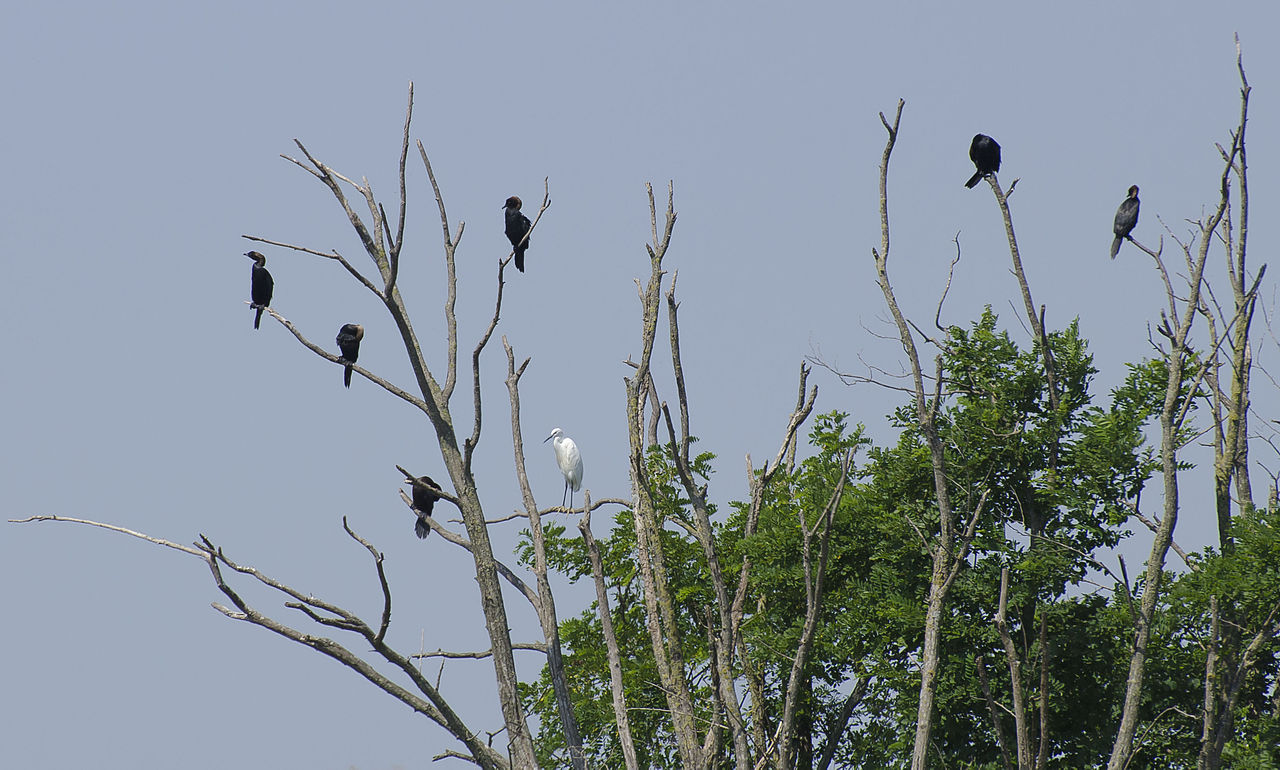
Pygmy cormorants and little egret (Egretta garzetta) in the Venetian Lagoon

Egg, Collection Museum Wiesbaden

Pygmy cormorant in the Sea of Galilee
Temperament
social and active
Flight Pattern
direct, low over water with rapid shallow wingbeats
Social Behavior
Typically nests in loose to dense colonies, often with other waterbirds, placing platform nests in dense reeds or low trees over water. Pairs form seasonally and defend small territories around the nest. Roosting communally is common, especially outside the breeding season.
Migratory Pattern
Partial migrant
Song Description
Generally quiet away from colonies, where it gives low, guttural croaks and grunts. At nesting sites, vocalizations increase and include harsh rattles and chattering exchanges between mates.
Plumage
Overall dark with glossy brown to blackish tones; breeding birds show richer brown on the head and neck and a slight greenish sheen on the body. Non-breeding plumage is duller and more uniformly brownish. Feathers appear tight and sleek when wet and slightly shaggy around the neck when dry.
Diet
Feeds mainly on small fish captured by pursuit-diving under water. Also takes aquatic invertebrates and occasionally amphibians when fish are scarce. It hunts singly or in loose groups, often working along reed edges and shallow bays. Prey is typically swallowed at the surface after brief handling.
Preferred Environment
Shallow, calm freshwater with good underwater visibility and abundant small fish. Frequently forages along reed margins, submerged vegetation, and around fallen branches or flooded shrubs.


