
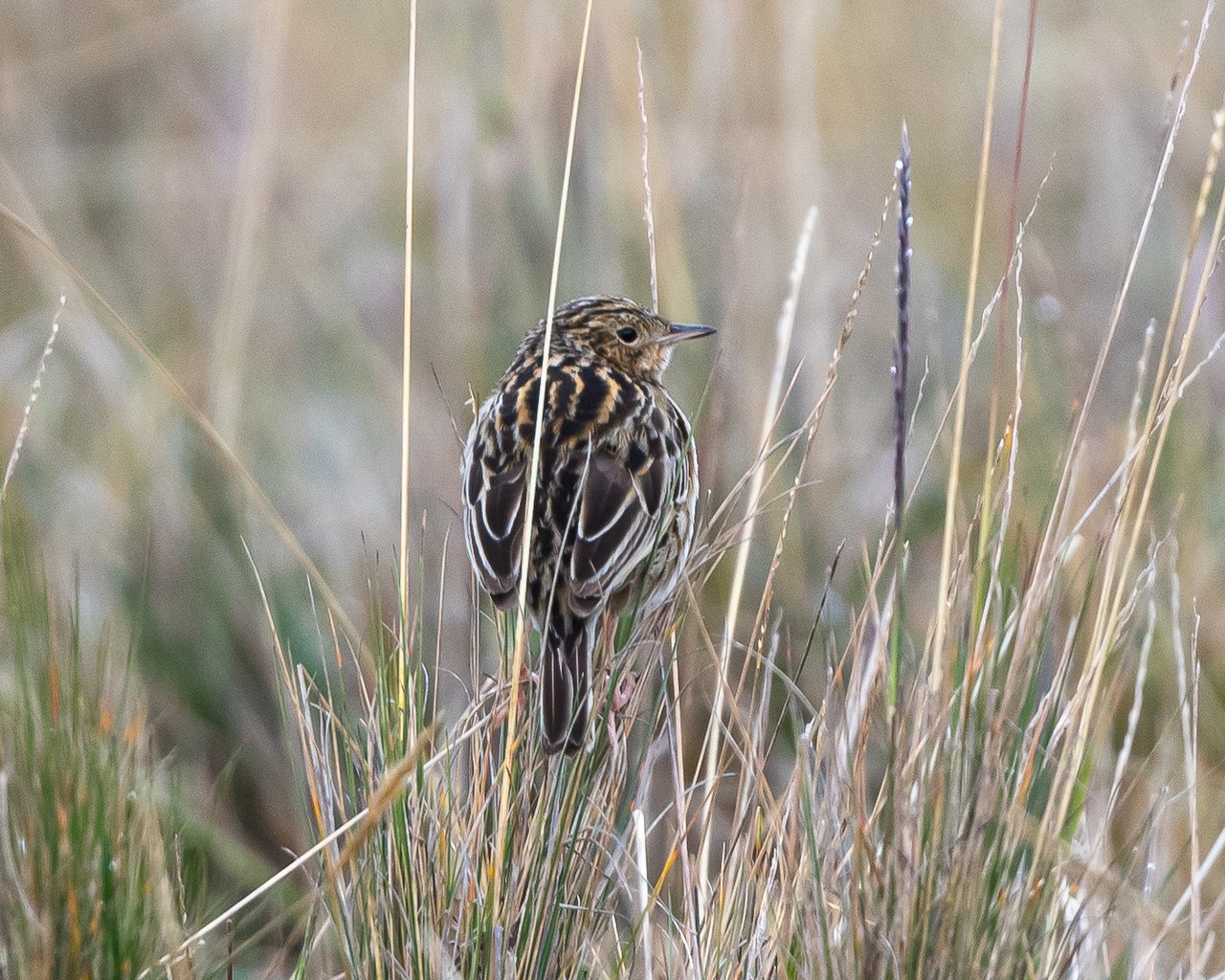
The paramo pipit is a species of bird in the family Motacillidae. It is found in Argentina, Bolivia, Colombia, Ecuador, Peru, and Venezuela. Its natural habitats are subtropical or tropical high-altitude grassland and pastureland.
Region
Andes Mountains
Typical Environment
Occurs along the northern and central Andes from Venezuela and Colombia through Ecuador and Peru to Bolivia and northwestern Argentina. It inhabits open high-altitude grasslands including páramo and puna, as well as grazed pastures and shrubby margins. Birds are commonly found in areas with tussock grasses, cushion bogs, and damp ground, where invertebrate prey is abundant. It often uses rocks and low mounds as vantage points for singing and scanning. Human-altered pastures can be used if some natural grass structure remains.
Altitude Range
2800–4700 m
Climate Zone
Highland
Ease of Keeping
Beginner friendly: 1/5
The páramo pipit is a high-Andean specialist that thrives in windswept grasslands above treeline. It often performs fluttering song-flights over its territory, a classic pipit behavior. Like many ground-nesting birds, it relies on dense grass tussocks for concealment, making it sensitive to overgrazing and frequent burning.


Temperament
wary and ground-oriented
Flight Pattern
short rapid wingbeats with bounding, low undulating flights
Social Behavior
Typically solitary or in pairs during the breeding season, maintaining small territories. Nests are shallow cups placed on or near the ground hidden within grass tussocks. Pairs are likely monogamous for the season, and both adults attend the young. Outside breeding, small loose groups may form in suitable foraging areas.
Migratory Pattern
Resident
Song Description
A bright, tinkling series of high notes often delivered during a brief fluttering song-flight. Calls include thin, sharp 'tsip' or 'tsee' notes given in flight or while foraging.
Plumage
Brown to olive-brown upperparts with heavy dark streaking; buffish underparts with strong streaks across the breast and flanks; white outer tail feathers conspicuous in flight.
Diet
Feeds mainly on small invertebrates such as beetles, flies, ants, caterpillars, spiders, and other arthropods gleaned from the ground and low vegetation. Occasionally takes seeds or small plant material, especially when insect prey is scarce. Foraging is done by walking and pausing to pick items from the substrate.
Preferred Environment
Open, short to medium-height grasslands with patches of bare ground and damp soil. Frequently uses grazed pastures, boggy margins, and rocky slopes where prey is easy to spot.


